NASA opens sample taken from the Moon 50 years on

 Botched US execution leaves murderer unconscious on ventilator: lawyers

 Cornell rape case exposes sexual violence at US colleges
 France held by Italy in Zidane's homecoming after Olise stunner

 Ethiopian pro-government militia claims Tigray airport as regional tensions spike

 Ohtani shaking off injuries as Dodgers launch MLB post-season
 Sea levels to rise in California as coastal wave surges up west coast

 New rallies urged in France as protests disrupt over 730 schools

 Djokovic survives China Open scare, Sabalenka starts strong

 King Charles to evoke colonial 'darkest days' on Caribbean tour

 Tesla shares jump after global car sales top estimates

 DR Congo Ebola outbreak killed more than 4,000: official figures

 Djokovic survives China Open scare against wildcard world no. 104

 Lula, Bolsonaro trade blows in final scramble for votes in Brazil

 New clashes erupt as protests disrupt over 560 French schools

 NY governor vows to close loophole after alleged Cornell gang rape

 Ethiopia Tigray rebels pushed back as regional tensions spike

 Stocks rise, yields fall as US job numbers disappoint

 Man City verdict a 'big topic' for England players, says Tuchel

 NY attorney general tasked with investigating alleged Cornell gang rape

 China widens military footprint with Laos air base

 G7 talks as US pressures Europe over diesel stocks

 Man City launch appeal against explosive financial ruling

 Swiss president to quit government

 Europe rejects US threats over diesel stocks, urges joint G7 action

 Philippines tennis star Eala says 'I get overwhelmed sometimes'

The Apollo missions to the Moon brought a total of 2,196 rock samples to Earth. But NASA has only just started opening one of the last ones, collected 50 years ago.
For all that time, some tubes were kept sealed so that they could be studied years later, with the help of the latest technical breakthroughs.
NASA knew "science and technology would evolve and allow scientists to study the material in new ways to address new questions in the future," Lori Glaze, director of the Planetary Science Division at NASA Headquarters, said in a statement.
Dubbed 73001, the sample in question was collected by astronauts Eugene Cernan and Harrison Schmitt in December 1972, during the Apollo 17 mission -- the last of the program.
The tube, 35 cm long and 4 cm (13.8 inches by 1.6 inches) wide, had been hammered into the ground of the Moon's Taurus-Littrow valley to collect the rocks.
Of the only two samples to have been vacuum sealed on the Moon, this is the first to be opened.
It could as such contain gases or volatile substances (water, carbon dioxide, etc.)
And the aim is to extract these gases, which are probably only present in very small quantities, to be able to analyze them using spectrometry techniques that have become extremely precise in recent years.
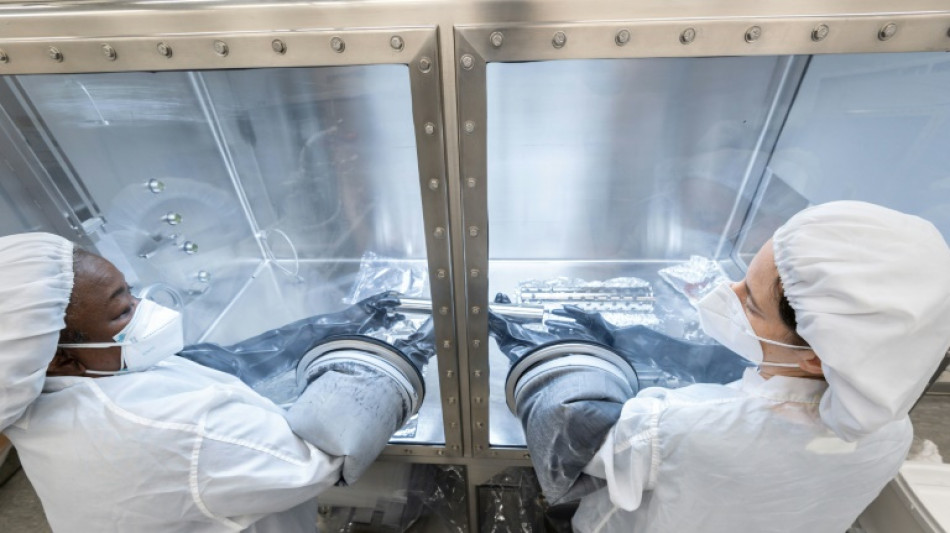
In early February, the outer protective tube was first removed.
It was not itself revealed to contain any lunar gas, indicating that the sample it contained remained sealed.
Then on February 23, scientists began a weeks-long process aimed at piercing the main tube and harvesting the gas contained inside.
In the spring, the rock will then be carefully extracted and broken up so that it can be studied by different scientific teams.
The extraction site of this sample is particularly interesting because it is the site of a landslide.
"Now we don't have rain on the Moon," said Juliane Gross, deputy Apollo curator. "And so we don't quite understand how landslides happen on the Moon."
Gross said researchers hope to study the sample to understand what causes landslides.
After 73001, there will be only three lunar samples still sealed. When will they in turn be opened?
"I doubt we'll wait another 50 years," said senior curator Ryan Zeigler.
"Particularly once they get Artemis samples back, it might be nice to do a direct comparison in real time between whatever's coming back from Artemis, and with one of these remaining unopened core, sealed cores," he said.
Artemis is NASA's next moon mission; the agency wants to send humans back to the Moon in 2025.
Large amounts of gas should then be collected, and the experiment currently being conducted helps to better prepare for it.
J.Pereira--PC



