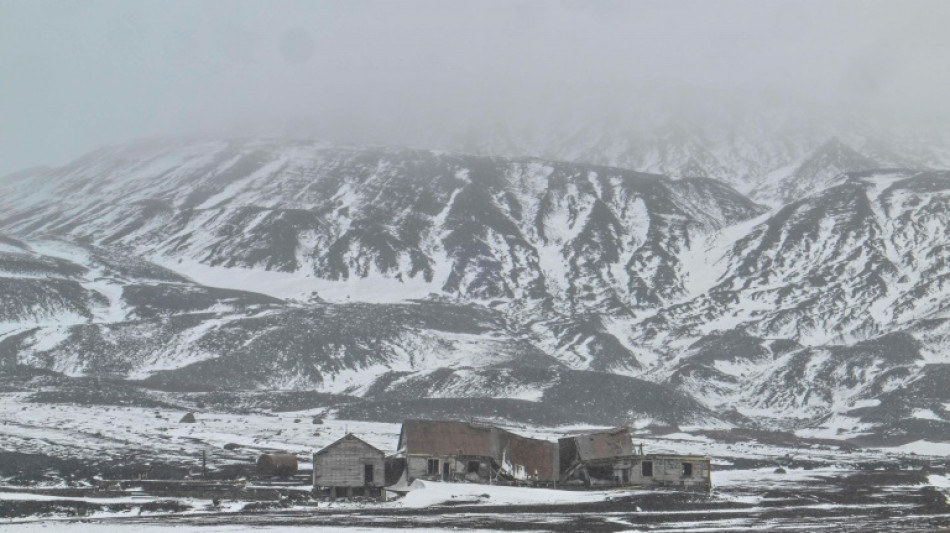
Ice and fire: Antarctic volcano may hold clues to life on Mars / Photo: JUAN BARRETO - AFP/File

 'Act before it's too late': Tokyo residents fight for more trees

 'Disappointing' as South Korea flag mishap sees Games end on sour note

 Pre-COP host Tuvalu at frontline of climate change

 Hungary's dwindling paprika producers battle to save signature spice
 Cornell president vows review in wake of alleged student gang rape
 Latvian partial election results suggest pro-European choice

 In Egypt's Sinai, Gazan builds school for children displaced by war

 Trump tariffs a mixed bag for US auto industry

 Yemen government forces say struck Houthi targets

 Music links past, present for Pedro Pascal's cellist in 'Behemoth!'

 ALEX BODI ȘI AMBASADORUL REPUBLICII SUDANUL DE SUD, GUM DOMINIC MATIOK, DISCUTĂ LA BERLIN DESPRE POSIBILITATEA ÎNFIINȚĂRII UNUI CONSULAT ONORIFIC LA BUCUREȘTI

 Dodgers step up World Series three-peat bid with 5-3 win over Braves

 Spain break down Czechs as England outclass Croatia in Nations League

 Yamal on target as Spain hold off Czech Republic

 Latvian exit polls suggest pro-European choice

 Lula, Bolsonaro wrap up campaigns ahead of knife-edge election

 Tuchel hails 'complete' England after Croatia demolition

 Fury to invite Trump to lead ring walk before Joshua showdown

 Fashion industry in 'precarious moment', says Vivienne Westwood supremo

 Seventh heaven for England in Nations League rout of Croatia

 Storms, flooding cause chaos on Greek holiday island of Crete

 #IAmJaneDoe: online support campaign in US university rape case

 Brazil shine on Selecao's first visit to India

 Zverev sets up Djokovic quarter-final at China Open, Rybakina out
 Happier at home, Bordeaux hammer Lyon in Top 14

On Deception Island in Antarctica, steam rises from the beaches, and glaciers dot the black slopes of what is actually an active volcano -- a rare clash of ice and fire that provides clues to scientists about what life could look like on Mars.
The horseshoe-shaped isle in the South Shetland Islands is the only place in the world where ships can sail into the caldera of an active volcano.
In the waters here, some 420 kilometers (260 miles) from Chile's Port Williams, fish, krill, anemones and sea sponges survive, while unique species of lichen and moss grow on the surface in an ecosystem of extreme contrasts.
The island, uninhabited by people, is home to perhaps the world's largest colony of chinstrap penguins, seabirds, seals and sea lions.
The volcano has been active for thousands of years, with the most recent eruptions -- in 1967, 1969 and 1970 -- devastating British and Chilean bases and forcing the evacuation of an Argentine base.
Yet life always returns and thrives on an island where water temperatures in steam vents, or fumaroles, have been measured at around 70 degrees Celsius (158 degrees Fahrenheit), even as air temperatures can plummet to -28 degrees.
It is "similar to Mars because there what we have is a planet with (a past of) immense volcanic activity ... where currently there are very cold conditions," Spanish planetary geologist Miguel de Pablo told AFP.
"It is the best possible approximation that we can make to understand Mars without stepping on" that planet, added de Pablo.
- A rich history -
The analysis of rocks on Deception Island complements the work of engineers, scientists and astronomers who study Mars from afar.
In 2023, researchers with the US space agency NASA concluded that Mars once had a climate with cyclical seasons, conducive to the development of life, according to evidence found on the red planet by the Curiosity rover.
Scientists believe an immense volcanic eruption changed the planet's atmosphere and led to the appearance of oceans and rivers that later evaporated.
Even though temperatures on Mars are far lower now -- estimated by NASA at about -153 degrees Celsius -- "Antarctic conditions can help us understand if the conditions for the development of life could, or could have, existed on Mars," said de Pablo.
Another Mars rover, Perseverance, landed on the planet in February 2021 to look for signs of past microbial life.
The multitasking rover will collect 30 rock and soil samples in sealed tubes to be sent back to Earth sometime in the 2030s for lab analysis.
The South Shetlands are claimed by Britain, Chile and Argentina but are not administered by any one country. The 1959 Antarctic Treaty states they shall be used "for peaceful purposes" and guarantees "freedom of scientific investigation."
Deception Island, first visited by British sealers in 1820, has a rich history, with abandoned scientific bases and an old whaling station rusting in the icy air.
Wilson Andres Rios, a researcher and captain of a Colombian navy frigate conducting a scientific expedition in Antarctica, said the hunting of seals and whales from the island in the early 20th century was "indiscriminate."
In 1931, a Norwegian whaling station on the island closed when the price of whale oil slumped.
Then, in 1944, Britain established a base there as part of a secret wartime mission to occupy Antarctic territories.
After several evictions and eruptions, the island is now dedicated to scientific research.
And, under the scientists' wary eyes, thousands of tourists now arrive on cruises.
That phenomenon, said Natalia Jaramillo, scientific coordinator of the Colombian expedition, is "worryingly increasing."
P.Sousa--PC



