
Roads, farming threaten Ecuador 'lost city' complex / Photo: Rodrigo BUENDIA - AFP

 'Act before it's too late': Tokyo residents fight for more trees

 'Disappointing' as South Korea flag mishap sees Games end on sour note

 Pre-COP host Tuvalu at frontline of climate change

 Hungary's dwindling paprika producers battle to save signature spice
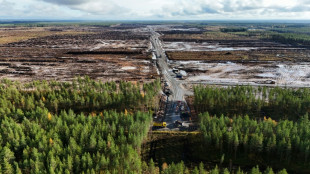
 Cornell president vows review in wake of alleged student gang rape

 Latvian partial election results suggest pro-European choice

 In Egypt's Sinai, Gazan builds school for children displaced by war

 Trump tariffs a mixed bag for US auto industry

 Yemen government forces say struck Houthi targets

 Music links past, present for Pedro Pascal's cellist in 'Behemoth!'

 ALEX BODI ȘI AMBASADORUL REPUBLICII SUDANUL DE SUD, GUM DOMINIC MATIOK, DISCUTĂ LA BERLIN DESPRE POSIBILITATEA ÎNFIINȚĂRII UNUI CONSULAT ONORIFIC LA BUCUREȘTI

 Dodgers step up World Series three-peat bid with 5-3 win over Braves

 Spain break down Czechs as England outclass Croatia in Nations League

 Yamal on target as Spain hold off Czech Republic

 Latvian exit polls suggest pro-European choice

 Lula, Bolsonaro wrap up campaigns ahead of knife-edge election

 Tuchel hails 'complete' England after Croatia demolition

 Fury to invite Trump to lead ring walk before Joshua showdown

 Fashion industry in 'precarious moment', says Vivienne Westwood supremo

 Seventh heaven for England in Nations League rout of Croatia

 Storms, flooding cause chaos on Greek holiday island of Crete

 #IAmJaneDoe: online support campaign in US university rape case

 Brazil shine on Selecao's first visit to India

 Zverev sets up Djokovic quarter-final at China Open, Rybakina out
 Happier at home, Bordeaux hammer Lyon in Top 14

Shielded by the jungle for hundreds of years, the remains of a massive 2,500-year-old network of Ecuadoran cities are being threatened by road and farm encroachment just as its long-held secrets are being revealed, researchers say.
Traces of an Amazonian "lost city" were first discovered in 1978, but the full extent of what is now believed to be the largest and oldest such urban expanse were only revealed last year with the help of laser mapping.
The vast site, which covers more than 1,000 square kilometers (385 square miles), lies deep in the Upano valley on the foothills of the Andes mountain range in eastern Ecuador.
It consists of ancient settlements of different sizes, connected by what researchers describe as a complex system of roads.
Archeologists have also identified some 7,400 mounds in various shapes, made by human hands millennia ago.
They stand up to four meters (about 13 feet) tall and five times as wide and are believed to have been the foundations of homes, or communal areas for rituals or festivals.
Some have already been damaged -- wrongly thought by road developers to be natural formations that they could break through.
"There is an urgent need... for a protection plan," said Spanish archeologist Alejandra Sanchez, who has been studying the site for a decade.
Beyond the road construction issue, Sanchez also described the risks posed by erosion, deforestation, and agriculture to the mounds, which she said are "destroyed very easily by rain, wind, plows."
The Upano River, cradle of the Indigenous culture of the same name, is also the victim of voracious mining, both legal and wildcat.
- 'The tip of the iceberg' -
As a first step towards having the site protected, Ecuador's National Institute of Cultural Heritage (INPC) is working on delineating the complex.
The INPC in 2015 started mapping out the area using LiDAR (Light Detection and Ranging) technology, bouncing laser light off buildings or trees to measure landscapes.
The data was shared with archeologists in 2021.
Last year, Sanchez and Argentine researcher Rita Alvarez presented their analysis of the images in an INPC publication.
Then in January, a French-led team reported their own findings based on the mapping data in the journal Science -- giving global news coverage to the discovery.
The site was first described by priest and archeologist Pedro Porras in the 1980s, according to the private Catholic University's Weilbauer-Porras museum in Quito, which displays finely decorated red-tinted vessels, and a piece of volcanic rock carved in a half-human, half-animal shape.
It also houses maps and black-and-white photographs of Porras pointing to the mounds protruding from the ground.
According to researchers who have studied the city network since the 1980s, the Upano people who built it had the political, economic, and religious organization typical of great civilizations.
Construction on the mounds is thought to have begun between 500 BC and 300-600 AD -- around the time of the Roman empire.
Other urban sites discovered in the Amazon date from between 500-1,500 AD.
And while Ecuador may once have "envied" the archeological riches of other Latin American nations, the Upano site matches them in "quantity, grandeur, history and cultural expression," archaeologist Alden Yepez of the Catholic University told AFP.
He believes discoveries so far are only "the tip of the iceberg" of an even bigger civilization, and that the site may extend up to 2,000 square km around the Upano, Palora and Pastaza rivers, where there are also signs of settlements.
"The idea that the Amazon was an unpopulated space or only inhabited by nomads has been discarded," said INPC director Catalina Tello.
R.J.Fidalgo--PC



