Ukrainian scientists feel helpless at Antarctic base as war rages

 Botched US execution leaves murderer unconscious on ventilator: lawyers

 Cornell rape case exposes sexual violence at US colleges

 France held by Italy in Zidane's homecoming after Olise stunner

 Ethiopian pro-government militia claims Tigray airport as regional tensions spike

 Ohtani shaking off injuries as Dodgers launch MLB post-season
 Sea levels to rise in California as coastal wave surges up west coast
 New rallies urged in France as protests disrupt over 730 schools
 Djokovic survives China Open scare, Sabalenka starts strong
 King Charles to evoke colonial 'darkest days' on Caribbean tour

 Tesla shares jump after global car sales top estimates

 DR Congo Ebola outbreak killed more than 4,000: official figures

 Djokovic survives China Open scare against wildcard world no. 104
 Lula, Bolsonaro trade blows in final scramble for votes in Brazil

 New clashes erupt as protests disrupt over 560 French schools
 NY governor vows to close loophole after alleged Cornell gang rape

 Ethiopia Tigray rebels pushed back as regional tensions spike
 Stocks rise, yields fall as US job numbers disappoint

 Man City verdict a 'big topic' for England players, says Tuchel

 NY attorney general tasked with investigating alleged Cornell gang rape

 China widens military footprint with Laos air base
 G7 talks as US pressures Europe over diesel stocks
 Man City launch appeal against explosive financial ruling
 Swiss president to quit government
 Europe rejects US threats over diesel stocks, urges joint G7 action

 Philippines tennis star Eala says 'I get overwhelmed sometimes'
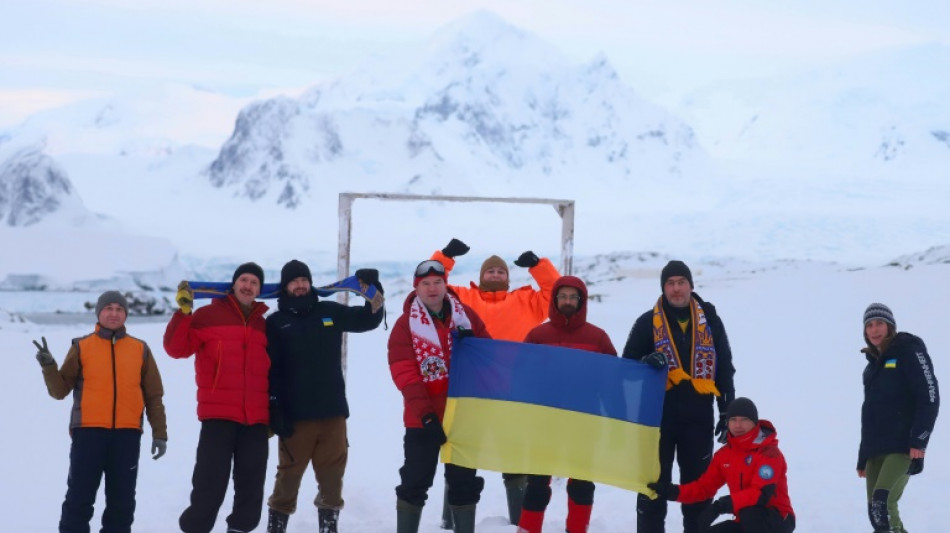
For a dozen Ukrainian scientists thousands of kilometers from home at the Vernadsky Antarctic base, the biting cold hurts less than the feeling of helplessness over the war in their homeland.
They spend their days measuring, observing, analyzing and doing their jobs as best they can as a way of coping with the situation.
"At the beginning, we didn't sleep for a few days. The whole time we were following news about our home cities," meteorologist Anastasiia Chyhareva, 26, told AFP in messages sent from the base.
Once the invasion was in full swing, the scientists started waking at 2:00 am -- 7:00 am in Ukraine -- to check in on family and see how their night went.
"Now, we're used to it... used to checking news in the morning and before going to bed, in every free minute."
The Ukrainian base is situated on Galindez island, some 1,200 kilometers (745 miles) from Tierra del Fuego in the far south of Argentina.
It is occupied all year round by a dozen people who have to endure temperatures that drop to -20 degrees Celsius (-4 degrees Fahrenheit) in winter.
The scientists' duties include observing meteorological, geophysical, geological and biological conditions, unless the weather forces them to shelter at the base.
"My first impression was like all these things happened in another universe, not our world," said geophysicist Oleksandr Koslokov, whose family lived in war-torn Kharkiv, a heavily targeted city just 40 kilometers from the Russian border.
"I started advising my family on what to do. I had no time to reflect. I had to help my family to survive and to escape from my city... before it became a burning and unpredictable hell.
"My wife heard and felt the explosions of cruise missiles 10 minutes after (Russian President Vladimir) Putin started this stupid and criminal war."
Since then, his family has fled to Germany.
- 'Our part of the war' -
At the base, which is named after a Soviet mineralogist and geochemist with Russian and Ukrainian roots, the scientists try to live as normal a life as possible. Sunday is a day off and Saturday night everyone has dinner together before playing board games and musical instruments.
"It is hard to be so far away from my family and have no possibility to support them," said biologist Artem Dzhulai, 34.
"At the station now, there is a wide range of feelings -- from sadness due to anxiety for relatives and friends, to high spirits, due to pride in our army and the people who are bravely fighting for the right to live in a free country," said marine biologist Oksana Savenko, who is studying humpback whales.
Giving practical advice, moral support, donating to the Ukrainian army, signing a petition, creating online lectures to divert Ukrainian children's attention from the war: the scientists are trying every means available to help in some way.
"It is our part of the war" effort, said Chyhareva.
Ukrainians "try to help each other, they try to help our compatriots, they try to help our army," said another scientist who requested to remain anonymous.
- 'Don't forget us' -
Dzhulai still remains bitter over the West's response the last time Russia invaded Ukraine, annexing Crimea in 2014.
"All democratic countries were indifferent to that act of violence," he said.
"Probably, they hoped that they will not be affected by someone else's grief... but everything can change if evil is not stopped and punished.
"A lot of children in Ukraine died because of the indifference of Europe and the US."
There is fear that the same could happen again.
"Please, don't forget about us after one month, don't be tired of Ukraine and our problems," said Chyhareva.
This team will be replaced later this month, and with their homeland in flames, the departing scientists face an uncertain future.
"I don't have any real plans," said Chychareva, who just hopes to go "back to Ukraine as soon as it will be possible."
"My university in Kharkiv where I studied was destroyed ... my research institute and scientific equipment in Ukraine are destroyed," said Koslokov.
He said he would likely try to continue doing science in Europe or America, adding "time will tell."
L.E.Campos--PC



