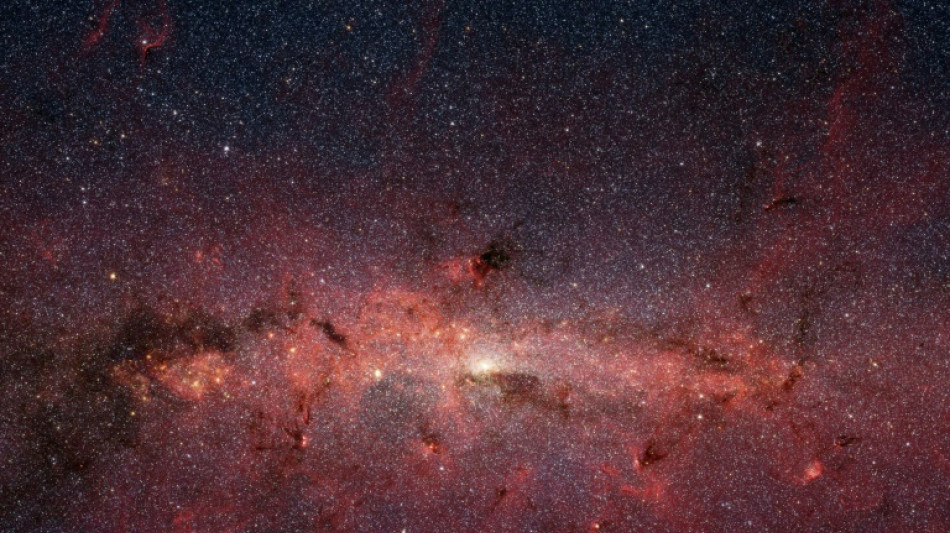
Object found in the Milky Way 'unlike anything astronomers have seen'

 Botched US execution leaves murderer unconscious on ventilator: lawyers

 Cornell rape case exposes sexual violence at US colleges

 France held by Italy in Zidane's homecoming after Olise stunner

 Ethiopian pro-government militia claims Tigray airport as regional tensions spike

 Ohtani shaking off injuries as Dodgers launch MLB post-season

 Sea levels to rise in California as coastal wave surges up west coast

 New rallies urged in France as protests disrupt over 730 schools

 Djokovic survives China Open scare, Sabalenka starts strong

 King Charles to evoke colonial 'darkest days' on Caribbean tour

 Tesla shares jump after global car sales top estimates

 DR Congo Ebola outbreak killed more than 4,000: official figures

 Djokovic survives China Open scare against wildcard world no. 104

 Lula, Bolsonaro trade blows in final scramble for votes in Brazil

 New clashes erupt as protests disrupt over 560 French schools

 NY governor vows to close loophole after alleged Cornell gang rape

 Ethiopia Tigray rebels pushed back as regional tensions spike

 Stocks rise, yields fall as US job numbers disappoint

 Man City verdict a 'big topic' for England players, says Tuchel

 NY attorney general tasked with investigating alleged Cornell gang rape

 China widens military footprint with Laos air base

 G7 talks as US pressures Europe over diesel stocks

 Man City launch appeal against explosive financial ruling

 Swiss president to quit government

 Europe rejects US threats over diesel stocks, urges joint G7 action

 Philippines tennis star Eala says 'I get overwhelmed sometimes'

Australian researchers have discovered a strange spinning object in the Milky Way they say is unlike anything astronomers have ever seen.
The object, first spotted by a university student working on his undergraduate thesis, releases a huge burst of radio energy three times every hour.
The pulse comes "every 18.18 minutes, like clockwork," said astrophysicist Natasha Hurley-Walker, who led the investigation after the student's discovery, using a telescope in the Western Australian outback known as the Murchison Widefield Array.
While there are other objects in the universe that switch on and off -- such as pulsars -- Hurley-Walker said 18.18 minutes is a frequency that has never been observed before.
Finding this object was "kind of spooky for an astronomer," she said, "because there's nothing known in the sky that does that."
The research team is now working to understand what they have found.
Trawling back through years of data, they have been able to establish a few facts: the object is about 4,000 light-years from Earth, is incredibly bright and has an extremely strong magnetic field.
But there are still many mysteries to untangle.
"If you do all of the mathematics, you find that they shouldn't have enough power to produce these kind of radio waves every 20 minutes," Hurley-Walker said.
"It just shouldn't be possible."
The object may be something researchers have theorised could exist but have never seen called an "ultra-long period magnetar".
It could also be a white dwarf, a remnant of a collapsed star.
"But that's quite unusual as well. We only know of one white dwarf pulsar, and nothing as great as this," Hurley-Walker said.
"Of course, it could be something that we've never even thought of -- it could be some entirely new type of object."
On the question of whether the powerful, consistent radio signal from space could have been sent by some other life form, Hurley-Walker conceded: "I was concerned that it was aliens."
But the research team was able to observe the signal across a wide range of frequencies.
"That means it must be a natural process, this is not an artificial signal," Hurley-Walker said.
The next step for the researchers is to look for more of these strange objects across the universe.
"More detections will tell astronomers whether this was a rare one-off event or a vast new population we'd never noticed before," Hurley-Walker said.
The team's paper on the object has been published in the latest edition of the journal Nature.
Nogueira--PC



