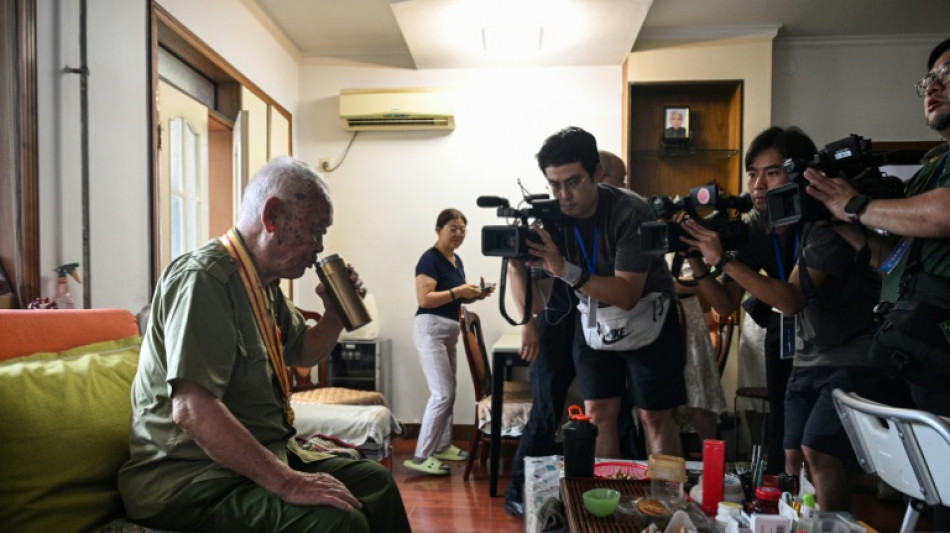
China's rulers push party role before WWII anniversary / Photo: Hector RETAMAL - AFP

 #IAmJaneDoe: online support campaign in US university rape case
 Brazil shine on Selecao's first visit to India
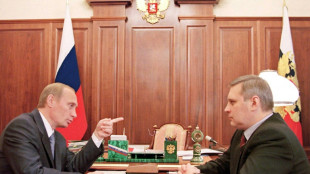
 Zverev sets up Djokovic quarter-final at China Open, Rybakina out
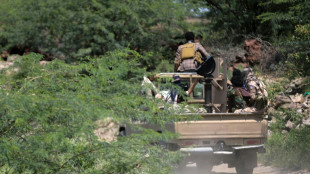
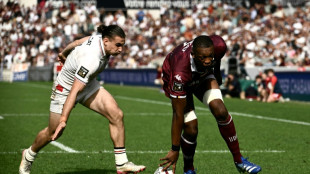 Happier at home, Bordeaux hammer Lyon in Top 14
 Lula, Bolsonaro in final push for votes ahead of knife-edge election
 Boisterous fashion week barnstorms 'sleepy' Nigerian capital

 UAE investigators say flydubai co-pilot was planning 'terrorist act'
 Rahul smacks century in India v Windies ODI

 Daryz seeks to join exclusive club of dual Arc winners
 Russia warns diplomats to leave Kyiv over new strikes threat
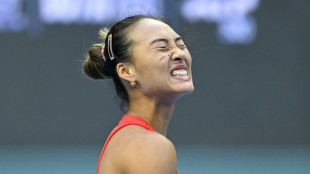 Olympic champ Zheng rebukes rowdy home crowd at China Open
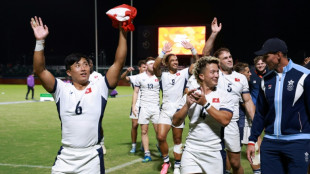
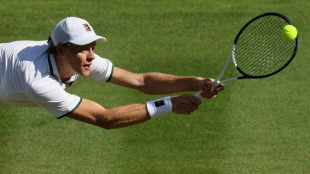 World No.1 Sinner pulls out of Shanghai Masters to delay return
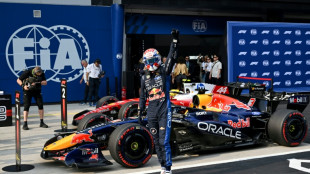 Red Bull's Verstappen grabs pole position for Bahrain GP
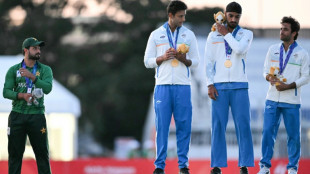 India beat Pakistan in blockbuster as golfer Kim wins 'crazy' gold

 India beat arch-rivals Pakistan to win Asian Games cricket gold
 Ethiopia's Tigray rebels abandon regional capital as govt advances: journalist
 Tom Kim powers to Games gold and exemption from military service
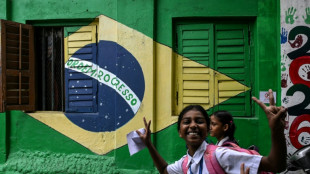 Split loyalties for Indian football fans at Brazil friendly
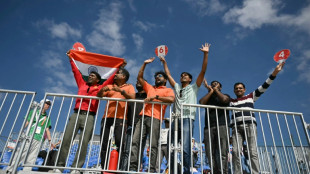 India-Pakistan blockbuster brings cricket fever to Japan baseball field
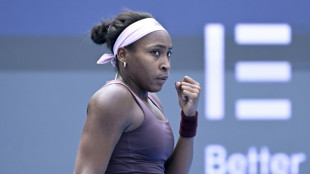
 Wong waiting on Rafa after winning Asian Games tennis gold
 With Russia next door and rising costs, Latvia goes to the polls

 Penalty hero rues empty seats as Games hosts Japan win football gold
 North Korea fires ballistic missile after Seoul's apology demand

 US regulator finds Boeing 737 MAX software bug 'not a safety concern'

 Ohtani 'managing' injuries as Dodgers launch MLB post-season
An elderly Chinese war veteran's shin still bears the mark of a bullet wound he suffered when fighting the Japanese as a teenager, a year before the end of World War II.
Eighty years on, Li Jinshui's scar remains as testimony to the bravery of Chinese troops in a conflict that killed millions of their people.
But the story behind China's overthrow of the brutal Japanese occupation is deeply contested.
Historians broadly agree that credit for victory lies primarily with the Nationalist army, the dominant Chinese force at the time.
However, its leader, Chiang Kai-shek, fled to Taiwan in 1949 after losing a civil war to Mao Zedong's communists, laying the groundwork for decades of cross-strait tensions that continue to this day.
Beijing argues that the Communist Party (CCP) played a central role in the war, bolstered by the stories of Li and his comrades' courage and sacrifice.
It is a narrative expected to prevail at a major military parade on September 3.
"With the country in trouble, Chinese people with conscience had to stand up," said Li, who turned 98 on Wednesday and was a soldier in the CCP-run Eighth Route Army.
After Japan's full-scale invasion in 1937, the CCP resisted mainly by guerrilla fighting in the rural, hilly stretches of northern China outside of Nationalist control.
Li was shot in the leg while fighting the Japanese in his native Wuxiang County in China's rugged northern province of Shanxi.
Released from the hospital early, he returned to the battlefield despite not having fully recovered.
Dressed in a green military uniform topped by a cap with a red star, Li bent to pull up his left trouser leg, revealing the scar he has carried for decades.
"It was extremely hard for us," he said.
"We were just young lads."
- Making grenades -
At a government-organised media tour in July, veterans including Li touted the CCP's role in liberating China from the yoke of Japanese imperialism.
"The Kuomintang didn't play a major role in the war against Japanese aggression," said Wen Yunfu, 96, referring to Chiang's Nationalist Party by its Chinese name.
"It was mainly the Communist Party."
Wen's hometown of Shenzhou in northern Hebei was attacked by the Japanese army just a few months after their 1937 invasion.
Chiang's army was forced to retreat south in the face of the Japanese onslaught.
That left the people under the leadership of the Communist Party, Wen said.
"Life was extremely difficult for the people," he said.
"Our home was burned down. My uncle was also killed by the Japanese."
Wen later joined Mao's CCP at 16 in the final months of the war, and was put to work making grenades.
A truce was called in the civil war between the Kuomintang, which ruled most of the country at the time, and the insurgent Communist Party in the years leading up to the defeat of Japan in 1945.
That suspension came to an end in the wake of Japan's defeat, and the CCP was ultimately victorious in the ensuing domestic conflict.
- 'Correct' history -
Under Xi Jinping -- China's most powerful leader since Mao -- special attention has been paid to pushing the "correct" interpretation of the complex history of the victory over Japan, said Rana Mitter, author of multiple books on China's role in World War II.
"They're trying to find ways in which the Communist role can be brought more to the forefront," Mitter told AFP.
Mitter doesn't contest that the party's role was significant.
However, he said, "the primary role in terms of political and military resistance against the Japanese was played by the then-government of China, which was the Nationalist Kuomintang government".
There have been efforts in recent decades to recognise the contributions made by forces other than the Communists, including the Kuomintang and the United States.
One chapter that has received widespread attention is the "Flying Tigers" US air brigade that fought with the Kuomintang in the early 1940s, conducting dangerous assaults on enemy bombers.
A museum in Zhijiang, Hunan, sheds light on their assistance just a stone's throw away from a key airport from which they launched their missions.
Still, there are glimmers of the complicated history at play.
AFP could see the scars of three Chinese characters since removed from the monument.
The erased name is likely Wang Tung-yuan, according to Ji Jianliang, a local Communist Party historian.
Wang, a general under Chiang and later Taiwan's ambassador to South Korea, had once provided an inscribed dedication for the monument.
Ji said his name had been removed for "complex political reasons".
V.Dantas--PC



