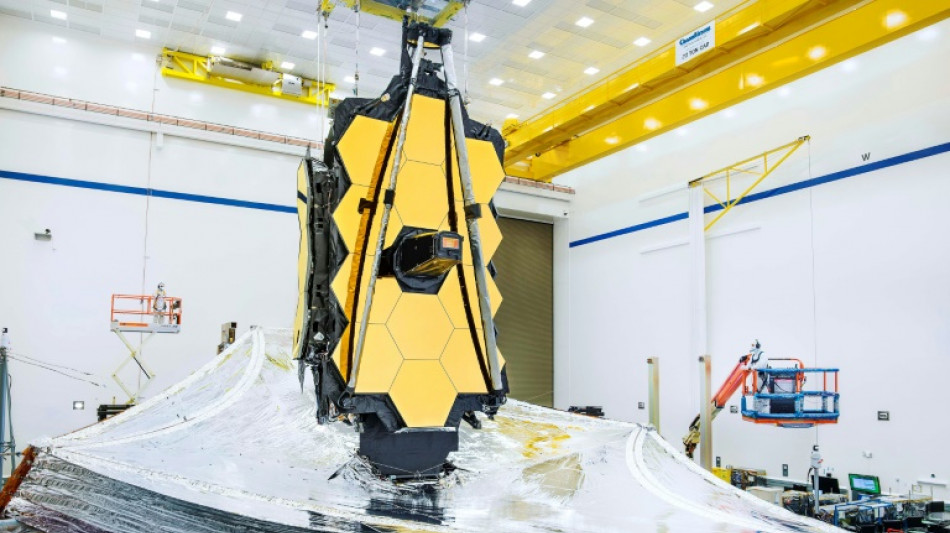
The James Webb Space Telescope, by the numbers / Photo: Chris GUNN - NASA/AFP/File

 'He's here with me': Japan cycle queen dedicates gold to late brother

 Japan Olympic chief says 'lot more' athletes at Games than expected

 Asian carmakers besting US rivals at home, China poised to strike

 Widgets & Web Offers All-Inclusive Investor Relations Websites for Public Companies, IPOs and SPACs

 Adams named new US captain to 2030 World Cup

 China a better influence in Latin America than US: poll

 Judge pauses construction of border project in Texas national park

 Belgium's De Bruyne fires double to sink Turkey, France held by Italy

 US jobs data boosts stocks as oil prices dip

 US Supreme Court to hear high-stakes climate case

 Trump expected to name intel chief Clayton as AI czar: reports

 Argentina unveils passports-for-investment scheme

 Brazil election debate chaos sparks censorship row

 England's Carse charged by cricket body over nightclub incident

 Amazon vows $1 bn for data center towns, decries 'myths'

 Oil prices drop on G7 fuel release, US jobs data boosts stocks

 G7 agrees deal to ease global energy supply concerns

 Spain's government dealt blow as lawmakers reject housing bills

 Food, medicine shortages deepen in Russian-occupied Oleshky

 Man City whistleblower Rui Pinto facing 'dire consequences' - lawyers
 Russia 'tearing Kyiv apart', mayor says, as strikes paralyse traffic

 Taiwan boxer Lin wins Games gold as Japan edge North Korea on penalties

 Japan tame North Korea to win Games gold after shootout drama

 US posts weak job growth data in September

 Ethiopia's conflict: the regional dimension
The most powerful space telescope ever built, James Webb is set to deliver its first full-color scientific images to the world Tuesday.
Here is an overview of this feat of human ingenuity, in five key figures.
- More than 21 feet -
The centerpiece of the observatory is its huge main mirror, measuring more than 21 feet (6.5 meters) in diameter and made up of 18 smaller, hexagonal-shaped mirrors.
The observatory also has four scientific instruments: cameras to take pictures of the cosmos, and spectrographs, which break down light to study which elements and molecules make up objects.
The mirror and the instruments are protected from the light of our Sun by a tennis-court sized thermal shield, made up of five superimposed layers.
Each layer is hair thin, and together they ensure the telescope operates in the darkness needed to capture faint glimmers from the far reaches of the Universe.
- Million miles away -
Unlike the Hubble telescope which revolves around the Earth, Webb orbits around the Sun, nearly a million miles (1.6 million kilometers) from us, or four times the distance from our planet to the Moon.
It took the spacecraft almost a month to reach this region, called Lagrange Point two, where it remains in a fixed position behind the Earth and Sun to give it a clear view of the cosmos.
Here, the gravity from the sun and Earth balance the centrifugal motion of a satellite, meaning it needs minimal fuel for course correction.
- 13.8 billion years -
In astronomy, the farther out you see, the deeper back in time you're looking.
Webb's infrared capabilities are what make it uniquely powerful -- allowing it to detect light from the earliest stars, which has been stretched into infrared wavelengths as the Universe expanded.
This lets it peer further back in time than any previous telescope, to within a few hundred million years after the Big Bang, 13.8 billion years ago.
- Three-decade wait -
The project was first conceived in the 1990s, but construction did not begin until 2004.
Then Webb's launch date was repeatedly postponed. Initially set for 2007, it finally took place on December 25, 2021, aboard an Ariane 5 rocket, from French Guiana.
- $10 billion -
Webb is an international collaboration between US space agency NASA, the European Space Agency (ESA), and the Canadian Space Agency (CSA), involving more than 10,000 people.
The lifetime cost to NASA alone will be approximately $9.7 billion, according to an analysis by the Planetary Society, or $10.8 billion adjusted for inflation to 2020 dollars.
V.Fontes--PC



