
-
 'He's here with me': Japan cycle queen dedicates gold to late brother
-
Penalty hero rues empty seats as Games hosts Japan win football gold

-
 Japan Olympic chief says 'lot more' athletes at Games than expected
-
North Korea fires ballistic missile after Seoul's apology demand

-
 Asian carmakers besting US rivals at home, China poised to strike
-
US regulator finds Boeing 737 MAX software bug 'not a safety concern'

-
 Widgets & Web Offers All-Inclusive Investor Relations Websites for Public Companies, IPOs and SPACs
-
Ohtani 'managing' injuries as Dodgers launch MLB post-season

-
 Adams named new US captain to 2030 World Cup
-
Botched US execution leaves murderer unconscious on ventilator: lawyers

-
 China a better influence in Latin America than US: poll
-
Cornell rape case exposes sexual violence at US colleges

-
 Judge pauses construction of border project in Texas national park
-
France held by Italy in Zidane's homecoming after Olise stunner

-
 Belgium's De Bruyne fires double to sink Turkey, France held by Italy
-
Ethiopian pro-government militia claims Tigray airport as regional tensions spike

-
 US jobs data boosts stocks as oil prices dip
-
Ohtani shaking off injuries as Dodgers launch MLB post-season

-
 US Supreme Court to hear high-stakes climate case
-
Sea levels to rise in California as coastal wave surges up west coast

-
 Trump expected to name intel chief Clayton as AI czar: reports
-
New rallies urged in France as protests disrupt over 730 schools

-
 Argentina unveils passports-for-investment scheme
-
Djokovic survives China Open scare, Sabalenka starts strong

-
 Brazil election debate chaos sparks censorship row
-
King Charles to evoke colonial 'darkest days' on Caribbean tour

-
 England's Carse charged by cricket body over nightclub incident
-
Tesla shares jump after global car sales top estimates

-
 Amazon vows $1 bn for data center towns, decries 'myths'
-
DR Congo Ebola outbreak killed more than 4,000: official figures

-
 Oil prices drop on G7 fuel release, US jobs data boosts stocks
-
Djokovic survives China Open scare against wildcard world no. 104
-
 G7 agrees deal to ease global energy supply concerns
-
Lula, Bolsonaro trade blows in final scramble for votes in Brazil
-
 Spain's government dealt blow as lawmakers reject housing bills
-
New clashes erupt as protests disrupt over 560 French schools
-
 Food, medicine shortages deepen in Russian-occupied Oleshky
-
NY governor vows to close loophole after alleged Cornell gang rape

-
 Man City whistleblower Rui Pinto facing 'dire consequences' - lawyers
-
Ethiopia Tigray rebels pushed back as regional tensions spike
-
 Russia 'tearing Kyiv apart', mayor says, as strikes paralyse traffic
-
Stocks rise, yields fall as US job numbers disappoint
-
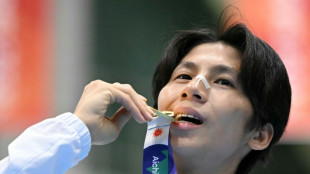 Taiwan boxer Lin wins Games gold as Japan edge North Korea on penalties
-
Man City verdict a 'big topic' for England players, says Tuchel

-
 Japan tame North Korea to win Games gold after shootout drama
-
NY attorney general tasked with investigating alleged Cornell gang rape

-
 US posts weak job growth data in September
-
China widens military footprint with Laos air base
-
 Ethiopia's conflict: the regional dimension
-
G7 talks as US pressures Europe over diesel stocks
Webb telescope to reveal earliest galaxies after Big Bang
NASA's James Webb Space Telescope is poised to reveal some of the earliest galaxies that formed after the Big Bang, the White House said Monday, as anticipation builds for the powerful observatory's first images.
President Joe Biden will unveil the images during a livestreamed event starting at 5:00 pm (2100 GMT).
"The high resolution images will show light captured from galaxies that are more than 13 billion years old," White House spokeswoman Karine Jean-Pierre said.
US space agency NASA revealed last week Webb's first targets included distant galaxies, bright nebulae and a faraway giant gas planet.
The rest of the first wave of images are set to be released by NASA on Tuesday.
Webb's infrared capabilities are what make it uniquely powerful, allowing it to both pierce through cosmic dust clouds and detect light from the earliest stars, which has been stretched into infrared wavelengths as the universe expanded.
This lets it peer further back in time than any previous telescope, to the period shortly after the Big Bang, 13.8 billion years ago.
"When I first saw the images... I suddenly learned three things about the Universe that I didn't know before," Dan Coe, a Space Telescope Science Institute (STSI) astronomer and expert on the early Universe, told AFP. "It's totally blown my mind."
- First targets -
An international committee decided the first wave of images would include the Carina Nebula, an enormous cloud of dust and gas 7,600 light years away.
Carina Nebula is famous for its towering pillars that include "Mystic Mountain," a three-light-year-tall cosmic pinnacle captured in an iconic image by the Hubble Space Telescope, until now humanity's premier space observatory.
Webb has also carried out a spectroscopy -- an analysis of light that reveals detailed information -- on a faraway gas giant called WASP-96 b, which was discovered in 2014.
Nearly 1,150 light-years from Earth, WASP-96 b is about half the mass of Jupiter and zips around its star in just 3.4 days.
Nestor Espinoza, an STSI astronomer, told AFP that previous exoplanet spectroscopies carried out using existing instruments were very limited compared to what Webb could do.
"It's like being in a room that is very dark and you only have a little pinhole you can look through," he said of the prior technology. Now, with Webb, "You've opened a huge window, you can see all the little details."
- Million miles from Earth -
Launched in December 2021 from French Guiana on an Ariane 5 rocket, Webb is orbiting the Sun at a distance of a million miles (1.6 million kilometers) from Earth, in a region of space called the second Lagrange point.
Here, it remains in a fixed position relative to the Earth and Sun, with minimal fuel required for course corrections.
A wonder of engineering, the total project cost is estimated at $10 billion, making it one of the most expensive scientific platforms ever built, comparable to the Large Hadron Collider at CERN.
Webb's primary mirror is over 21 feet (6.5 meters) wide and is made up of 18 gold-coated mirror segments. Like a camera held in one's hand, the structure must remain as stable as possible to achieve the best shots.
Charlie Atkinson, chief engineer on the James Webb Space Telescope program at lead contractor Northrop Grumman, told AFP that it wobbles no more than 17 millionths of a millimeter.
After the first images, astronomers around the globe will get shares of time on the telescope, with projects selected competitively through a process in which applicants and selectors don't know each others' identities, to minimize bias.
Thanks to an efficient launch, NASA estimates Webb has enough propellant for a 20-year life, as it works in concert with the Hubble and Spitzer space telescopes to answer fundamental questions about the cosmos.
L.E.Campos--PC



