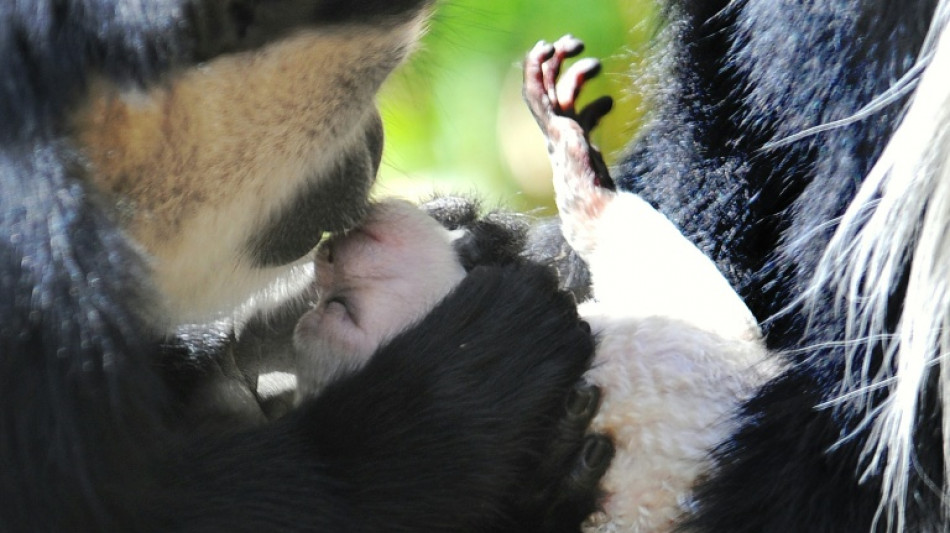
Monkey business: Neanderthals and ancient apes likely kissed too / Photo: WILLIAM WEST - AFP

 Zverev thrashes Shang to set up Djokovic quarter-final at China Open

 Turkey football ref chief jailed pending trial for graft

 North Korea says test of intermediate-range strategic missile included use of AI

 Rampant Sayers leads Hong Kong to third men's rugby gold in a row

 Ethiopia's Tigray rebels abandon regional capital as govt advances

 Bulgaria's Tsar Samuel returns 'home' after 1,000 years

 'Glad it's over': Kim powers to Games gold and military exemption

 After 11 World Cups, football finally comes home for one Indian fan

 Marc Marquez wins sprint at Japan MotoGP, Martin grabs pole
 Alcaraz fends off Arnaldi to reach Japan Open quarters

 Antonelli tops times in final practice at Bahrain GP

 Gauff digs deep to beat Osorio in China Open second round

 Fresh protests to hit Spain after housing measures defeated

 'He's here with me': Japan cycle queen dedicates gold to late brother

 Japan Olympic chief says 'lot more' athletes at Games than expected

 Asian carmakers besting US rivals at home, China poised to strike

 Widgets & Web Offers All-Inclusive Investor Relations Websites for Public Companies, IPOs and SPACs

 Adams named new US captain to 2030 World Cup

 China a better influence in Latin America than US: poll

 Judge pauses construction of border project in Texas national park

 Belgium's De Bruyne fires double to sink Turkey, France held by Italy

 US jobs data boosts stocks as oil prices dip

 US Supreme Court to hear high-stakes climate case

 Trump expected to name intel chief Clayton as AI czar: reports

 Argentina unveils passports-for-investment scheme

Scientists have found evidence suggesting that kissing dates back up to 21 million years and that our ape ancestors and Neanderthals likely locked lips, research published Wednesday said.
Kissing has long presented an evolutionary puzzle to scientists as it appears to carry high risks such as disease transmission while having no obvious reproductive or survival advantages.
But the new study found that the practice has evolved over millions of years, and that our extinct human relatives, the Neanderthals, could have shared a peck to stay warm in the ice age.
The research led by scientists at the University of Oxford was published in the journal "Evolution and Human Behaviour".
"This is the first time anyone has taken a broad evolutionary lens to examine kissing," said co-author Matilda Brindle, an evolutionary biologist at the University of Oxford.
"Our findings add to a growing body of work highlighting the remarkable diversity of sexual behaviours exhibited by our primate cousins."
For the purpose of the study, researchers defined kissing as a "non-aggressive, mouth-to-mouth contact that did not involve food transfer".
"The results indicate that kissing is an ancient trait in the large apes," evolving in primate ancestors from 17 to 21 million years ago, according to an Oxford University statement.
"Kissing was retained over the course of evolution and is still present in most of the large apes," it added.
The researchers first collected data about modern primates that have been observed kissing, including chimpanzees, bonobos and orangutans.
Then, treating kissing as a "trait", they mapped it to the family tree of primates. By stimulating different evolutionary scenarios, they estimated the probability that ancient ancestors also engaged in kissing.
Previous studies have found that humans and Neanderthals had shared oral microbes through saliva transfer, suggesting that the species had kissed each other.
A.Silveira--PC



