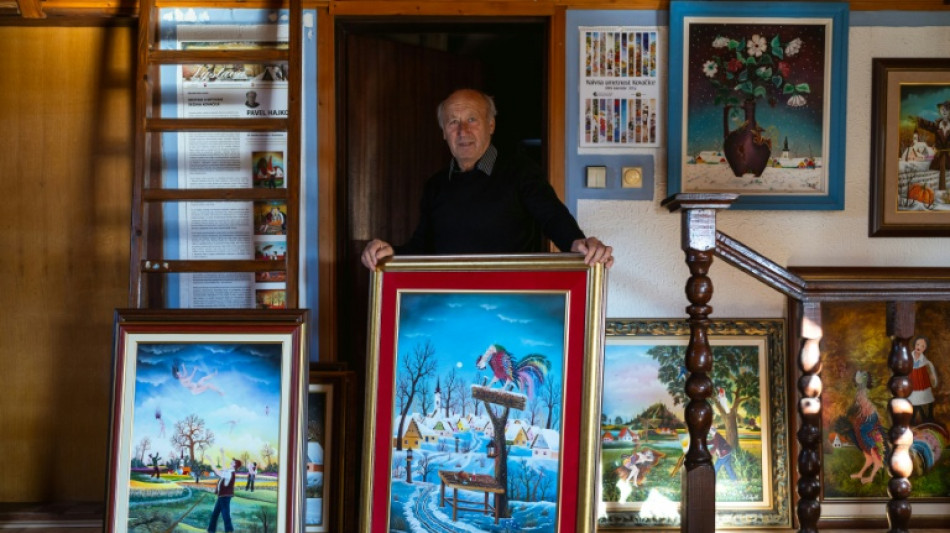
Naively brilliant: Serbia's world-famous village painters / Photo: Andrej ISAKOVIC - AFP

 Zverev thrashes Shang to set up Djokovic quarter-final at China Open
 Turkey football ref chief jailed pending trial for graft

 North Korea says test of intermediate-range strategic missile included use of AI

 Rampant Sayers leads Hong Kong to third men's rugby gold in a row
 Ethiopia's Tigray rebels abandon regional capital as govt advances

 Bulgaria's Tsar Samuel returns 'home' after 1,000 years

 'Glad it's over': Kim powers to Games gold and military exemption

 After 11 World Cups, football finally comes home for one Indian fan

 Marc Marquez wins sprint at Japan MotoGP, Martin grabs pole

 Alcaraz fends off Arnaldi to reach Japan Open quarters
 Antonelli tops times in final practice at Bahrain GP

 Gauff digs deep to beat Osorio in China Open second round
 Fresh protests to hit Spain after housing measures defeated
 'He's here with me': Japan cycle queen dedicates gold to late brother

 Japan Olympic chief says 'lot more' athletes at Games than expected

 Asian carmakers besting US rivals at home, China poised to strike

 Widgets & Web Offers All-Inclusive Investor Relations Websites for Public Companies, IPOs and SPACs

 Adams named new US captain to 2030 World Cup

 China a better influence in Latin America than US: poll

 Judge pauses construction of border project in Texas national park

 Belgium's De Bruyne fires double to sink Turkey, France held by Italy

 US jobs data boosts stocks as oil prices dip

 US Supreme Court to hear high-stakes climate case

 Trump expected to name intel chief Clayton as AI czar: reports

 Argentina unveils passports-for-investment scheme

Pavel Hajko never tires of painting roosters. Inside his home studio in Kovacica -- a sleepy town in northern Serbia famous for its style of naive art -- the brightly coloured creatures cover the walls.
"From the beginning, even in elementary school, I painted only roosters," the 73-year-old artist told AFP, as he worked on an unfinished canvas in the afternoon light.
Outside, a cockerel obligingly crowed.
Hajko and his fellow artists have become world-famous for their childlike renderings of the traditional village life of the Slovak minority in the flatlands of the Banat region, north of the Danube.
"In naive painting, everything is done as you learn. It's not a school where the colour has to be this or that... we can put any colour," Hajko said.
The naive painting movement of self-taught artists first emerged in the 1930s, depicting everything from harvests to the traditional dress of the region.
Last year UNESCO recognised the Kovacica painters on its list of Intangible Cultural Heritage of Humanity, a milestone for a movement shaped by unschooled artists.
- Preserving identity -
In the leafy centre of town, Pavel Babka runs a gallery showing the art, which he said is key to preserving the traditions of the ethnic Slovaks who settled in the Vojvodina region more than two centuries ago.
"I think the Slovak minority preserves its identity in this way, by painting what the previous generation did," Babka said.
The style quickly spread to other Slovak communities, and the first major exhibitions of work began in the 1950s.
But Babka said its beginnings lie in the folk art of the region, from the decoration of everyday objects to the murals in homes, mostly painted by women.
A key figure in the foundation of the style is Zuzana Chalupova, who Babka credits with giving naive painting its bold colours.
"Today, more women paint than men. And what women paint is more authentic than men," he said.
Across the walls of his gallery, Babka traces the symbols and signature "handwriting" of each artist through the decades.
"They paint life here, but they have not forgotten where they come from," he said.
The curator sees a discernible style through the early days of peasant painters in the Austro-Hungarian empire through the movement's boom in 1970s Yugoslavia, and even in today's crop of artists.
"The youngest generation paints according to the stories of their grandparents," he said.
- 'There must be sincerity' -
But with UNESCO's recognition comes a new challenge -- the over-commercialisation of the art form, driven by tourists' tastes rather than authenticity.
"When we say Kovacica, it should evoke Kovacica," Babka said.
Since founding his gallery 35 years ago, he has helped promote the movement, and now urges painters to preserve their style and keep the region's Slovak culture at its core.
"There must be sincerity and no deception."
The Slovak minority accounted for less than one percent of Serbia's population in the 2022 census, with the vast majority living in the multiethnic northern Vojvodina region.
A 2024 study found the community has declined over the last three decades, partly due to its ageing population and migration to Slovakia.
- Global recognition -
For art historian Elenka Djuris, this makes preserving the paintings of the unique culture "tied to the area of Kovacica" all the more critical.
"In this way, we actually ensure the longevity of our identity, traditions and customs, especially in this time when traditions and customs are truly being lost, everything is becoming globalised," the 36-year-old academic said.
But Djuris hopes that global recognition of the movement's value will also spur renewed efforts to preserve it at home.
"Unfortunately, it often takes someone from outside to show us the wealth we have, and then we realise that our culture is truly valuable and worthy of attention."
G.Machado--PC



