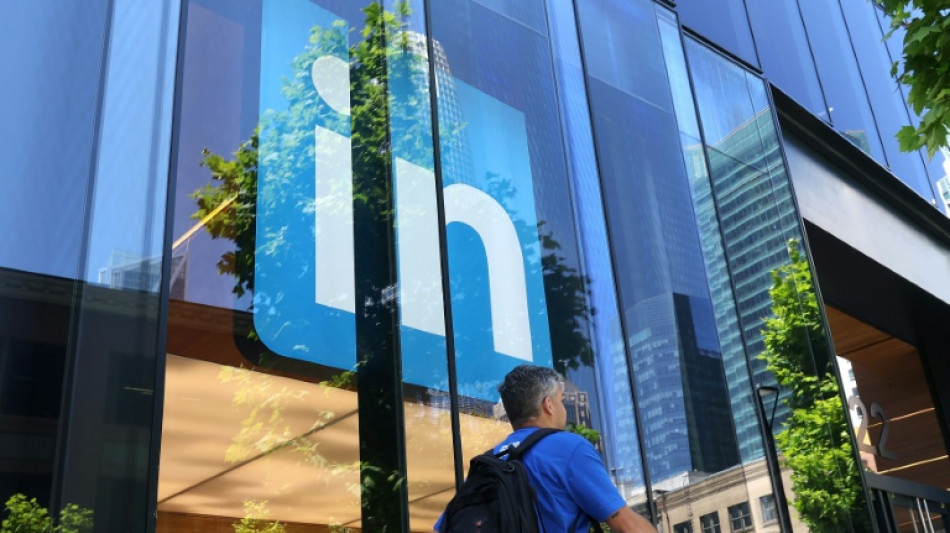
Women don fake mustaches in LinkedIn 'gender bias' fight / Photo: JUSTIN SULLIVAN - GETTY IMAGES NORTH AMERICA/AFP/File

 World No.1 Sinner pulls out of Shanghai Masters to delay return

 Red Bull's Verstappen grabs pole position for Bahrain GP

 India beat Pakistan in blockbuster as golfer Kim wins 'crazy' gold

 India beat arch-rivals Pakistan to win Asian Games cricket gold

 Ethiopia's Tigray rebels abandon regional capital as govt advances: journalist

 Tom Kim powers to Games gold and exemption from military service

 Split loyalties for Indian football fans at Brazil friendly

 India-Pakistan blockbuster brings cricket fever to Japan baseball field
 Wong waiting on Rafa after winning Asian Games tennis gold

 With Russia next door and rising costs, Latvia goes to the polls

 Penalty hero rues empty seats as Games hosts Japan win football gold

 North Korea fires ballistic missile after Seoul's apology demand

 US regulator finds Boeing 737 MAX software bug 'not a safety concern'

 Ohtani 'managing' injuries as Dodgers launch MLB post-season

 Botched US execution leaves murderer unconscious on ventilator: lawyers

 Cornell rape case exposes sexual violence at US colleges

 France held by Italy in Zidane's homecoming after Olise stunner

 Ethiopian pro-government militia claims Tigray airport as regional tensions spike

 Ohtani shaking off injuries as Dodgers launch MLB post-season

 Sea levels to rise in California as coastal wave surges up west coast

 New rallies urged in France as protests disrupt over 730 schools

 Djokovic survives China Open scare, Sabalenka starts strong

 King Charles to evoke colonial 'darkest days' on Caribbean tour

 Tesla shares jump after global car sales top estimates

 DR Congo Ebola outbreak killed more than 4,000: official figures

Flipping their gender setting to "male" and even posting photos with fake mustaches, a growing number of women on LinkedIn have posed a provocative challenge to what they allege is an algorithmic bias on the platform.
Last month, female users began claiming that adopting a male identity had dramatically boosted their visibility on the professional networking site, setting off a chain reaction.
Women adopted male aliases -- Simone became Simon -- swapped their pronouns for he/him, and even deployed AI to rewrite old posts with testosterone-laden jargon to cultivate what they describe as an attention-grabbing alpha persona.
To add a dash of humor, some women uploaded profile photos of themselves sporting stick-on mustaches.
The result?
Many women said their reach and engagement on LinkedIn soared, with once-quiet comment sections suddenly buzzing with activity.
"I changed my pronouns and accidentally broke my own LinkedIn engagement records," wrote London-based entrepreneur and investor Jo Dalton, adding that the change boosted her reach by 244 percent.
"So here I am, in a stick-on moustache, purely in the interest of science to see if I can trick the algorithm into thinking I am a man."
- 'Gendered discrepancies' -
When a female AFP reporter changed her settings to male, LinkedIn's analytics data showed the reach of multiple posts spiked compared to a week earlier.
The posts cumulatively garnered thousands more impressions compared to the previous week.
Malin Frithiofsson, chief executive of the Sweden-based Daya Ventures, said the LinkedIn experiment reflected "gendered discrepancies" that professional women have felt for years.
"We're at a point where women are changing their LinkedIn gender to male, swapping their names and profile photos, even asking AI to rewrite their bios as 'if a man wrote them,'" Frithiofsson said.
"And their reach skyrockets."
LinkedIn rejected accusations of in-built sexism.
"Our algorithms do not use gender as a ranking signal, and changing gender on your profile does not affect how your content appears in search or feed," a LinkedIn spokesperson told AFP.
However, women who saw their engagement spike are now calling for greater transparency about how the algorithm -- largely opaque, like those of other platforms -- works to elevate some profiles and posts while downgrading others.
- 'More successful' -
"I don't believe there's a line of code in LinkedIn's tech stack that says 'if female < promote less,'" Frithiofsson wrote in a post on the site.
"Do I believe gendered bias can emerge through data inputs, reinforcement loops, and cultural norms around what a 'professional voice' sounds like? Yes. Absolutely."
LinkedIn's Sakshi Jain said in a blog post that the site's AI systems and algorithms consider "hundreds of signals" -- including a user's network or activity -- to determine the visibility of posts.
Rising volumes of content have also created more "competition" for attention, she added.
That explanation met with some skepticism on the networking site, where more visibility could mean enhanced career opportunities or income.
Rosie Taylor, a Britain-based journalist, said the boost her profile got "from being a 'man' for just one week" saw unique visitors to her newsletter jump by 161 percent compared to the previous week.
That led to an 86 percent spike in new weekly subscriptions via LinkedIn.
"Who knows how much more successful I might have been if the algorithm had thought I was a man from the start?" Taylor said.
burs-ac/msp/iv
B.Godinho--PC



