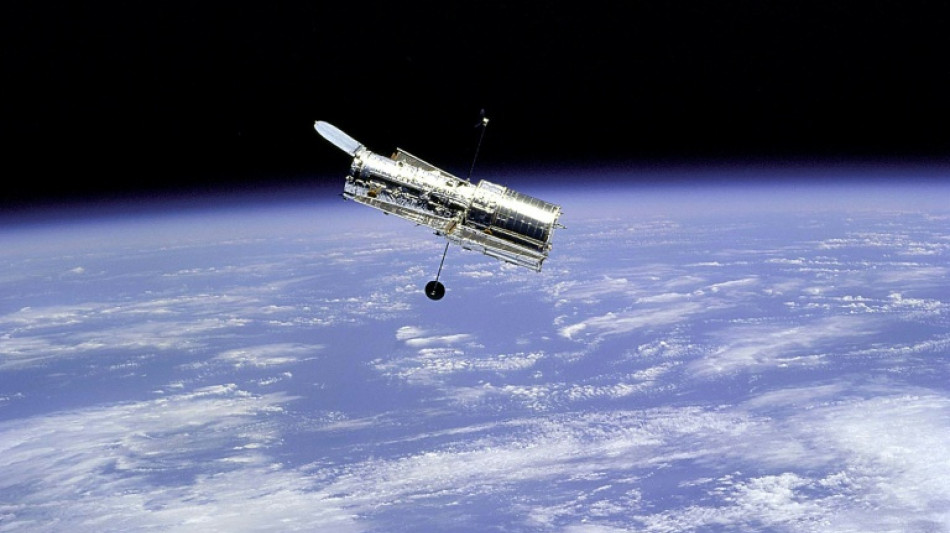
Satellite surge threatens space telescopes, astronomers warn / Photo: NASA - NASA/AFP

 World No.1 Sinner pulls out of Shanghai Masters to delay return
 Red Bull's Verstappen grabs pole position for Bahrain GP

 India beat Pakistan in blockbuster as golfer Kim wins 'crazy' gold

 India beat arch-rivals Pakistan to win Asian Games cricket gold

 Ethiopia's Tigray rebels abandon regional capital as govt advances: journalist

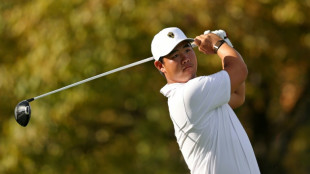 Tom Kim powers to Games gold and exemption from military service

 Split loyalties for Indian football fans at Brazil friendly
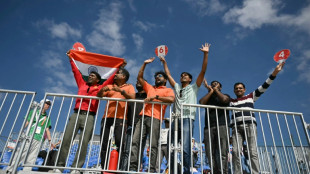 India-Pakistan blockbuster brings cricket fever to Japan baseball field

 Wong waiting on Rafa after winning Asian Games tennis gold

 With Russia next door and rising costs, Latvia goes to the polls

 Penalty hero rues empty seats as Games hosts Japan win football gold

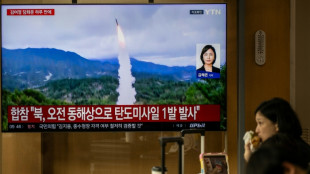 North Korea fires ballistic missile after Seoul's apology demand

 US regulator finds Boeing 737 MAX software bug 'not a safety concern'

 Ohtani 'managing' injuries as Dodgers launch MLB post-season

 Botched US execution leaves murderer unconscious on ventilator: lawyers
 Cornell rape case exposes sexual violence at US colleges
 France held by Italy in Zidane's homecoming after Olise stunner

 Ethiopian pro-government militia claims Tigray airport as regional tensions spike
 Ohtani shaking off injuries as Dodgers launch MLB post-season
 Sea levels to rise in California as coastal wave surges up west coast

 New rallies urged in France as protests disrupt over 730 schools

 Djokovic survives China Open scare, Sabalenka starts strong
 King Charles to evoke colonial 'darkest days' on Caribbean tour

 Tesla shares jump after global car sales top estimates

 DR Congo Ebola outbreak killed more than 4,000: official figures
Light from the half a million satellites that humanity is planning to launch into Earth's orbit in the coming years could contaminate almost all the images taken by space telescopes, NASA astronomers warned Wednesday.
Scientists have already been sounding the alarm about how light pollution from increasingly massive satellites threaten the future of dark skies seen from the ground.
Now, a study published in the journal Nature is the first to estimate how the immense number of satellites planned for the future could stray into the view of nearby telescopes attempting to probe the universe.
Since 2019, the number of satellites in low-Earth orbit has skyrocketed from roughly 2,000 to 15,000, according to the study -- many of them part of billionaire Elon Musk's Starlink internet constellation.
But that is a drop in the bucket compared to what is coming.
If all of the plans currently filed to regulators launch into space, there will be 560,000 satellites orbiting Earth by the end of the 2030s, the study said.
This poses "a very severe threat" to space telescopes, the study's lead author, Alejandro Borlaff of the NASA Ames Research Center in California, told AFP.
For the research, the astronomers simulated how the 560,000 satellites would impact four space telescopes.
Reflected light from the satellites would affect 96 percent of all images taken by NASA's SPHEREx telescope, the European Space Agency's planned ARRAKIHS telescope and China's planned Xuntian telescope, the study found.
The Hubble Space Telescope, which is less likely to snap a satellite as it takes in a narrower view of the universe, would have a third of its images tainted.
This could have an impact on all sorts of scientific endeavours.
"Imagine that you are trying to find asteroids that may be potentially harmful for Earth," Borlaff said.
An asteroid streaking through the sky "looks exactly like a satellite... it's really hard to figure out which one is the bad one," he added.
Some space telescopes, such as the famous James Webb, are unaffected because they are hovering at a stable spot 1.5 million kilometres (932,000 miles) from Earth called the second Lagrange point.
- 'As bright as the brightest star' -
One solution could be to deploy satellites at lower altitudes than space telescopes -- but that could potentially deplete Earth's ozone layer, the study said.
The most straightforward solution may just be to launch fewer satellites.
But competition from rival satellite internet companies -- and the surging needs of the artificial intelligence boom -- make that unlikely.
Nearly three-quarters of the satellites currently in orbit are part of Musk's Starlink network, Borlaff said.
But Starlink is expected to represent just 10 percent of all satellites in a couple of decades as competition blasts off, according to the study.
For now, companies could help by providing the location, orientation and colour of their satellites to those operating space telescopes, Borlaff said.
Another problem is that satellites are getting much bigger.
To the naked eye, satellites that are 100 square metres (more than 1,000 square feet) in size are "as bright as the brightest star that you can see in the sky", Borlaff said.
However, to handle AI's data requirements, there are now plans to build ones 3,000 square metres wide.
These giants could be "as bright as a planet", Borlaff added.
A.S.Diogo--PC



