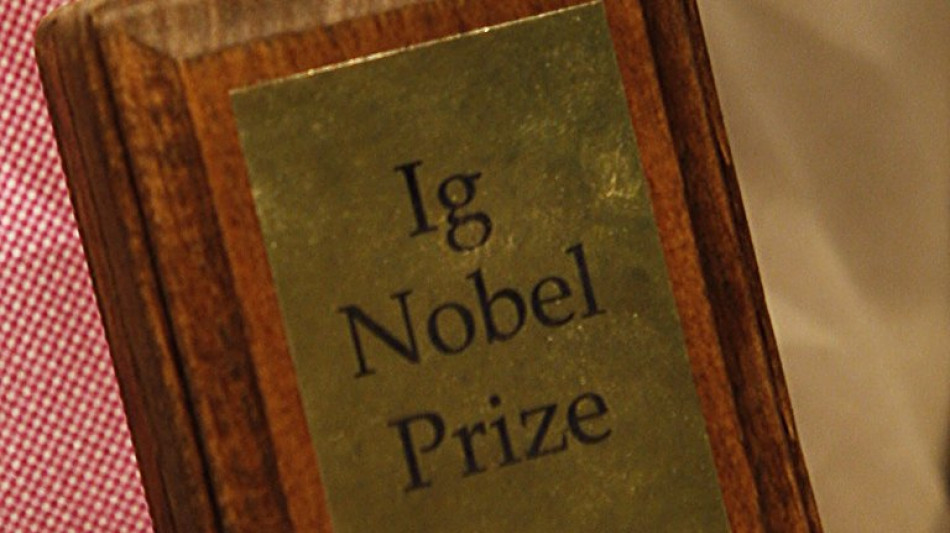
Laughing about science more important than ever: Ig Nobel founder / Photo: mkwajafa - afp.com/File

 World No.1 Sinner pulls out of Shanghai Masters to delay return

 Red Bull's Verstappen grabs pole position for Bahrain GP

 India beat Pakistan in blockbuster as golfer Kim wins 'crazy' gold

 India beat arch-rivals Pakistan to win Asian Games cricket gold

 Ethiopia's Tigray rebels abandon regional capital as govt advances: journalist

 Tom Kim powers to Games gold and exemption from military service

 Split loyalties for Indian football fans at Brazil friendly

 India-Pakistan blockbuster brings cricket fever to Japan baseball field

 Wong waiting on Rafa after winning Asian Games tennis gold

 With Russia next door and rising costs, Latvia goes to the polls

 Penalty hero rues empty seats as Games hosts Japan win football gold

 North Korea fires ballistic missile after Seoul's apology demand

 US regulator finds Boeing 737 MAX software bug 'not a safety concern'

 Ohtani 'managing' injuries as Dodgers launch MLB post-season

 Botched US execution leaves murderer unconscious on ventilator: lawyers

 Cornell rape case exposes sexual violence at US colleges

 France held by Italy in Zidane's homecoming after Olise stunner

 Ethiopian pro-government militia claims Tigray airport as regional tensions spike

 Ohtani shaking off injuries as Dodgers launch MLB post-season

 Sea levels to rise in California as coastal wave surges up west coast

 New rallies urged in France as protests disrupt over 730 schools

 Djokovic survives China Open scare, Sabalenka starts strong

 King Charles to evoke colonial 'darkest days' on Caribbean tour

 Tesla shares jump after global car sales top estimates

 DR Congo Ebola outbreak killed more than 4,000: official figures

With science increasingly coming under attack, using humour as a way to get people interested in scientific research is more important than ever, the founder of the satirical Ig Nobel prizes said.
But not to be too serious, AFP's interview with the founder Marc Abrahams also included a callout for public donations of pubic lice -- and the sudden, unexpected appearance of a taxidermy duck.
Since 1991, the Ig Nobel prizes have celebrated the sillier side of science, handing out awards -- and 10-trillion-Zimbabwean-dollar notes -- at often-raucous ceremonies in Boston every year for genuine research projects that inadvertently have an absurd side.
The research "has to make people laugh and then think", explained Abrahams, who is also the editor of the Annals of Improbable Research magazine which organises the prizes.
As the serious Nobel prizes were awarded in Stockholm this week, several events were held in Paris featuring Ig Nobel laureates presenting their work while paper airplanes rained down -- a long-running Ig Nobel gag.
Among those speaking were French physicist Marc-Antoine Fardin, who investigated whether cats can be both solids and liquids, and Italy's Daniel Maria Busiello for his research about avoiding clumpiness while making the iconic Italian pasta dish cacio e pepe.
"If you're laughing at something, you are paying attention," Abrahams said.
The idea of the Ig Nobels is to capture a person's attention -- even if just for three seconds, he said. Then maybe when they are telling their friends about it later they might realise it is actually "really interesting".
- Science 'threatened and destroyed' -
At a time when scientific research is being "threatened and actively destroyed", particularly under the administration of US President Donald Trump, many people "have been telling us that now what we're doing has become much more important", Abrahams said.
Several of this year's prize winners decided not to attend the ceremony in September out of concern about travelling to the US under Trump, the mathematician added.
At first some scientists were suspicious of the gag prize, but the Ig Nobels have now become something of an institution -- few refuse the honour, Abrahams said.
There is little antagonism with the real Nobel prizes. In fact, Nobel laureates hand out Ig Nobels every year -- often wearing funny hats. One of them, British physicist Andre Geim, has even won both prizes.
Each year's 10 winners are chosen from thousands of nominees sent into Abrahams.
An increasing number -- over 10 percent -- are researchers nominating themselves. "They almost never win," Abrahams said.
Indeed, the phone call when he tells scientists they have won is often "the first moment any of them realised that what they had done is funny", he said with a laugh.
- Pubic lice needed -
Dutch biologist and Ig Nobel laureate Kees Moeliker said the prizes award scientists for doing their job: being curious, discovering what is happening, then publishing what they found.
For example, Moeliker's prize-winning research -- the first documented case of homosexual necrophilia in a mallard -- started when an unlucky duck crashed into his office window.
At this point in the interview, Moeliker pulled the duck in question -- which is now stuffed -- out of his bag, prompting the waiter at the restaurant to ask whether it was real.
When the waiter was gone, Moeliker said: "I have a little request."
He is looking for some pubic lice, and is hoping AFP's readers can help.
The insect's numbers are thought to be dwindling because of the modern tendency to trim pubic hair, Moeliker said, comparing the phenomenon to how deforestation has threatened pandas.
But he needs more samples to research the subject, so he is asking the public to send any specimens they have to the Natural History Museum in Rotterdam. One helpful person has already sent in lice sticky-taped to the back of a postcard.
But it might not be all bad news for pubic lice.
"I've heard stories from people in the fashion industry that pubic hair is coming back," Moeliker said.
E.Raimundo--PC



