Rescued condors spread wings in Chilean Andes

 Germans vote in elections threatening fresh blow to Merz

 US fears rapid escalation in Mideast after Houthis attack Riyadh

 Japan triathlete Hojo wins first gold of Asian Games

 IOC president impressed by 'beautiful' Asian Games wooden huts

 First Asian Games gold goes to Japan as China's 13-year-old Yu lights up pool

 Data centre command hub keeps AI up and running

 Pope Leo in France: the issues on the table

 Packing for a pope: behind the scenes on foreign trips

 Republicans find transgender issues a powerful political weapon in midterm campaigning

 German state elections threaten new shock waves for Merz

 Chile's Bachelet quits race to be next UN chief

 Raphinha treble fires perfect Barca to win at Sevilla

 Thiam makes winning heptathlon return at Decastar meet

 Czechs beat USA to qualify for Davis Cup finals

 Dortmund sink Stuttgart to climb to Bundesliga summit

 Trump says will not tolerate attempts to slow AI growth

 'It has to stop': runners protest women's murders in S.Africa district

 Fire erupts near Riyadh airport as Houthis claim strikes

 Cuba works to restore power after another blackout

 England thrash Sri Lanka again to return to top of T20 rankings

 Arsenal thrashed by Brighton, sorry Spurs lose again

 South Korea, Austria qualify for Davis Cup finals

 Seare shocks Ingebrigtsen to win world 5km gold

 Brigitte Bardot widower slams sale of star's belongings

 Aston Villa compound Tottenham's misery despite late rally

Pumalin and Liquine, two juvenile condors rescued from certain death, have been released back into the wild in a much-needed boost for a dwindling species emblematic of the Chilean Andes.
After 14 months of rehabilitation, the pair of scavengers were freed last week in the Patagonian National Park in Chile's extreme south, where every individual counts for a species listed by the International Union for Conservation of Nature (IUCN) as "vulnerable" to extinction.
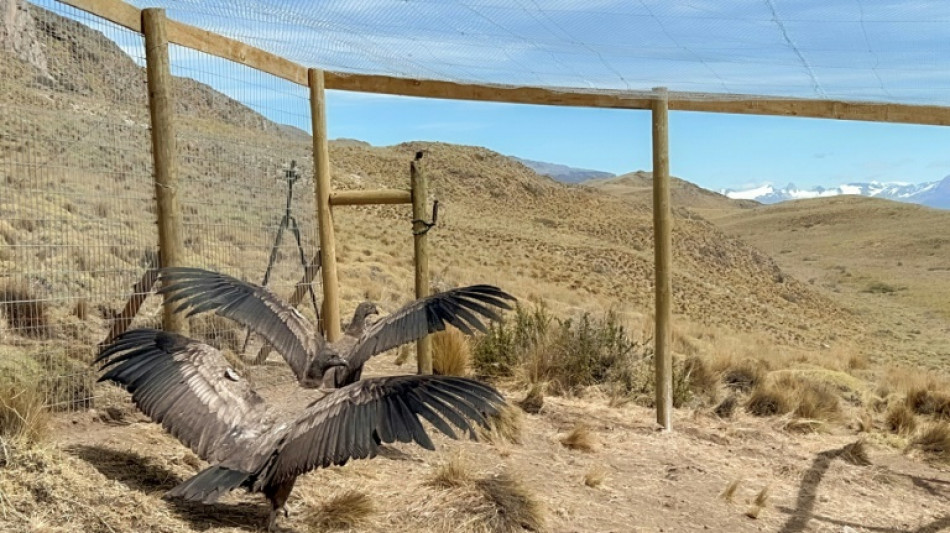
From a vast cage perched on the edge of a cliff overlooking the Patagonian valley, the pair spread their massive wings, waddled to the ledge, and took the leap of freedom, soaring away graciously.
"Today we have witnessed a milestone," Christian Saucedo of the Rewilding Chile Foundation told AFP.
"It is a very complex process... but it means returning individuals who would otherwise be condemned to live in captivity," he said.
According to the IUCN, the Andean condor -- a type of scavenging vulture -- is a declining species, with fewer than 7,000 left in the wild.
- Human 'persecution' -
The main threat is "direct and indirect persecution by humans," it states.
Dominic Duran, the executive director of the Manku Project for condor conservation, told AFP "the biggest threat is toxic baits set by humans to poison... pumas or wild dogs eating their livestock."
When the condors feed on these carcasses, up to 30 at a time, they get poisoned in turn.
The first to eat, he added, are usually the breeding males and females, and "when condors are killed by toxic bait, all the reproductive individuals at the top of the chain die."
Other threats are hunting by humans, intoxication from poorly-managed landfills and dwindling numbers of the wild animals that make up their diet.
The foundation that rescued Pumalin and Liquine is a legacy of US philanthropist Douglas Tompkins, who in 1990 donated 8,000 square kilometers (3,088 square miles) of land to Chile and Argentina for conservation.
The Patagonia National Park now housed there holds an estimated 70 percent of Chile's Andean condors -- the largest population in South America.
Pumalin, a male, was found over a year ago unable to fly after getting caught in a heavy storm, and Liquine, a female, was rescued struggling to make it in the wild after an earlier attempt to rehabilitate her.
They will now go back to "learning the codes of condor society," said Saucedo.
The pair's progress will be monitored with radio transmitters implanted in their wings.
B.Godinho--PC