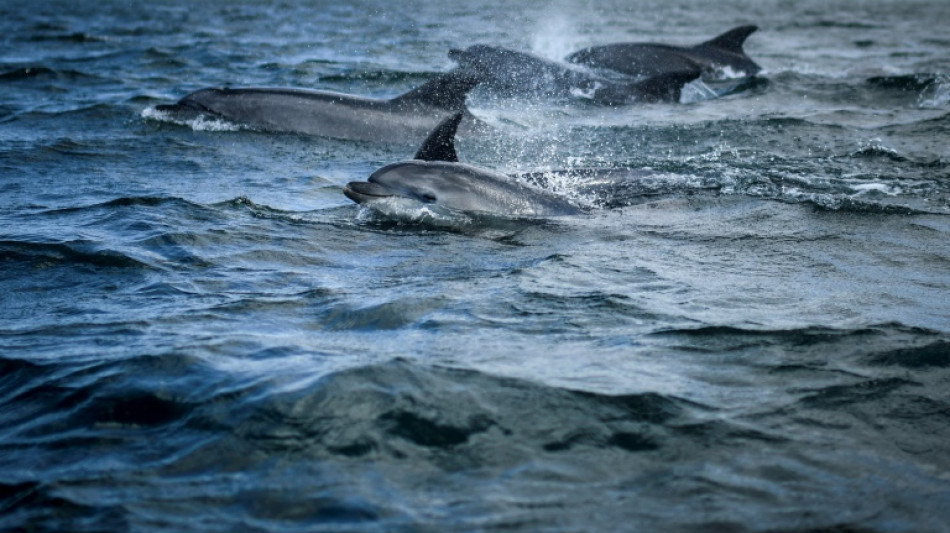
Study predicts mass marine life extinction if warming continues / Photo: PATRICIA DE MELO MOREIRA - AFP/File

 Germans vote in elections threatening fresh blow to Merz

 US fears rapid escalation in Mideast after Houthis attack Riyadh

 Japan triathlete Hojo wins first gold of Asian Games

 IOC president impressed by 'beautiful' Asian Games wooden huts

 First Asian Games gold goes to Japan as China's 13-year-old Yu lights up pool

 Data centre command hub keeps AI up and running

 Pope Leo in France: the issues on the table

 Packing for a pope: behind the scenes on foreign trips

 Republicans find transgender issues a powerful political weapon in midterm campaigning

 German state elections threaten new shock waves for Merz

 Chile's Bachelet quits race to be next UN chief

 Raphinha treble fires perfect Barca to win at Sevilla

 Thiam makes winning heptathlon return at Decastar meet

 Czechs beat USA to qualify for Davis Cup finals

 Dortmund sink Stuttgart to climb to Bundesliga summit

 Trump says will not tolerate attempts to slow AI growth

 'It has to stop': runners protest women's murders in S.Africa district

 Fire erupts near Riyadh airport as Houthis claim strikes

 Cuba works to restore power after another blackout

 England thrash Sri Lanka again to return to top of T20 rankings

 Arsenal thrashed by Brighton, sorry Spurs lose again

 South Korea, Austria qualify for Davis Cup finals

 Seare shocks Ingebrigtsen to win world 5km gold

 Brigitte Bardot widower slams sale of star's belongings

 Aston Villa compound Tottenham's misery despite late rally

By the year 2300, life in the oceans faces a mass die-off rivaling the great extinctions of Earth's deep past if humanity fails to curb greenhouse gas emissions, a study said Thursday.
But limiting planetary warming to two degrees Celsius above pre-industrial levels will stave off such a catastrophe, said the paper's authors, Justin Penn and Curtis Deutsch, both affiliated with the University of Washington and Princeton University.
The authors used ecophysiological modeling to weigh species' physical limits with projected marine temperatures and depletion of oxygen levels -- a task that was particularly challenging given a lack of previous work in the area.
The results were alarming: under "business as usual" warming, marine ecosystems planetwide could experience a mass extinction comparable to that of the end-Permian extinction, known as the "Great Dying."
This occurred 250 million years ago and led to the demise of more than two-thirds of marine animals, because of warming and oxygen depletion, similar conditions that are occurring today.
While the tropical oceans would lose the most species, many from these areas would migrate to higher latitudes in order to survive.
On the other hand, polar species would disappear en masse, since their types of habitat would disappear from the planet entirely.
Limiting warming to 2C, the upper limit of goal set by the Paris agreement, "would cut the severity of extinctions by >70%, avoiding a marine mass extinction," the paper said.
The preferred goal, of limiting warming to 1.5C, is impossible to achieve with current international commitments, according to UN climate experts.
"Because marine extinctions have not progressed as far as those on land, society has time to turn the tide in favor of ocean life," wrote scientists Malin Pinsky and Alexa Fredston in an accompanying commentary.
"Exactly where the future falls between the best-case and worst-case scenarios will be determined by the choices that society makes not only about climate change, but also about habitat destruction, overfishing, and coastal pollution."
L.Torres--PC