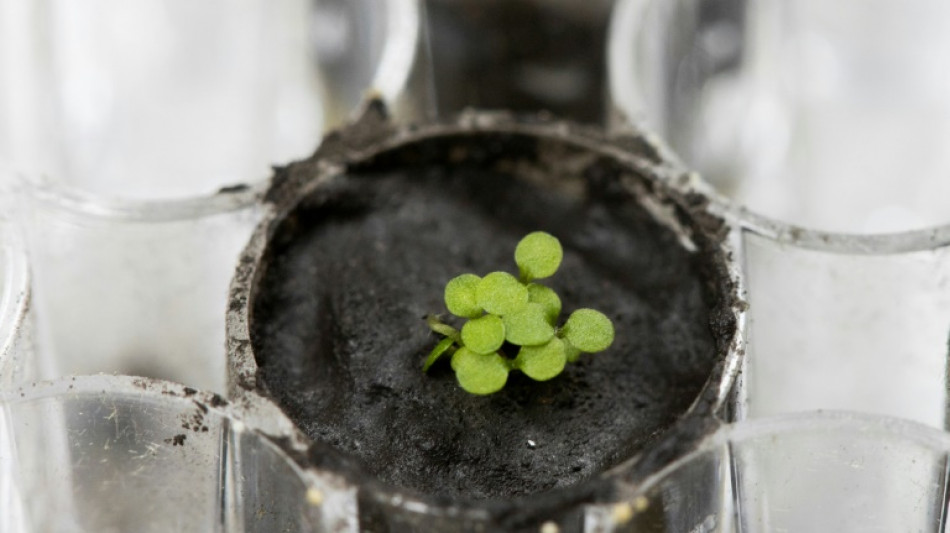
Scientists successfully grow plants in soil from the Moon / Photo: Tyler JONES - UF/IFAS Communications/AFP

 Germans vote in elections threatening fresh blow to Merz

 US fears rapid escalation in Mideast after Houthis attack Riyadh

 Japan triathlete Hojo wins first gold of Asian Games

 IOC president impressed by 'beautiful' Asian Games wooden huts

 First Asian Games gold goes to Japan as China's 13-year-old Yu lights up pool

 Data centre command hub keeps AI up and running

 Pope Leo in France: the issues on the table

 Packing for a pope: behind the scenes on foreign trips

 Republicans find transgender issues a powerful political weapon in midterm campaigning

 German state elections threaten new shock waves for Merz

 Chile's Bachelet quits race to be next UN chief

 Raphinha treble fires perfect Barca to win at Sevilla

 Thiam makes winning heptathlon return at Decastar meet

 Czechs beat USA to qualify for Davis Cup finals

 Dortmund sink Stuttgart to climb to Bundesliga summit

 Trump says will not tolerate attempts to slow AI growth

 'It has to stop': runners protest women's murders in S.Africa district

 Fire erupts near Riyadh airport as Houthis claim strikes

 Cuba works to restore power after another blackout

 England thrash Sri Lanka again to return to top of T20 rankings

 Arsenal thrashed by Brighton, sorry Spurs lose again

 South Korea, Austria qualify for Davis Cup finals

 Seare shocks Ingebrigtsen to win world 5km gold

 Brigitte Bardot widower slams sale of star's belongings

 Aston Villa compound Tottenham's misery despite late rally

That's one small pot of soil, one giant leap for man's knowledge of space agriculture: scientists have for the first time grown plants in lunar soil brought back by astronauts in the Apollo program.
The ground-breaking experiment, detailed in the journal Communications Biology on Thursday, has given researchers hope that it may be possible to one day grow plants directly on the Moon.
That would save future space missions much hassle and expense, facilitating longer and farther trips.
However, according to the study's University of Florida authors, much remains to be studied on the topic, and they intend to leave no stone unturned.
"This research is critical to NASA's long-term human exploration goals," said Bill Nelson, the head of the US space agency. "We'll need to use resources found on the Moon and Mars to develop food sources for future astronauts living and operating in deep space."
For their experiment, the researchers used just 12 grams (a few teaspoons) of lunar soil collected from various spots on the Moon during the Apollo 11, 12, and 17 missions.
In tiny thimble-sized pots, they placed about a gram of soil (called "regolith") and added water, then the seeds. They also fed the plants a nutrient solution every day.
The researchers chose to plant arabidopsis thaliana, a relative of mustard greens, because it grows easily and, most importantly, has been studied extensively. Its genetic code and responses to hostile environments -- even in space -- are well known.
As a control group, seeds were also planted in soil from Earth as well as samples imitating lunar and Martian soil.
The result: after two days, everything sprouted, including the lunar samples.
"Every plant -- whether in a lunar sample or in a control -- looked the same up until about day six," Anna-Lisa Paul, lead author of the paper, said in a statement.
But after that, differences started to appear: the plants in the lunar samples grew more slowly and had stunted roots.
After 20 days, the scientists harvested all the plants, and ran studies on their DNA.
Their analysis showed that the lunar plants had reacted similarly to those grown in hostile environments, such as soil with too much salt, or heavy metals.
In the future, scientists want to understand how this environment could be made more hospitable.
NASA is preparing to return to the Moon as part of the Artemis program, with a long-term goal of establishing a lasting human presence on its surface.
S.Caetano--PC