Scientists produce chimp genetic map to combat trafficking / Photo: JOHN WESSELS - AFP/File

 Germans vote in elections threatening fresh blow to Merz

 US fears rapid escalation in Mideast after Houthis attack Riyadh

 Japan triathlete Hojo wins first gold of Asian Games

 IOC president impressed by 'beautiful' Asian Games wooden huts

 First Asian Games gold goes to Japan as China's 13-year-old Yu lights up pool

 Data centre command hub keeps AI up and running

 Pope Leo in France: the issues on the table

 Packing for a pope: behind the scenes on foreign trips

 Republicans find transgender issues a powerful political weapon in midterm campaigning

 German state elections threaten new shock waves for Merz

 Chile's Bachelet quits race to be next UN chief

 Raphinha treble fires perfect Barca to win at Sevilla

 Thiam makes winning heptathlon return at Decastar meet

 Czechs beat USA to qualify for Davis Cup finals

 Dortmund sink Stuttgart to climb to Bundesliga summit

 Trump says will not tolerate attempts to slow AI growth

 'It has to stop': runners protest women's murders in S.Africa district

 Fire erupts near Riyadh airport as Houthis claim strikes

 Cuba works to restore power after another blackout

 England thrash Sri Lanka again to return to top of T20 rankings

 Arsenal thrashed by Brighton, sorry Spurs lose again

 South Korea, Austria qualify for Davis Cup finals

 Seare shocks Ingebrigtsen to win world 5km gold

 Brigitte Bardot widower slams sale of star's belongings

 Aston Villa compound Tottenham's misery despite late rally

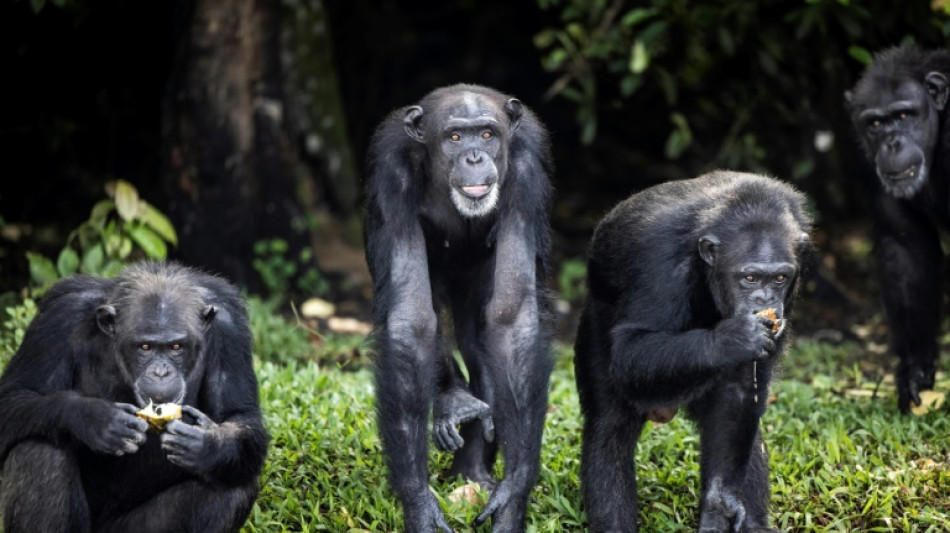
Scientists have produced the first genetic map of chimpanzees in the wild, offering a detailed reconstruction of the endangered species' past migrations, and a new tool to combat illegal trafficking.
The genomic catalogue, which includes 828 individuals from across their vast African range, can now be used to link kidnapped chimpanzees -- or their meat and body parts -- to their place of origin within 100 kilometers.
The results of the years-long research project was published Wednesday in the journal Cell Genomics.
First author Claudia Fontsere of the Institute of Evolutionary Biology in Spain told AFP: "If we can know the genetic diversity of this endangered species, and its past demographic history...this can help design a better conservation plan."
DNA samples were collected from thousands of chimp droppings as part of the Pan African Program at 48 locations across central and western Africa.
Fecal samples are a useful way to study endangered species because they allow for extensive collection with minimal interference to the animals.
But they also present technical challenges because they contain only trace amounts of host DNA.
To overcome these constraints, the team applied a new DNA sequencing technique called "target capture" that was first used to study Neanderthals whose remains have been degraded over thousands of years.
This allowed them to discover 50 percent more variants on a particular chromosome -- number 21 -- than had previously been found, and from this infer past gene flow between chimpanzee populations, plugging gaps in scientific understanding.
Previously, only 59 whole chimpanzee genomes had been sequenced, mainly from captive animals with limited information about their origin.
- Complex migrations -
Just like humans, chimps have complex migration histories, and the new research allowed the scientists to peer back over the past 100,000 years at a new level of detail.
"There has been a lot of debate on whether the four chimpanzee subspecies truly diverged from one another or whether there has been persistent gene-flow between them," co-lead author Mimi Arandjelovic of the Max Planck Institute for Evolutionary Anthropology told AFP.
"We were able to show, using different analyses methods that look at very old and more recent variation, that the history is complex, much like that of our own species."
The team learned that the chimpanzee subspecies were separated in the past, but also experienced periods of genetic exchange -- helping explain why past studies that tried to reconstruct chimps' evolutionary history came to differing conclusions.
They found geographical barriers like lakes and rivers also created genetic barriers between subspecies as well as between communities, and discovered new insights about periods when chimps cross bred with bonobos.
Importantly, they confirmed there was a high level of connectivity between Western chimpanzees, underscoring the need to preserve connections between forests across Western Africa, said Arandjelovic.
Fontsere explained the genetic map could help pinpoint where illegally trafficked chimps had come from.
Though reintroducing the chimps to the wild is a fraught task because of the animals' complex social structure, research has shown they do better when placed in a sanctuary near their place of origin.
"It can help law enforcement to look at the more probable routes, we can trace it back," said Fontsere.
They next hope to improve the genetic map with more samples, and, having proved that fecal DNA is a viable option, extend its use to study other primates.
F.Cardoso--PC