Nepal's war victims watch political changes with fragile hope / Photo: Prakash MATHEMA - AFP

 Drones hit Moscow as Russians go to the polls

 New England boss Fleming says 'wrong' to ask Stokes to end retirement

 Germans vote in elections threatening fresh blow to Merz

 US fears rapid escalation in Mideast after Houthis attack Riyadh

 Japan triathlete Hojo wins first gold of Asian Games

 IOC president impressed by 'beautiful' Asian Games wooden huts

 First Asian Games gold goes to Japan as China's 13-year-old Yu lights up pool

 Data centre command hub keeps AI up and running

 Pope Leo in France: the issues on the table

 Packing for a pope: behind the scenes on foreign trips

 Republicans find transgender issues a powerful political weapon in midterm campaigning

 German state elections threaten new shock waves for Merz

 Chile's Bachelet quits race to be next UN chief

 Raphinha treble fires perfect Barca to win at Sevilla

 Thiam makes winning heptathlon return at Decastar meet

 Czechs beat USA to qualify for Davis Cup finals

 Dortmund sink Stuttgart to climb to Bundesliga summit

 Trump says will not tolerate attempts to slow AI growth

 'It has to stop': runners protest women's murders in S.Africa district

 Fire erupts near Riyadh airport as Houthis claim strikes

 Cuba works to restore power after another blackout

 England thrash Sri Lanka again to return to top of T20 rankings

 Arsenal thrashed by Brighton, sorry Spurs lose again

 South Korea, Austria qualify for Davis Cup finals

 Seare shocks Ingebrigtsen to win world 5km gold

When families of those killed in Nepal's deadly September protests that toppled the government demanded justice, the anguish felt painfully familiar to Sunamati Chaudhari.
Her husband, an English teacher, was taken by security forces 22 years ago at the height of a decade-long civil war. He never returned.
Chaudhari, 62, has been searching for the truth about her husband's disappearance ever since.
"We left no stone unturned in search of my husband. We went to court, sought help of many organisations -- and even reached Geneva," she told AFP, referring to her bid to seek help from the United Nations. "But nothing happened."
She is among the thousands of relatives waiting for closure since a 2006 peace deal ended a conflict in which more than 16,000 people were killed and 1,400 remain missing.
Abuses were committed by both Maoist rebels and state forces.
"I would dream of him every night," Chaudhari said.
Justice has been glacial in the Himalayan nation.
Nepal's authorities have long been criticised for failing to adequately probe wartime abuses.
Two transitional justice commissions set up in 2015 have yet to resolve a single case, despite receiving more than 65,000 complaints of rape, murder and enforced disappearances.
- 'Culture of impunity' -
Nepal is now reeling from fresh political upheaval.
Youth-led demonstrations against a social media ban, worsening economic woes and corruption erupted nationwide in September, leaving at least 76 people dead in a violent crackdown.
Parliament, courts and civil service buildings were torched, and the government collapsed.
Former chief justice Sushila Karki, 73, was named interim prime minister to steer Nepal until elections in March 2026.
For many families still haunted by the civil war, the political shake-up has stirred a fragile mix of hope and anxiety.
Preeti Tharu, 22, whose father was abducted by rebels before she was born, fears history will repeat itself.
"The previous government only showed assurances," she said. "And I know, with this changing situation, the state's priority might be something else."
Gita Rasaili, who heads the Conflict Victim Women National Network, said she hoped they could find common cause with the new generation demanding government action.
"We worried that our agenda was over, because there are now new victims' families and new martyrs," she told AFP.
"But we are all fighting against a culture of impunity."
- 'Volatile' -
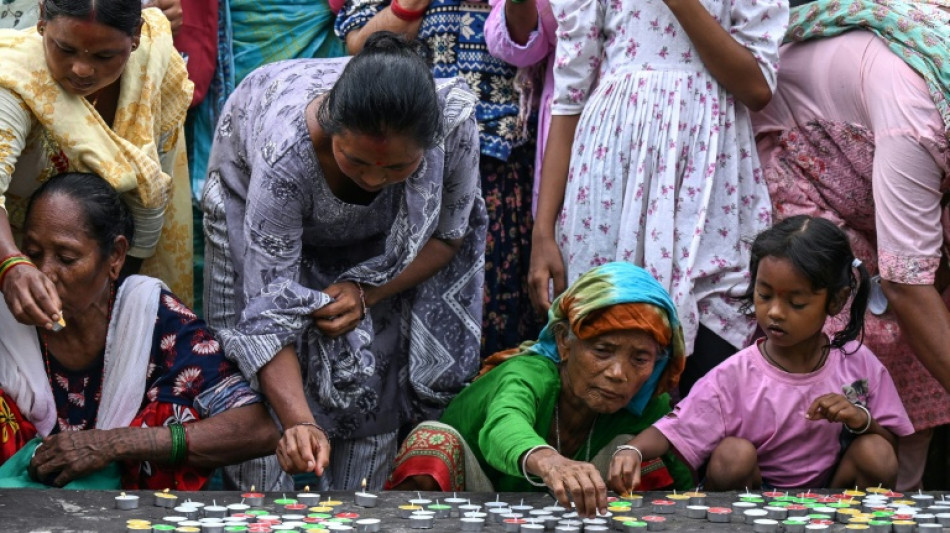
In August, before the uprising, families gathered to mark the International Day of the Disappeared at a new memorial park in western Nepal's Bardiya district.
Families of some of the 258 missing people from the district planted trees and lit candles.
Park coordinator Niranjan Kumar Chaudhari, whose father was taken away by the army, said the new crop of politicians in the interim government were among the few who had taken action to support their cause.
"The current prime minister and home minister are both advocates for victims of war crimes," Chaudhari said.
"But the political situation is volatile."
It was under Karki's watch as chief justice that a court in 2017 sentenced three soldiers to 20 years in jail for the murder of a teenage girl.
At the time, it was only the second conviction for crimes committed during the war.
The Commission of Investigation on Enforced Disappeared Persons says its work will continue regardless of the political situation.
"We have received 2,610 complaints so far," said commission chief Lila Devi Gadtaula, who aims to complete investigations within four years, with progress slowed by limited forensic resources.
But for families like Chaudhari's, time has already run out.
In July, she and her two sons performed her husband's death rites.
"It's already too late," she said. "Many prime ministers have come and gone, but nobody addressed our problem."
A.P.Maia--PC