Ethiopia's invasive prosopis tree chokes livelihoods and land / Photo: Marco Simoncelli - AFP

 Drones hit Moscow as Russians go to the polls

 New England boss Fleming says 'wrong' to ask Stokes to end retirement

 Germans vote in elections threatening fresh blow to Merz

 US fears rapid escalation in Mideast after Houthis attack Riyadh

 Japan triathlete Hojo wins first gold of Asian Games

 IOC president impressed by 'beautiful' Asian Games wooden huts

 First Asian Games gold goes to Japan as China's 13-year-old Yu lights up pool

 Data centre command hub keeps AI up and running

 Pope Leo in France: the issues on the table

 Packing for a pope: behind the scenes on foreign trips

 Republicans find transgender issues a powerful political weapon in midterm campaigning

 German state elections threaten new shock waves for Merz

 Chile's Bachelet quits race to be next UN chief

 Raphinha treble fires perfect Barca to win at Sevilla

 Thiam makes winning heptathlon return at Decastar meet

 Czechs beat USA to qualify for Davis Cup finals

 Dortmund sink Stuttgart to climb to Bundesliga summit

 Trump says will not tolerate attempts to slow AI growth

 'It has to stop': runners protest women's murders in S.Africa district

 Fire erupts near Riyadh airport as Houthis claim strikes

 Cuba works to restore power after another blackout

 England thrash Sri Lanka again to return to top of T20 rankings

 Arsenal thrashed by Brighton, sorry Spurs lose again

 South Korea, Austria qualify for Davis Cup finals

 Seare shocks Ingebrigtsen to win world 5km gold

Once hailed as a solution to Ethiopia's creeping desertification, a foreign tree is now spreading uncontrollably across the east African nation, threatening fragile ecosystems and the very survival of local communities.
Native to Latin America, the prosopis shrub-like tree was first planted in Ethiopia's northeastern Afar region in the 1970s.
It has become a nightmare for locals like livestock farmer Khadija Humed.
"Because of this plant, we have become poor," she told AFP.
Heat-resistant and fast-growing, prosopis initially promised to curb soil erosion and provide shade to cool the local micro-climate in Afar's arid lowlands.
But today it has overrun the region's vast plains -- its thorny, drooping branches rising up to 10 metres (33 feet) high.
Each tree can draw up to seven litres of water a day through its deep roots, drying out the soil and crippling agriculture.
The prosopis also harms livestock, local pastoralists say.
"The plant has turned against us," Hailu Shiferaw, a researcher at the Ethiopian Water and Land Resources Centre, told AFP.
"No one could have foreseen its harmful effects."
- 'Everything has changed' -
In Khadija's village, some 200 kilometres (124 miles) northeast of the capital Addis Ababa, she said the tree's pods make their cows sick, blocking their mouths and stomachs and killing some -- losses that have driven the community into deep poverty.
"I personally have 10 cows and more than 20 goats and sheep. But before prosopis, people here used to have 50 to 100 cattle shesaid.
"Everything has changed," said 76-year-old local Yusuf Mohammed, adding that the tree's dense foliage attracted wild animals that attack their livestock.
"We never had wild animal attacks before... after prosopis spread, lions, hyenas, wild cats and foxes invaded our villages," Mohammed said.
Its poisonous thorns also injure livestock, leaving them too weak to roam for food, he added.
Worldwide, there are some 3,500 invasive species introduced by humans, many of which have damaged local ecosystems.
They cost local economies a total of $423 billion, according to a 2023 report by the Intergovernmental Science-Policy Platform on Biodiversity and Ecosystem Services -- equivalent to the entire GDP of Denmark.
Ketema Bekele, associate professor of environmental economics at Ethiopia's Haramaya University, estimates that prosopis has cost Afar $602 million over the past three decades -- nearly four times its annual budget.
- Out of control -
Some 20,000 square-kilometres of Afar is now invaded by the plant, which is "out of control" and spreading into Amhara and Oromia, he said.
It covered 8.61 percent of Ethiopia in 2023, according to the Journal of Environmental Management published last year, up from 2.16 percent in 2003, while overall pastureland shrank by more than a quarter.
The report said prosopis could occupy 22 percent of Ethiopia's 1.1 million square kilometres by 2060.
Camels help it spread by eating the pods and excreting them far and wide.
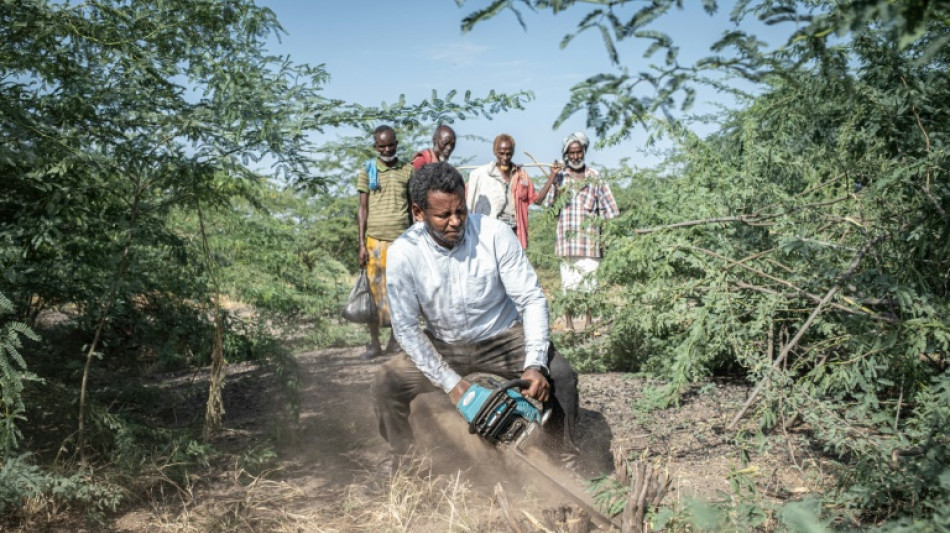
CARE International, an NGO, has attempted to stop the spread since 2022 by encouraging locals to harvest the plant.
Supported by Danish fund Danida, it also removes the trees to plant fruit orchards.
It is controllable, said Mohammed, but more support is needed.
"We can't tackle it alone," he said.
F.Cardoso--PC