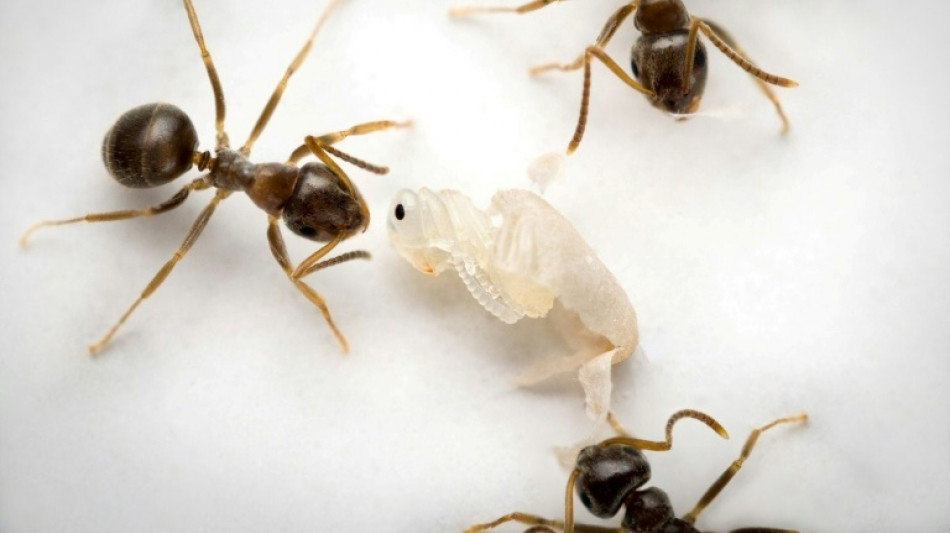
'Come and kill me': sick ants invite destruction to save colony / Photo: Christopher PULL - ISTA/AFP

 Drones hit Moscow as Russians go to the polls

 New England boss Fleming says 'wrong' to ask Stokes to end retirement

 Germans vote in elections threatening fresh blow to Merz

 US fears rapid escalation in Mideast after Houthis attack Riyadh

 Japan triathlete Hojo wins first gold of Asian Games

 IOC president impressed by 'beautiful' Asian Games wooden huts

 First Asian Games gold goes to Japan as China's 13-year-old Yu lights up pool

 Data centre command hub keeps AI up and running

 Pope Leo in France: the issues on the table

 Packing for a pope: behind the scenes on foreign trips

 Republicans find transgender issues a powerful political weapon in midterm campaigning

 German state elections threaten new shock waves for Merz

 Chile's Bachelet quits race to be next UN chief

 Raphinha treble fires perfect Barca to win at Sevilla

 Thiam makes winning heptathlon return at Decastar meet

 Czechs beat USA to qualify for Davis Cup finals

 Dortmund sink Stuttgart to climb to Bundesliga summit

 Trump says will not tolerate attempts to slow AI growth

 'It has to stop': runners protest women's murders in S.Africa district

 Fire erupts near Riyadh airport as Houthis claim strikes

 Cuba works to restore power after another blackout

 England thrash Sri Lanka again to return to top of T20 rankings

 Arsenal thrashed by Brighton, sorry Spurs lose again

 South Korea, Austria qualify for Davis Cup finals

 Seare shocks Ingebrigtsen to win world 5km gold

Sick young ants release a smell to tell worker ants to destroy them to protect the colony from infection, scientists said Tuesday, adding that queens do not seem to commit this act of self-sacrifice.
Many animals conceal illness for social reasons. For example, sick humans are known to risk infecting others so they can still go to the office -- or the pub.
Ant colonies, however, act as one "super-organism" which works to ensure the survival of all, similar to how infected cells in our bodies send out a "find-me and eat-me" signal, according to an Austria-led team of scientists.
Ant nests are a "perfect place for a disease outbreak to occur because there are thousands of ants crawling over each other," Erika Dawson, a behavioural ecologist at the Institute of Science and Technology Austria and lead author of a new study, told AFP.
When adult worker ants get an illness that could spread through the colony, they leave the nest to die alone.
Young ants, known as pupae, in contrast are still trapped inside a cocoon, making this kind of social distancing impossible.
Scientists had already figured out that when these pupae are terminally ill, there is a chemical change that produces a particular smell.
Adult worker ants then gather around, remove the cocoon, "bite holes in the pupae and insert poison," Dawson said.
The poison acts as a disinfectant, which kills both the colony-threatening pathogen and the pupae.
For the new research, the scientists wanted to figure out whether the pupae "were actively saying: 'hey, come and kill me'," Dawson said.
- 'Altruistic act' -
First, the scientists extracted the smell from the sick pupae of a small black garden ant called Lasius neglectus. When they applied the smell to a healthy brood in the lab, the workers still destroyed them.
Then, the team conducted an experiment showing that the sick pupae only produce the smell when worker ants are nearby, proving it is a deliberate signal for destruction.
"While it is a sacrifice -- an altruistic act -- it's also in their own interest, because it means that their genes are going to survive and be passed on to the next generation," Dawson said.
However, there is one member of the nest that does not sacrifice itself.
When queen pupae are infected inside their cocoons, they do not send out the smelly warning signal, the team found.
"Are they cheating the system?" Dawson said the team asked themselves.
However, they found that the "queen pupae have much better immune systems than the worker pupae, and so they were able to fight off the infection -- and that's why we think that they weren't signalling", she said.
Dawson hopes future research will investigate whether queen pupae sacrifice themselves when it becomes clear they will not beat their infection.
The study was published in the journal Nature Communications.
E.Raimundo--PC