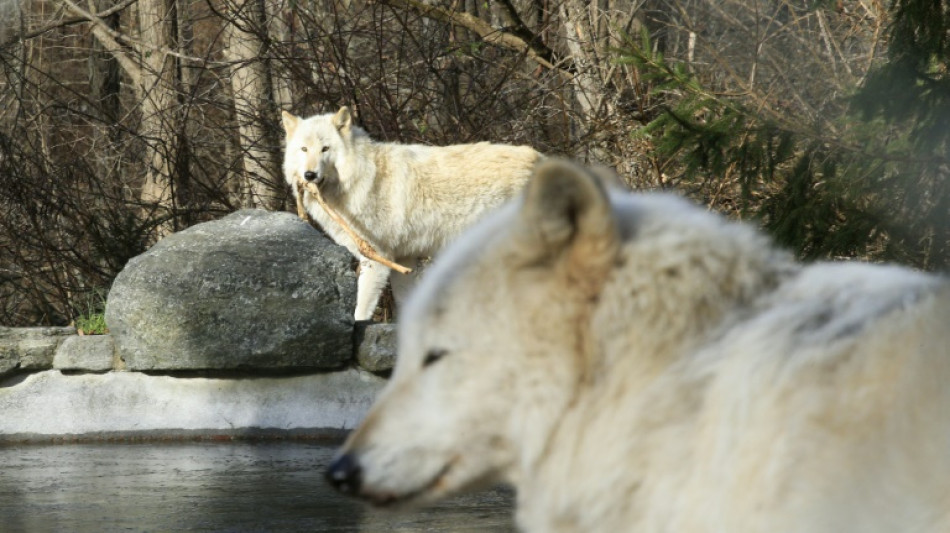
US court reinstates gray wolf endangered species protections

 Germans vote in elections threatening fresh blow to Merz

 US fears rapid escalation in Mideast after Houthis attack Riyadh

 Japan triathlete Hojo wins first gold of Asian Games

 IOC president impressed by 'beautiful' Asian Games wooden huts

 First Asian Games gold goes to Japan as China's 13-year-old Yu lights up pool

 Data centre command hub keeps AI up and running

 Pope Leo in France: the issues on the table

 Packing for a pope: behind the scenes on foreign trips

 Republicans find transgender issues a powerful political weapon in midterm campaigning

 German state elections threaten new shock waves for Merz

 Chile's Bachelet quits race to be next UN chief

 Raphinha treble fires perfect Barca to win at Sevilla

 Thiam makes winning heptathlon return at Decastar meet

 Czechs beat USA to qualify for Davis Cup finals

 Dortmund sink Stuttgart to climb to Bundesliga summit

 Trump says will not tolerate attempts to slow AI growth

 'It has to stop': runners protest women's murders in S.Africa district

 Fire erupts near Riyadh airport as Houthis claim strikes

 Cuba works to restore power after another blackout

 England thrash Sri Lanka again to return to top of T20 rankings

 Arsenal thrashed by Brighton, sorry Spurs lose again

 South Korea, Austria qualify for Davis Cup finals

 Seare shocks Ingebrigtsen to win world 5km gold

 Brigitte Bardot widower slams sale of star's belongings

 Aston Villa compound Tottenham's misery despite late rally

A US court has struck down a Trump-era decision to remove federal protections for gray wolves across much of the country, in a move hailed by conservationists who said the listing was vital for the species' recovery.
A 26-page ruling issued Thursday by Judge Jeffrey White in a case brought by wildlife groups found the Fish and Wildlife Service (FWS) had erred in its October 2020 decision to remove the apex predators from the Endangered Species Act (ESA), where they were first listed in the 1970s.
Though the decision to delist gray wolves across most of the lower-48 states was taken by the administration of former president Donald Trump, Joe Biden's government had continued to defend the move in court.
"It really is a win for wolves across the country," Collette Adkins of the Center for Biological Diversity, told AFP.
"And I hope it finally convinces the Fish and Wildlife Service to really focus on recovering wolves instead of prematurely removing their protections."
A quarter million gray wolves -- long a symbol of the free spirit of the American wilderness -- once roamed from coast to coast before the arrival of European settlers and eradication campaigns that endured into the 20th Century.
At the time of the decision to de-list them, the wolves had recovered from a low of 1,000 to around 6,000 -- but hundreds were subsequently legally killed, either through hunting or conflicts with livestock operators.
In one egregious example, hunters in Wisconsin killed over 218 wolves in less than three days in February 2021, using packs of dogs, snares and leg-hold traps -- well beyond the state's own limit of killing 119 wolves.
The 2020 decision to remove the species' protections had been opposed by 1.8 million Americans in public comments, as well as hundreds of scientists, veterinary professionals, and the iconic conservationist Jane Goodall.
Even the researchers commissioned by the FWS to carry out a review of the science found it did not support de-listing.
"Both under Democratic and Republican administrations, there has been this year-to-year desire to just be done recovering wolves," said Adkins.
"It's been frustrating because the Endangered Species Act envisions a recovery of these animals so that they can fulfill their ecosystem role," she added.
Research has confirmed the wolf's importance in thinning over-browsing herds of elk, which in turn prevents destruction of habitat, for example. And a recent study from Wisconsin found that wolves kept deer away from roads, reducing collisions between deer and cars.
Adkins said she was hopeful of a change in policy after interior secretary Deb Haaland this week penned an op-ed in USA Today criticizing some western States in the northern Rocky mountain range, which have stepped up hunting campaigns in recent months.
The gray wolves of the northern Rockies haven't been covered by the Endangered Species Act since a 2011 Congressional act, but Halaand wrote she could reinstate federal protections specifically for them if necessary.
A.S.Diogo--PC