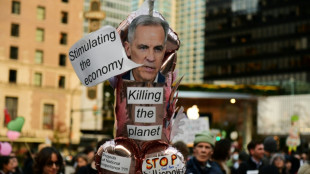
Wicked winter storm threatens US holiday travel chaos / Photo: Patrick T. FALLON - AFP

 Hong Kong court set to sentence activist Joshua Wong in security case

 Australia raises benchmark rate to highest level in 18 years

 'The Remarried Empress' Cast Discusses Bringing Fantasy Royal Drama to Life

 Asian stocks retreat as AI worries outweigh steep oil-price drop

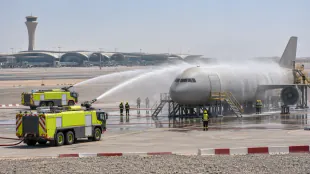 Hamad International Airport stages emergency drills during WATAN 2026

 Global failure to punish attacks leaves journalists at continuing risk

 Researchers Warn 'Bookkeeping Trick' Masks Beef Industry's Methane Emissions

 Climate Change Intensified Atlantic Hurricanes, Study Finds

 Qatar solar expansion opens scope for technical performance gains

 IXOPAY Announces IXO One, a Modular Payments Platform Built for an Era of Fluid Commerce
Life-threatening blizzards and bone-chilling winds are forecast across much of the United States over the next few days, threatening chaos for millions during the peak holiday travel period.
The National Weather Service (NWS) warned on Wednesday that a powerful winter storm would produce "a multitude of weather hazards" across the northern, central and eastern parts of the country.
Airlines told holiday travelers to brace for delays and cancellations as an Arctic cold front grips the northern Plains on Wednesday, sweeps through the Midwest and heads towards the East Coast on Friday just before Christmas.
"This will not be your average cold front as temperatures could drop 20 or more degrees within a few hours," the NWS said, bringing "record-breaking frigid temperatures" to the Gulf Coast and eastern United States by Friday.
It said the Great Lakes region could expect more than a foot (30.5 centimeters) of snow.
"Wind chill values could drop as low as minus 70 degrees Fahrenheit (minus 57 degrees Celsius) throughout parts of the central High Plains," the NWS said, warning that "cold of this magnitude could lead to frostbite on exposed skin within minutes."
"Prepare now for extreme cold and ensure outdoor animals and livestock have sufficient shelter," it said.
The NWS said wind gusts of over 50 miles (80 kilometers) per hour and snow will result in blizzard conditions from the northern and central Plains to the Great Lakes, creating "extremely dangerous travel conditions for both drivers and air travel."
- 'Bomb cyclone' -
The winter storm comes as the Transportation Security Administration said it expects holiday travel volume to be close to pre-pandemic levels, with the busiest day on Thursday.
The American Automobile Association estimated that more than 112 million people will travel 50 miles or more from home between Friday and January 2, the vast majority -- 102 million -- by car.
The Federal Aviation Administration warned that high winds and heavy snow could delay flights at major air travel hubs Minneapolis-St. Paul, Chicago and Denver.
AccuWeather forecasters said the storm could rapidly strengthen into what is known as a "bomb cyclone" through a process known as "bombogenesis," when the barometric pressure drops and a cold air mass collides with a warm air mass.
The NWS in Buffalo, New York called it a "once-in-a-generation storm" with wind gusts of over 65 mph, wind chill as low as 10 to 20 degrees below zero, and scattered or possibly widespread power outages.
Forecasters in Minneapolis described it a "high-end, life-threatening event" that "needs to be taken seriously."
In Fort Worth, Texas, the NWS told residents the cold snap was not expected to be as devastating as the one in February of last year, when freezing temperatures knocked out power to millions in the Lone Star State and caused dozens of deaths.
And in Washington, lawmakers were scrambling to complete work on a sweeping $1.7 trillion spending package before the massive winter storm complicates travel plans.
V.Dantas--PC