US west coast girds for more damaging storms / Photo: Nic Coury - AFP

 Hong Kong court set to sentence activist Joshua Wong in security case

 Australia raises benchmark rate to highest level in 18 years

 'The Remarried Empress' Cast Discusses Bringing Fantasy Royal Drama to Life

 Asian stocks retreat as AI worries outweigh steep oil-price drop

 Hamad International Airport stages emergency drills during WATAN 2026

 Global failure to punish attacks leaves journalists at continuing risk

 Researchers Warn 'Bookkeeping Trick' Masks Beef Industry's Methane Emissions

 Climate Change Intensified Atlantic Hurricanes, Study Finds

 Qatar solar expansion opens scope for technical performance gains

 IXOPAY Announces IXO One, a Modular Payments Platform Built for an Era of Fluid Commerce
Western US states were readying Thursday for yet more torrid weather as so-called atmospheric rivers lined up to dump heavy rain across the already soaked region.
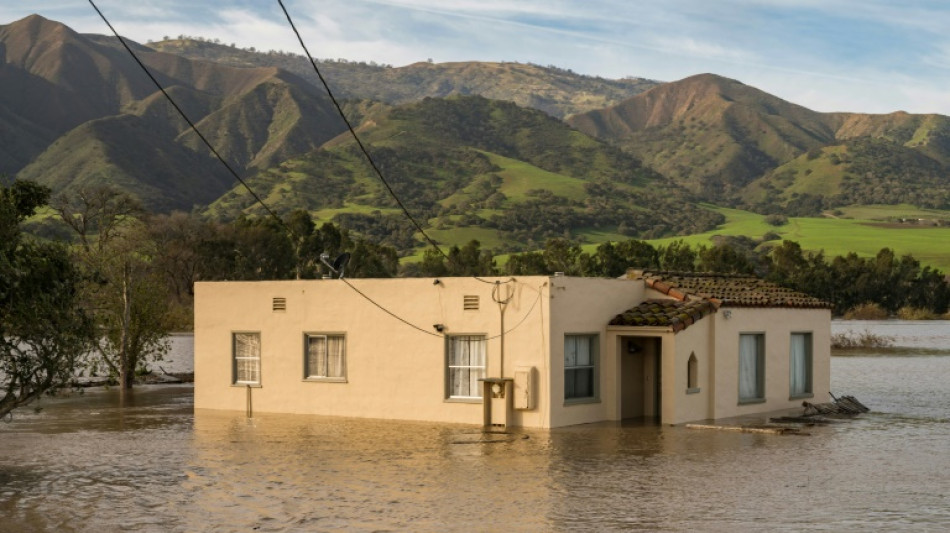
California has been battered by weeks of downpours that have killed 19 people, flooding communities, toppling powerlines and threatening deadly mudslides.
Forecasters now say a cyclone churning in the Pacific Ocean will spread the rain further north, forming a band from northern California to Washington state.
"The relentless parade of cyclones that have been targeting California in the past week is forecast to shift focus," the National Weather Service said Thursday.
A strengthening ridge of high pressure will "keep the heaviest precipitation locked in place across northern California to coastal Pacific Northwest," which includes Oregon and Washington state.
"By Friday night, this somewhat stagnant pattern will show signs of breaking down, allowing the next Pacific cyclone to direct yet another surge of atmospheric river toward California by Saturday morning."
Forecasters said they expect up to six inches (15 centimeters) of rain to fall over 48 hours near Seattle.
Avalanche warnings were in effect for a tranche of Washington state, with the storm bringing wetter, heavier snow into the mountains.
"Dangerous, large avalanches are expected to run naturally during this snowy, wet weather event that will be impacting us Thursday," the Northwest Avalanche Center (NWAC) said.
So-called "wet slab avalanches" were a particular concern as the wetter snow piles up on top of fluffier, lighter snow, making the snowpack unstable.
"Wet slab avalanches are not something to tiptoe around, and this is a day where it's a good idea to stay off steep slopes and runouts beneath avalanche paths," the NWAC said.
- Sewage -
In northern California, up to six feet (1.8 meters) of snow was forecast over the mountains between Friday and Tuesday, with winds gusting up to 50 miles (80 kilometers) an hour.
"Mountain travel is highly discouraged this weekend! If you must travel, plan to be at your destination before 4pm Friday," the NWS said.
At lower elevations, a flood watch was in place in a vast area from around San Francisco and into Oregon.
The warnings come as the region picked up the pieces after repeated downpours.
San Francisco saw more rain over a two-week period than at any other time in 150 years, straining the city's drains where raw sewage was mixed with storm run off.
"Don’t jump in puddles. Especially in San Francisco...there (could be) sewage in that," said Eileen White of the regional Water Quality Control Board, according to the San Francisco Chronicle.
The storms have left at least 19 people dead in California.
They include drivers who have been found in submerged cars, people struck by falling trees, a husband and wife killed in a rockfall, and people whose bodies were discovered in floodwaters.
In San Luis Obispo, members of the National Guard joined the search for 5-year-old Kyle Doan, who was swept away in floodwaters as his mother tried to pull him to safety from their car.
The sheriff of San Luis Obispo County said Wednesday that underwater teams were combing water courses.
"We will search until we find him," spokesman Tony Cipolla told The San Luis Obispo Tribune.
- Climate change -
California is no stranger to wild weather, with winter storms commonplace.
But scientists say climate change, supercharged by humanity's burning of fossil fuels, is making such storms more ferocious.
While it is causing short term misery, the rain is badly needed in the western United States, where more than two decades of drought have forced unprecedented restrictions on water usage.
However, climatologists warn that even the kind of monster downpours that have pummelled the region this month are not going to reverse 20-plus years of below-average rainfall.
Shasta Lake, the state's largest reservoir, was still only at two-thirds of its historical average for early January, water resources department data showed.
P.L.Madureira--PC