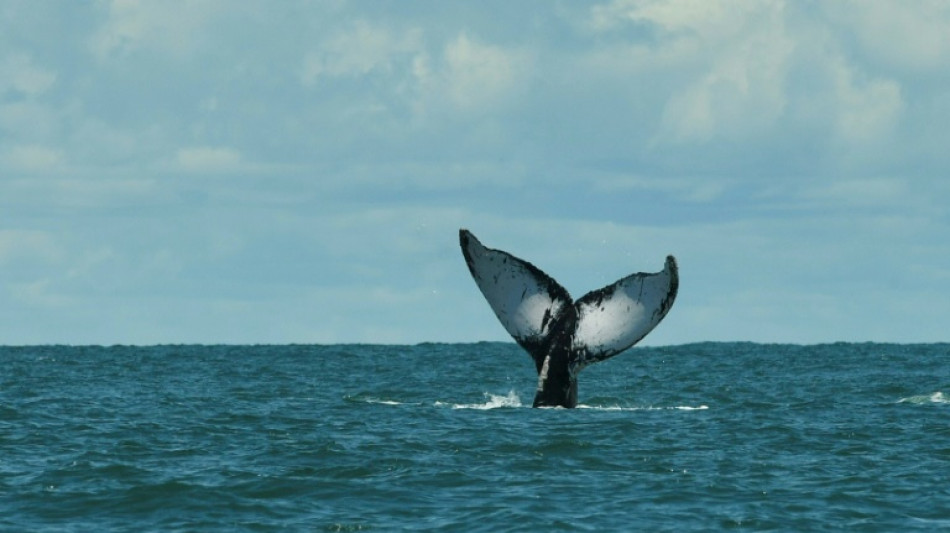
Protecting 30 percent of oceans a huge challenge for the planet / Photo: JOAQUIN SARMIENTO - AFP/File

 Trump's beef policies irk Texas ranchers, testing their loyalty

 Nvidia, OpenAI CEOs to attend Xi dinner at White House

 Anthropic picks Accenture for in-house AI safety evaluation

 Balogun returns as Monaco beat Lens to continue strong Ligue 1 start

 'Pause' on overt repression in Venezuela, but reforms still needed: HRW

 Global stocks mixed as yen falls despite Bank of Japan rate hike

 Cuba hit with seventh major blackout of the year

 Murray out with concussion so Wentz will start for Vikings

 UN chief 'deeply regrets' US visa refusal to Abbas for annual meeting

 England quick Carse to face no charges over alleged nightclub assault

 Mancini brings nine newcomers into the first squad of his Italy comeback

 Czechs level Davis Cup tie against USA as South Korea eye Finals

 New France boss Zidane confirms Mbappe as captain after naming first squad

 California governor signs order to explore AI 'kill switch'

 Head leads run spree as Australia win Zimbabwe ODI series

 In-form Raphinha wants to finish career at Barcelona

 Warren Buffett steps down as Berkshire Hathaway chairman

 Carrick confident Man Utd can 'work through' tough time

 Mbappe ends Nike partnership to join Swiss brand On

 Liverpool boss Iraola puts Bournemouth love affair on hold

 'A disaster' if Man City do not win says Maresca after flawless start

 Kerry James Marshall: American 'blackness' painter celebrated in Europe

 Spain coach De la Fuente offers 'full support' to people of Ceuta

 Russia seizes assets of Nestle, French firms over West's Ukraine support

 England can build on World Cup 'spirit', says Tuchel

How do we go from protecting eight percent of marine areas to 30 percent in less than 10 years? This question is at the heart of a global forum in Canada this weekend aiming to save marine ecosystems under threat from overfishing, pollution and climate change.
On the heels of the historic biodiversity agreement signed at COP15 in Montreal late last year, about 3,000 officials, scientists, NGOs and Indigenous groups are meeting in Vancouver for the fifth International Marine Protected Areas Congress (IMPAC5), which opened Friday and runs until February 9.
Scientists have said the meeting is crucial for setting up a framework to reach the agreed target at COP15 of protecting 30 percent of the planet's lands and oceans by 2030.
It's an immense step for ocean conservation, which will see a tripling of areas made off-limits to most human activities, with an aim to preserve sensitive ecosystems and species at risk.
The summit, usually held every four years, is taking place two years late due to the Covid-19 pandemic.
"We must re-think our policies, economies, priorities, and processes in ways that reflect the important role nature plays in our own health, equity, well-being and economic sustainability," said host Canada, which has some of the world's longest coastlines.
Covering almost three-quarters of the earth's surface, oceans are home to a quarter of known species and absorb 30 percent of CO2 emissions from human activities.
"COP15 marked a historic inflection point in conservation efforts for nature... but the pressure is on now not just to reach the numerical target, but to make sure that we do it right, that our marine protected areas are in the right places (and) that they're managed well," Pepe Clarke of the World Wide Fund For Nature (WWF) told AFP.
Some experts fear the "politics of figures."
- Resistance to climate change -
Biodiversity hotspots or particularly vulnerable areas that deserve urgent conservation measures have been identified, scientists have said.
Now it is essential to have discussions to "establish a global network, ecologically representative and which adequately protects the whole range of ecosystem types," according to Clarke.
Especially since protecting and managing our oceans more sustainably will make them more resistant to climate change.
But even if the world achieves "the ambitious target of protecting 30 percent of the oceans by 2030 within high-quality (marine protected areas), the goals of the framework cannot be fully met without appropriate management of the other 70 percent of the oceans," said the Pew Charitable Trusts, a non-profit.
For Sian Owen, director of the Deep Sea Conservation Coalition (DSCC), "it is crucial that both existing and emerging industries that threaten our deep ocean are quickly and unequivocally rejected and that we sustainably manage the remaining 70 percent."
UN member states will meet again at the end of February to try and hammer out a treaty for the protection of the high seas, a session that should in principle be the last.
Protecting international waters, which cover nearly half the planet, is crucial for the health of the entire ocean and its biodiversity, and for limiting global warming.
"Governments must restrict activities that destroy and disturb vital ecosystems that support life on Earth," said DSCC.
L.Henrique--PC