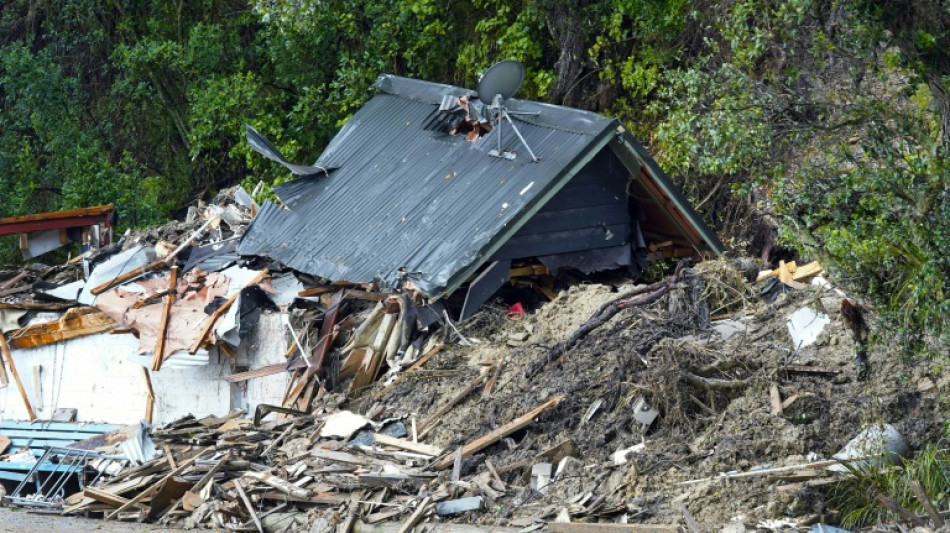
Cyclone-battered New Zealand declares national emergency / Photo: Diego OPATOWSKI - AFP

 Trump's beef policies irk Texas ranchers, testing their loyalty

 Nvidia, OpenAI CEOs to attend Xi dinner at White House

 Anthropic picks Accenture for in-house AI safety evaluation

 Balogun returns as Monaco beat Lens to continue strong Ligue 1 start

 'Pause' on overt repression in Venezuela, but reforms still needed: HRW

 Global stocks mixed as yen falls despite Bank of Japan rate hike

 Cuba hit with seventh major blackout of the year

 Murray out with concussion so Wentz will start for Vikings

 UN chief 'deeply regrets' US visa refusal to Abbas for annual meeting

 England quick Carse to face no charges over alleged nightclub assault

 Mancini brings nine newcomers into the first squad of his Italy comeback

 Czechs level Davis Cup tie against USA as South Korea eye Finals

 New France boss Zidane confirms Mbappe as captain after naming first squad

 California governor signs order to explore AI 'kill switch'

 Head leads run spree as Australia win Zimbabwe ODI series

 In-form Raphinha wants to finish career at Barcelona

 Warren Buffett steps down as Berkshire Hathaway chairman

 Carrick confident Man Utd can 'work through' tough time

 Mbappe ends Nike partnership to join Swiss brand On

 Liverpool boss Iraola puts Bournemouth love affair on hold

 'A disaster' if Man City do not win says Maresca after flawless start

 Kerry James Marshall: American 'blackness' painter celebrated in Europe

 Spain coach De la Fuente offers 'full support' to people of Ceuta

 Russia seizes assets of Nestle, French firms over West's Ukraine support

 England can build on World Cup 'spirit', says Tuchel

New Zealand declared a national state of emergency Tuesday as Cyclone Gabrielle swept away roads, inundated homes and left more than 100,000 people without power.
High winds and heavy rain lashed the country's populous North Island, in what officials called an "unprecedented weather event".
"It's been a big night for New Zealanders. A lot of families are displaced, a lot of homes are without power," Prime Minister Chris Hipkins told reporters in Auckland.
"There has been extensive damage across the country."
This is only the third time New Zealand has declared a state of emergency -- following the 2019 Christchurch attacks and the Covid-19 pandemic.
Daylight revealed the severity of the disaster: roads eaten away by landslips and collapsed homes buried in mud, silt and a slew of storm detritus.
Falling trees smashed power lines and flood waters blocked several roads, leaving communities across the country's north stranded.
Local media reported some were forced to swim from their homes to safety.
Others waded through stormwaters on foot.
"At about midnight we got the emergency text saying 'evacuate'," recalled Jane Scott, a resident of coastal community Muriwai, who gathered a torch and a few essentials before seeking refugee in a local community centre.
"It was pitch black and pouring with rain," she told local channel TVNZ. "It was very scary."
- 'Too early to say' -
Cyclone Gabrielle formed off the northeastern coast of Australia in the Coral Sea on February 8, before barrelling across the South Pacific.
It bore down on New Zealand's northern coast on Sunday, bringing gusts of 140 kilometres (87 miles) an hour, spraying coastal communities with 20 centimetres (almost eight inches) of rain in 24 hours and 11-metre (36-foot) high waves.
More than three-quarters of New Zealand's five million residents live on the North Island, where the brunt of the storm is being felt.
Hipkins said it "was too early to say" how many people had been evacuated from their homes and were without power or cellphone coverage.
Electricity providers estimated that more than 100,000 people are without power.
International and domestic flights have been grounded, with Air New Zealand alone reporting 592 flights cancelled and 35,000 customers affected.
- 'Cascading' crises -
Many parts of northern New Zealand were already waterlogged when Cyclone Gabrielle hit, having been drenched by record rainfall two weeks ago.
Massey University Professor Christine Kenney warned that New Zealand is living in the age of "cascading" natural disasters -- where the impacts of repeated severe weather events build up over time.
"Cascading natural hazard events fuelled by climate change are the new norm for Auckland," she said ahead of Tuesday's emergency.
Climate scientist Daithi Stone said Cyclone Gabrielle had been feeding off unusually warm seas, driven by a combination of climate change and La Nina weather patterns.
"Gabrielle is very much part of the story this summer of a warm nearby ocean using a warm atmosphere to pump rain onto Aotearoa," he said Tuesday, using the Maori-language name for New Zealand.
"It is also part of the global story of tropical cyclones becoming more intense under human-induced climate change."
More rain and high winds were expected Tuesday, further hampering rescue efforts.
"The emergency services are working night and day, but the unstable ground, flood waters and closed roads are making things hard," said Minister for Emergency Management Kieran McAnulty.
The New Zealand Fire and Emergency services said a firefighter is missing and another is in critical condition after a house collapsed in West Auckland.
"It's been a tough night for the North Island as a whole, but it's been especially tough for fire and emergency," said Kerry Gregory, chief executive of the fire service.
Hipkins has promised an aid package of 11.5 million New Zealand dollars ($7.25 million) to help recovery efforts, but McAnulty admitted the cost of the clean-up was set to spiral.
"The honest answer is that it's not going to be cheap, but that isn't what we are worried about right now," he said.
G.M.Castelo--PC