Humanity must chart new course on water use: UN chief / Photo: Kenzo TRIBOUILLARD - AFP

 Trump's beef policies irk Texas ranchers, testing their loyalty

 Nvidia, OpenAI CEOs to attend Xi dinner at White House

 Anthropic picks Accenture for in-house AI safety evaluation

 Balogun returns as Monaco beat Lens to continue strong Ligue 1 start

 'Pause' on overt repression in Venezuela, but reforms still needed: HRW

 Global stocks mixed as yen falls despite Bank of Japan rate hike

 Cuba hit with seventh major blackout of the year

 Murray out with concussion so Wentz will start for Vikings

 UN chief 'deeply regrets' US visa refusal to Abbas for annual meeting

 England quick Carse to face no charges over alleged nightclub assault

 Mancini brings nine newcomers into the first squad of his Italy comeback

 Czechs level Davis Cup tie against USA as South Korea eye Finals

 New France boss Zidane confirms Mbappe as captain after naming first squad

 California governor signs order to explore AI 'kill switch'

 Head leads run spree as Australia win Zimbabwe ODI series

 In-form Raphinha wants to finish career at Barcelona

 Warren Buffett steps down as Berkshire Hathaway chairman

 Carrick confident Man Utd can 'work through' tough time

 Mbappe ends Nike partnership to join Swiss brand On

 Liverpool boss Iraola puts Bournemouth love affair on hold

 'A disaster' if Man City do not win says Maresca after flawless start

 Kerry James Marshall: American 'blackness' painter celebrated in Europe

 Spain coach De la Fuente offers 'full support' to people of Ceuta
 Russia seizes assets of Nestle, French firms over West's Ukraine support

 England can build on World Cup 'spirit', says Tuchel
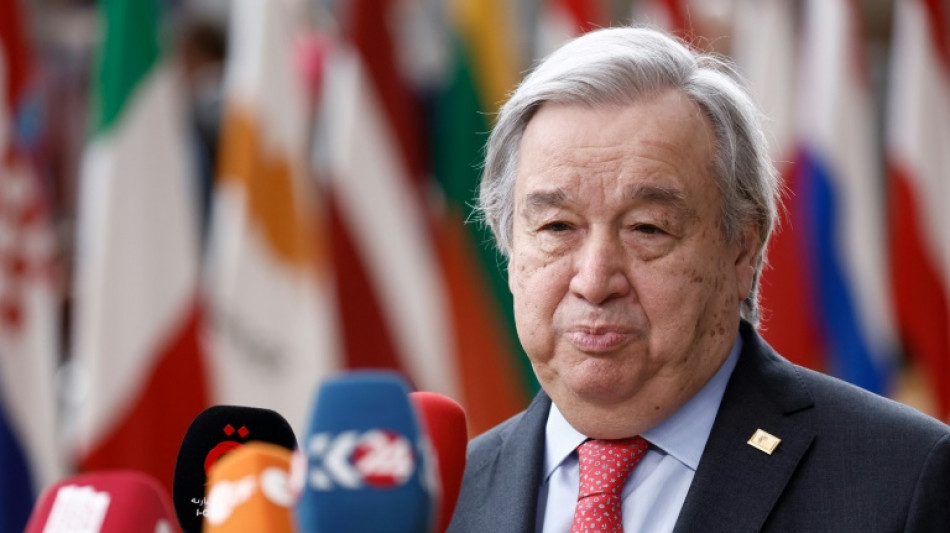
UN Secretary-General Antonio Guterres on Friday delivered an urgent call for the world to modify and safeguard water resources to avert conflict and ensure future global prosperity.
Water is "the most precious common good," and "needs to be at the center of the global political agenda," Guterres said at the end of a three-day UN conference that experts said held a measure of promise.
"All of humanity's hopes for the future depend, in some way, on charting a new science-based course to bring the water action agenda to life," Guterres said.
"Now is the time to act."
The world is not on track to meet its 2030 water goals, including access to safe drinking water and sanitation for all.
Guterres earlier in the week described water as humanity's "lifeblood" and said its "vampiric overconsumption" had "broken the water cycle" and led to more natural disasters.
NGOs, governments and the private sector offered nearly 700 commitments before and during the three days of the UN gathering that drew some 10,000 participants. Pledges ranged from the construction of toilets to the restoration of 300,000 kilometers (186,400 miles) of degraded rivers and massive areas of wetlands.
Less than a third of the commitments have funding said Charles Iceland of the World Resources Institute think tank, adding that about a third "are going to have substantial impact."
Despite this, "these voluntary commitments are a good start," he told AFP, referring in particular to a project led by Germany on the management of the Niger River basin which touches nine nations in Africa.
- 'Pleasantly surprised' -
"It's probably the part of the world that is the most fragile, and where we're starting to see actual violent conflict over water between different groups," he said.
But at the global level, the issue of water "is a huge problem and one conference is not going to do it," Iceland added, pleading for annual conferences on water.
"You hear a lot of pledges," Stuart Orr of WWF told AFP. "But this feels somehow quite different."
While it "is not all rosy," Orr added, "a lot of the commitments that have been made this week are very good."
He said he was "pleasantly surprised," in part, at the variety of institutions and organizations now talking about water.
"This issue is not going away. The water issue is only going to get worse. And I think that's why everybody is starting to feel maybe now really is the time to get going," Orr said.
The conference pleaded for Guterres to appoint a UN special envoy for water, which the secretary-general says is under consideration.
Without a dedicated UN agency or global treaty, "water has no home here at the UN," said Henk Ovink, water envoy of the Netherlands, which was a coorganizer of the conference.
In 2020, two billion people were still without safe drinking water and 3.6 billion lacked access to safely managed sanitation services, including 494 million who had to relieve themselves in the open, according to the latest figures compiled by the UN-Water website.
At least two billion people drink water contaminated with feces, and 2.3 billion lack basic sanitation services -- conditions conducive to the spread of cholera, dysentery and polio.
While climate change makes droughts more frequent and intense, UN climate experts (IPCC) also estimate that about half of the world's population suffers from "severe" water shortages during at least part of the year.
A young Dutch woman, Aniek Moonen, addressed the conference as if she were speaking from the year 2050.
She suggested that the summit could be a pivotal moment for water management "to become more sustainable, equitable and just than ever before."
"This is the future speaking. Don't forget to listen," she told the delegates.
P.Sousa--PC