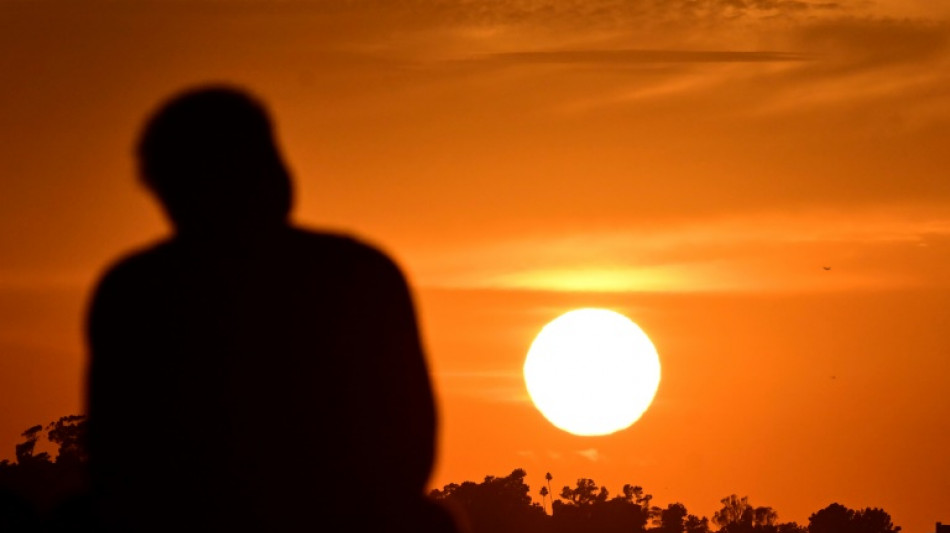
'Human-induced' climate change behind deadly Sahel heatwave: study / Photo: Frederic J. BROWN - AFP

 Ed Sheeran returns to stage after Palestinian controversy

 Asian Games to open in Japan after troubled build-up

 Drone owners rush to offload devices ahead of Beijing ban

 Trump's beef policies irk Texas ranchers, testing their loyalty

 Nvidia, OpenAI CEOs to attend Xi dinner at White House

 Anthropic picks Accenture for in-house AI safety evaluation

 Balogun returns as Monaco beat Lens to continue strong Ligue 1 start

 'Pause' on overt repression in Venezuela, but reforms still needed: HRW

 Global stocks mixed as yen falls despite Bank of Japan rate hike

 Cuba hit with seventh major blackout of the year

 Murray out with concussion so Wentz will start for Vikings

 UN chief 'deeply regrets' US visa refusal to Abbas for annual meeting

 England quick Carse to face no charges over alleged nightclub assault

 Mancini brings nine newcomers into the first squad of his Italy comeback

 Czechs level Davis Cup tie against USA as South Korea eye Finals

 New France boss Zidane confirms Mbappe as captain after naming first squad

 California governor signs order to explore AI 'kill switch'

 Head leads run spree as Australia win Zimbabwe ODI series

 In-form Raphinha wants to finish career at Barcelona

 Warren Buffett steps down as Berkshire Hathaway chairman

 Carrick confident Man Utd can 'work through' tough time

 Mbappe ends Nike partnership to join Swiss brand On

 Liverpool boss Iraola puts Bournemouth love affair on hold

 'A disaster' if Man City do not win says Maresca after flawless start
 Kerry James Marshall: American 'blackness' painter celebrated in Europe

The deadly heatwave that hit Africa's Sahel region in early April would not have occurred without human-induced climate change, according to a study by the World Weather Attribution (WWA) group published Thursday.
The West African nations of Mali and Burkina Faso experienced an exceptional heatwave from April 1 until April 5, with soaring temperatures above 45 degrees Celsius (113 degrees Fahrenheit) triggering many deaths.
Observations and climate models used by researchers at the WWA showed that "heatwaves with the magnitude observed in March and April 2024 in the region would have been impossible to occur without the global warming of 1.2C to date", which scientists attribute to human-induced climate change.
While periods of high temperatures are common in the Sahel at this time of year, the report said that the April heatwave would have been 1.4C cooler "if humans had not warmed the planet by burning fossil fuels".
It added that the five days of extreme heat was a once-in-a-200-year event, but that "these trends will continue with future warming".
The length and severity of the extreme heat led to an increase in the number of deaths and hospitalisations in the two countries, despite their populations being acclimatised to high temperatures, the WWA said.
- Deaths in heatwave -
A lack of data in the affected countries made it impossible to know the exact number of deaths, the WWA said, adding there were likely hundreds, if not thousands, of other heat-related casualties.
"From April 1 to 4, we saw an increase in the use of services," Djibo Mahamane Diango, head of anaesthesia at Gabriel Toure hospital in the capital Bamako, told reporters on April 5.
He said the hospital had seen the arrival of 102 bodies -- more than half of them people aged over 60 -- during the first four days of this month.
That compares with 130 for the whole of the month of April the previous year, he added.
The April heatwave in Mali -- where the temperature spiked at 48.5 degrees Celsius -- and neighbouring Burkina Faso coincided with the holy month of Ramadan when Muslims fast from dawn until dusk.
It also came during power outages which restricted the use of fans and air conditioning and affected health services.
The national blood transfusion centre in Bamako had called on medical centres to suspend any non-essential transfusions because of daily power shutdowns lasting more than 12 hours a day.
Mali often suffers from electricity cuts partly due to the state of disrepair of its power stations.
Countries in the Sahel region have had to contend with drought since the 1970s, as well as periods of intense rainfall from the 1990s.
The dwindling availability of water and pasture, compounded by the development of agricultural land, has disrupted the lives of pastoral populations and encouraged the emergence of armed groups that have extended their hold over vast swathes of territory in Mali, Burkina Faso and Niger.
Ferreira--PC