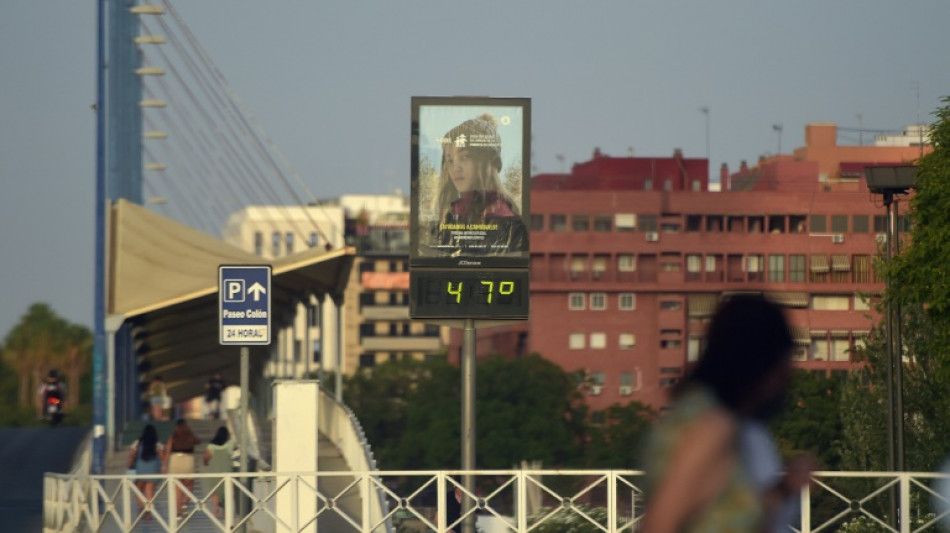
Every heatwave enhanced by climate change: experts / Photo: CRISTINA QUICLER - AFP/File

 Trump's beef policies irk Texas ranchers, testing their loyalty

 Nvidia, OpenAI CEOs to attend Xi dinner at White House

 Anthropic picks Accenture for in-house AI safety evaluation

 Balogun returns as Monaco beat Lens to continue strong Ligue 1 start

 'Pause' on overt repression in Venezuela, but reforms still needed: HRW

 Global stocks mixed as yen falls despite Bank of Japan rate hike

 Cuba hit with seventh major blackout of the year

 Murray out with concussion so Wentz will start for Vikings

 UN chief 'deeply regrets' US visa refusal to Abbas for annual meeting

 England quick Carse to face no charges over alleged nightclub assault

 Mancini brings nine newcomers into the first squad of his Italy comeback

 Czechs level Davis Cup tie against USA as South Korea eye Finals

 New France boss Zidane confirms Mbappe as captain after naming first squad

 California governor signs order to explore AI 'kill switch'

 Head leads run spree as Australia win Zimbabwe ODI series

 In-form Raphinha wants to finish career at Barcelona

 Warren Buffett steps down as Berkshire Hathaway chairman

 Carrick confident Man Utd can 'work through' tough time

 Mbappe ends Nike partnership to join Swiss brand On

 Liverpool boss Iraola puts Bournemouth love affair on hold

 'A disaster' if Man City do not win says Maresca after flawless start

 Kerry James Marshall: American 'blackness' painter celebrated in Europe

 Spain coach De la Fuente offers 'full support' to people of Ceuta

 Russia seizes assets of Nestle, French firms over West's Ukraine support

 England can build on World Cup 'spirit', says Tuchel

All heatwaves today bear the unmistakable and measurable fingerprint of global warming, top experts on quantifying the impact of climate change on extreme weather said Wednesday.
Burning fossil fuels and destroying forests have released enough greenhouse gases into the atmosphere to also boost the frequency and intensity of many floods, droughts, wildfires and tropical storms, they detailed in a state-of-science report.
"There is no doubt that climate change is a huge game changer when it comes to extreme heat," Friederike Otto, a scientist at Imperial College London's Grantham Institute, told AFP.
Extreme hot spells such as the heatwave that gripped South Asia in March and April are already the most deadly of extreme events, she added.
"Every heatwave in the world is now made stronger and more likely to happen because of human-caused climate change," Otto and co-author Ben Clarke of the University of Oxford said in the report, presented as a briefing paper for the news media.
Evidence of global warming's impact on extreme weather has been mounting for decades, but only recently has it been possible to answer the most obvious of questions: To what extent was a particular event caused by climate change?
The most scientists could say before is that an unusually severe hurricane, flood or heatwave was consistent with general predictions of how global warming would eventually influence weather.
News media, meanwhile, sometimes left climate change out of the picture altogether or, at the other extreme, mistakenly attributed a weather disaster entirely to rising temperatures.
With more data and better tools, however, Otto and other pioneers of a field known as event attribution science have been able to calculate -- sometimes in near realtime -- how much more likely or intense a particular storm or hot spell has become due to global warming.
- Courtroom evidence -
Otto and colleagues in the World Weather Attribution (WWA) consortium, for example, concluded that the heatwave that gripped western North America last June -- sending temperatures in Canada to a record 49.6 C (121 F) -- would have been "virtually impossible" without human-induced climate change.
A heatwave that scorched India and Pakistan last month is still under review, Otto told AFP, but the larger picture is frighteningly clear.
"What we see right now in terms of extreme heat will be very normal, if not cool, in a 2-degree to 3-degree Celsius world," she said, referring to average global temperatures above preindustrial levels.
The world has warmed nearly 1.2C so far.
That increase made record-setting rainfall and flooding last July in Germany and Belgium that left more than 200 dead up to nine times more likely, the WWA found.
But global warming is not always to blame.
A two-year drought in southern Madagascar leading to near famine conditions attributed by the UN to climate change was in fact a product of natural variability in the weather, experts reported.
Quantifying the impact of global warming on extreme weather events using peer-reviewed methods has real-world policy implications.
Attribution studies, for example, have been used as evidence in landmark climate litigation in the United States, Australia and Europe.
In one case set to resume later this month, Saul Luciano Lliuya v. RWE AG, a Peruvian farmer is suing the German energy giant for the costs of preventing harmful flooding from a glacial lake destabilised by climate change.
A scientific assessment entered into evidence concluded that human-caused global warming is directly responsible for creating a "critical threat" of a devastating outburst, putting a city of some 120,000 people in the path of potential floodwaters.
Ferreira--PC