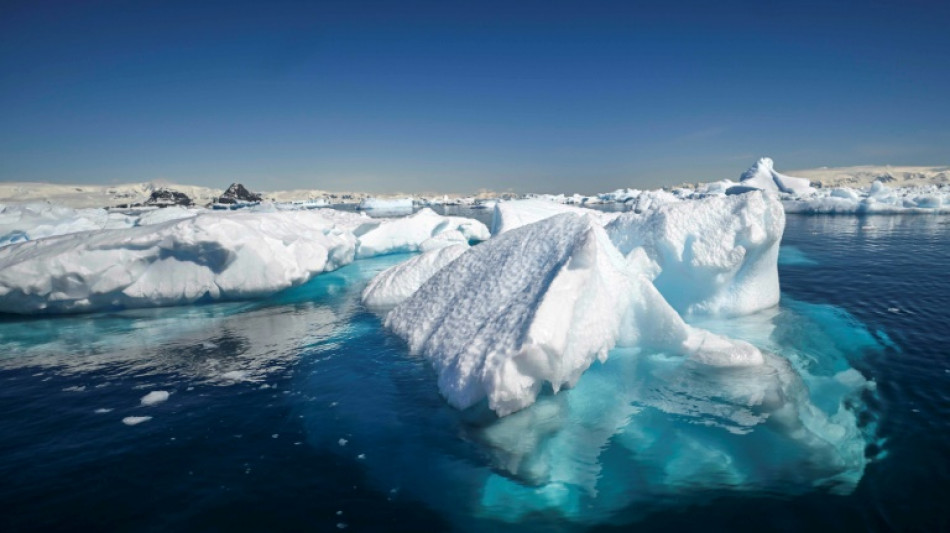
Melting ice could slow vital Antarctic ocean current: study / Photo: Juan BARRETO - AFP

 Ed Sheeran returns to stage after Palestinian controversy

 Asian Games to open in Japan after troubled build-up

 Drone owners rush to offload devices ahead of Beijing ban

 Trump's beef policies irk Texas ranchers, testing their loyalty

 Nvidia, OpenAI CEOs to attend Xi dinner at White House

 Anthropic picks Accenture for in-house AI safety evaluation

 Balogun returns as Monaco beat Lens to continue strong Ligue 1 start

 'Pause' on overt repression in Venezuela, but reforms still needed: HRW

 Global stocks mixed as yen falls despite Bank of Japan rate hike

 Cuba hit with seventh major blackout of the year

 Murray out with concussion so Wentz will start for Vikings

 UN chief 'deeply regrets' US visa refusal to Abbas for annual meeting

 England quick Carse to face no charges over alleged nightclub assault

 Mancini brings nine newcomers into the first squad of his Italy comeback

 Czechs level Davis Cup tie against USA as South Korea eye Finals

 New France boss Zidane confirms Mbappe as captain after naming first squad

 California governor signs order to explore AI 'kill switch'

 Head leads run spree as Australia win Zimbabwe ODI series

 In-form Raphinha wants to finish career at Barcelona

 Warren Buffett steps down as Berkshire Hathaway chairman

 Carrick confident Man Utd can 'work through' tough time

 Mbappe ends Nike partnership to join Swiss brand On

 Liverpool boss Iraola puts Bournemouth love affair on hold

 'A disaster' if Man City do not win says Maresca after flawless start

 Kerry James Marshall: American 'blackness' painter celebrated in Europe

The world's strongest ocean current could slow as melting Antarctic ice sheets flood it with fresh water, according to research published on Monday that warned of "severe" climate consequences.
Scientists used one of Australia's most powerful supercomputers to model how melting ice sheets might change the Antarctic Circumpolar Current, which plays a major role in global climate patterns.
If fossil fuel emissions increased over the next 25 years -- a so-called high emissions scenario -- the current could slow by around 20 percent, the peer-reviewed research found.
"The ocean is extremely complex and finely balanced," said University of Melbourne scientist Bishakhdatta Gayen.
"If this current 'engine' breaks down, there could be severe consequences, including more climate variability -- with greater extremes in certain regions, and accelerated global warming due to a reduction in the ocean's capacity to act as a carbon sink."
The Antarctic Circumpolar Current acted as a kind of "ocean conveyor belt" shifting immense columns of water through the Indian, Atlantic and Pacific Oceans, Gayen said.
Melting ice sheets would "dump vast quantities of fresh water" into the current, the modelling found.
This would change the ocean's salt content, making it harder for cold water to circulate between the surface and the depths.
Oceans play vital roles as climate regulators and carbon sinks.
Cooler waters can absorb greater amounts of heat from the atmosphere.
The strength of the current -- which flows clockwise around Antarctica -- also acts as a barrier that stops invasive species washing up on the continent's shores.
Algae and molluscs could more easily colonise Antarctica if the current slowed down, the researchers wrote.
Even if global warming was limited to a threshold of 1.5 degrees Celsius, the Antarctic current could still slow down.
"The 2015 Paris Agreement aimed to limit global warming to 1.5 degrees Celsius above pre-industrial levels," said climate scientist and co-author Taimoor Sohail.
"Many scientists agree that we have already reached this 1.5 degree target, and it is likely to get hotter, with flow-on impacts on Antarctic ice melting."
The research team, which included scientists from Australia, India and Norway, noted that their findings contrasted with previous studies that observed the current speeding up.
They said further observation and modelling was needed to understand how the "poorly observed region" was responding to climate change.
The research was published in the Environmental Research Letters journal.
F.Cardoso--PC