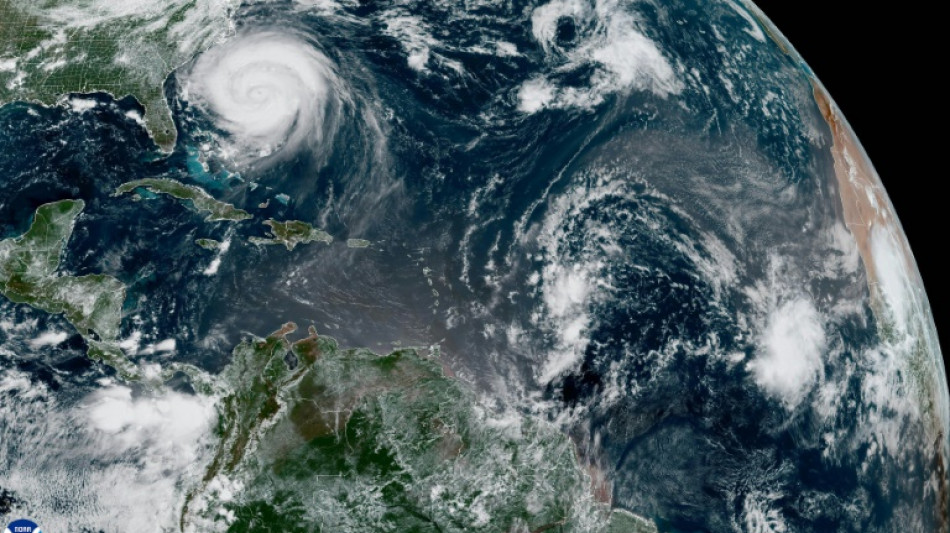
North Carolina braces for flooding from 'Enormous' Erin / Photo: Handout - NOAA/AFP

 Drone owners rush to offload devices ahead of Beijing ban

 Trump's beef policies irk Texas ranchers, testing their loyalty

 Nvidia, OpenAI CEOs to attend Xi dinner at White House

 Anthropic picks Accenture for in-house AI safety evaluation

 Balogun returns as Monaco beat Lens to continue strong Ligue 1 start

 'Pause' on overt repression in Venezuela, but reforms still needed: HRW

 Global stocks mixed as yen falls despite Bank of Japan rate hike

 Cuba hit with seventh major blackout of the year

 Murray out with concussion so Wentz will start for Vikings

 UN chief 'deeply regrets' US visa refusal to Abbas for annual meeting

 England quick Carse to face no charges over alleged nightclub assault

 Mancini brings nine newcomers into the first squad of his Italy comeback

 Czechs level Davis Cup tie against USA as South Korea eye Finals

 New France boss Zidane confirms Mbappe as captain after naming first squad

 California governor signs order to explore AI 'kill switch'

 Head leads run spree as Australia win Zimbabwe ODI series

 In-form Raphinha wants to finish career at Barcelona

 Warren Buffett steps down as Berkshire Hathaway chairman

 Carrick confident Man Utd can 'work through' tough time

 Mbappe ends Nike partnership to join Swiss brand On

 Liverpool boss Iraola puts Bournemouth love affair on hold

 'A disaster' if Man City do not win says Maresca after flawless start

 Kerry James Marshall: American 'blackness' painter celebrated in Europe

 Spain coach De la Fuente offers 'full support' to people of Ceuta

 Russia seizes assets of Nestle, French firms over West's Ukraine support

Hurricane Erin was nearing North Carolina's coast Wednesday, threatening huge waves and flooding as the strengthening Category 2 storm triggered mandatory evacuation orders despite its offshore path.
The US state, still reeling from last year's deadly Hurricane Helene, declared an emergency Tuesday as Erin's impacts were predicted to begin from Wednesday evening through Thursday.
"Based on the current forecast, we are anticipating coastal flooding from massive waves, tropical storm force winds and tidal and storm surge for much of the state shoreline, especially the Outer Banks, from this evening through Thursday," Governor Josh Stein told reporters.
As of Wednesday afternoon, Erin was churning northward some 300 miles southeast of North Carolina, packing maximum sustained winds of 110 mph (175 kph), according to the National Hurricane Center -- with the possibility it could still restrengthen to a major hurricane.
Its unusually large size means tropical storm-force winds extend hundreds of miles from its center, earning it the moniker "Enormous Erin" by hurricane specialist Michael Lowry, who wrote on Substack the US was fortunate to be spared a direct hit.
Erin's low pressure of around 940 millibars at its center is "remarkably low" and a more telling indicator of its destructive potential than wind speed, Lowry added.
Mandatory evacuation orders were issued for Ocracoke and Hatteras Islands. Parts of North Carolina to Virginia were under a tropical storm warning.
Stein urged residents to pack enough food, water and supplies to last up to five days -- and to safeguard important documents like insurance policies.
"We have already pre-positioned three swift water rescue teams and 200 National Guard troops to various locations on the coast, along with boats, high clearance vehicles and aircraft," he added.
- 'Massive' waves -
Highway 12 -- which runs through the scenic Outer Banks, a string of low-lying islands and spits already under threat from sea-level rise and erosion -- could be left impassable by waves as high as 20 feet (six meters).
Last year's Hurricane Helene caused approximately $60 billion in damage to North Carolina, equivalent to almost two years of the state's budget, said Stein, who criticized what he called inadequate federal assistance from the administration of President Donald Trump.
Trump has mused about dismantling the Federal Emergency Management Agency, which has long been a target of conspiracy theories from the political right.
Beyond the flooding risks in North Carolina, nearly the whole of the US East Coast meanwhile is threatened by rip currents, powerful surges that run against the tide.
- Insurance risks -
The Atlantic hurricane season, which runs from June 1 to November 30, has entered its historical peak.
Despite a relatively quiet start with just four named storms so far, the National Oceanic and Atmospheric Administration continues to forecast an above-normal season.
Scientists say climate change is supercharging tropical cyclones: warmer oceans fuel stronger winds, a warmer atmosphere intensifies rainfall, and higher sea levels magnify storm surge.
There is also some evidence, though less certainty, that climate change is making hurricanes more frequent.
A.Aguiar--PC