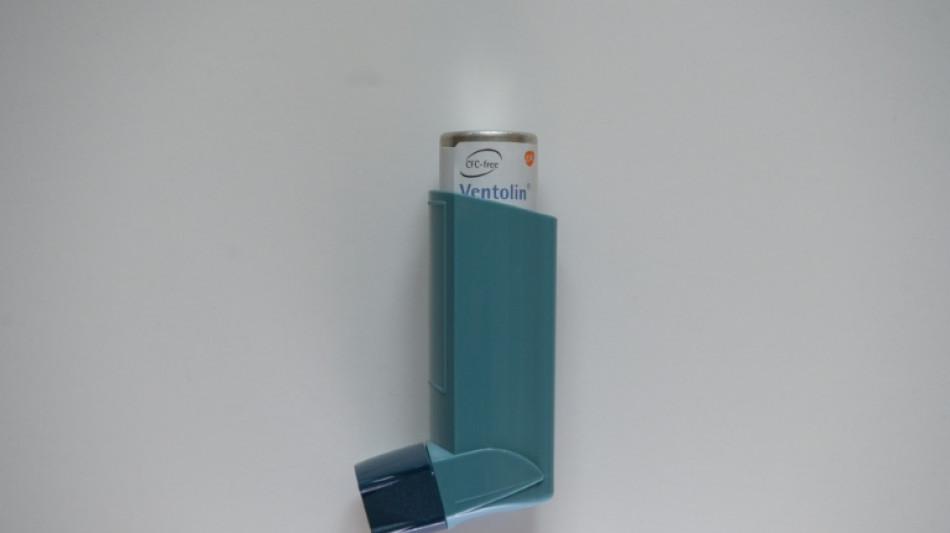
Common inhalers carry heavy climate cost, study finds / Photo: Anthony WALLACE - AFP/File

 Drone owners rush to offload devices ahead of Beijing ban

 Trump's beef policies irk Texas ranchers, testing their loyalty

 Nvidia, OpenAI CEOs to attend Xi dinner at White House

 Anthropic picks Accenture for in-house AI safety evaluation

 Balogun returns as Monaco beat Lens to continue strong Ligue 1 start

 'Pause' on overt repression in Venezuela, but reforms still needed: HRW

 Global stocks mixed as yen falls despite Bank of Japan rate hike

 Cuba hit with seventh major blackout of the year

 Murray out with concussion so Wentz will start for Vikings

 UN chief 'deeply regrets' US visa refusal to Abbas for annual meeting

 England quick Carse to face no charges over alleged nightclub assault

 Mancini brings nine newcomers into the first squad of his Italy comeback

 Czechs level Davis Cup tie against USA as South Korea eye Finals

 New France boss Zidane confirms Mbappe as captain after naming first squad

 California governor signs order to explore AI 'kill switch'

 Head leads run spree as Australia win Zimbabwe ODI series

 In-form Raphinha wants to finish career at Barcelona

 Warren Buffett steps down as Berkshire Hathaway chairman

 Carrick confident Man Utd can 'work through' tough time

 Mbappe ends Nike partnership to join Swiss brand On

 Liverpool boss Iraola puts Bournemouth love affair on hold

 'A disaster' if Man City do not win says Maresca after flawless start

 Kerry James Marshall: American 'blackness' painter celebrated in Europe

 Spain coach De la Fuente offers 'full support' to people of Ceuta

 Russia seizes assets of Nestle, French firms over West's Ukraine support

The inhalers people depend on to breathe are also warming the planet, producing annual emissions equivalent to more than half a million cars in the United States alone, researchers said Monday in a major new study.
Using a national drug database, researchers at the University of California, Los Angeles and Harvard analyzed global warming pollution from three types of inhalers used to treat asthma and chronic obstructive pulmonary disease (COPD) between 2014 and 2024.
The study, published in the Journal of the American Medical Association, found that inhalers used by US patients with commercial insurance and the government-run programs Medicaid and Medicare generated 24.9 million metric tons of carbon dioxide equivalent over the decade.
Metered-dose inhalers, or "puffers," were by far the most damaging, accounting for 98 percent of emissions. They use pressurized canisters containing hydrofluoroalkane (HFA) propellants -- potent greenhouse gases -- to deliver medication.
By contrast, dry powder and soft mist inhalers don't use propellants. The former rely on a patient's breath to release medicine, and the latter turn liquid into a fine spray -- making both far less harmful to the planet.
"Five hundred and thirty thousand cars on the road each year is a lot, and I think this is a really important topic because it's fixable -- there are easy ways to reduce emissions," lead author William Feldman, a pulmonologist and researcher at UCLA, told AFP.
Medically, only a small fraction of patients require metered-dose inhalers.
Very young children need spacers -- valved chambers that help deliver medicine to the lungs -- and these only work with metered-dose devices. Frail older adults with weak lungs may also need puffers because they can't generate enough inhalation force.
"But the vast majority of people could use dry powder or soft mist inhalers," Feldman said, noting that countries such as Sweden and Japan use alternative inhalers without any loss in health outcomes.
- Insurance barriers -
The slower US uptake of greener inhalers, he added, stems from insurance and market barriers.
A dry-powder version of albuterol, the most commonly used inhaler drug, exists but is often not covered by insurance, making it more expensive. Another drug, budesonide-formoterol, is widely sold in dry-powder form in Europe, which is not available in the United States.
Feldman emphasized that the goal of the research is not to blame patients but to highlight the need for policy and pricing reform.
"We absolutely do not want to stigmatize patients with asthma and COPD," he said.
"I think it's incumbent upon us as a society to get those medications to the patients in a sustainable way, and that ultimately falls to the highest levels."
A related JAMA commentary authored by Alexander Rabin of the University of Michigan and others echoed that insurers and policymakers must ensure lower-emission inhalers are affordable and accessible for all.
They warned that several new low-global-warming metered-dose inhalers are expected to launch in the US as high-priced brand-name products, "raising the risk that patients without robust insurance coverage...could be left behind."
T.Resende--PC