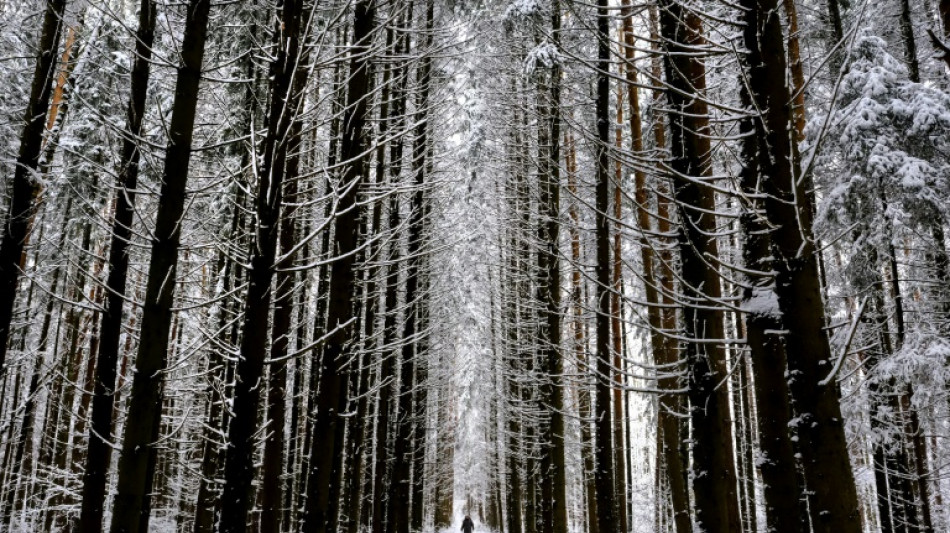
UN says forests should form key plank of COP30 / Photo: Yuri KADOBNOV - AFP

 Drone owners rush to offload devices ahead of Beijing ban

 Trump's beef policies irk Texas ranchers, testing their loyalty

 Nvidia, OpenAI CEOs to attend Xi dinner at White House

 Anthropic picks Accenture for in-house AI safety evaluation

 Balogun returns as Monaco beat Lens to continue strong Ligue 1 start

 'Pause' on overt repression in Venezuela, but reforms still needed: HRW

 Global stocks mixed as yen falls despite Bank of Japan rate hike

 Cuba hit with seventh major blackout of the year

 Murray out with concussion so Wentz will start for Vikings

 UN chief 'deeply regrets' US visa refusal to Abbas for annual meeting

 England quick Carse to face no charges over alleged nightclub assault

 Mancini brings nine newcomers into the first squad of his Italy comeback

 Czechs level Davis Cup tie against USA as South Korea eye Finals

 New France boss Zidane confirms Mbappe as captain after naming first squad

 California governor signs order to explore AI 'kill switch'

 Head leads run spree as Australia win Zimbabwe ODI series

 In-form Raphinha wants to finish career at Barcelona

 Warren Buffett steps down as Berkshire Hathaway chairman

 Carrick confident Man Utd can 'work through' tough time

 Mbappe ends Nike partnership to join Swiss brand On

 Liverpool boss Iraola puts Bournemouth love affair on hold

 'A disaster' if Man City do not win says Maresca after flawless start

 Kerry James Marshall: American 'blackness' painter celebrated in Europe

 Spain coach De la Fuente offers 'full support' to people of Ceuta

 Russia seizes assets of Nestle, French firms over West's Ukraine support

The United Nations warned Wednesday that climate change poses a threat to the world's northern forests, saying it was putting the planet's most powerful natural defence at serious risk.
The UNECE regional agency urged the forthcoming COP30 climate summit to put forest resilience at the centre of efforts to combat global warming.
"The forests of the northern hemisphere are of crucial importance when it comes to climate," said Paola Deda, UNECE's forests division director.
"Over the years, the attention to forests in COPs has been lost. The technicalities of the discussion have taken over," she told a press conference in Geneva.
"You cannot talk about climate solutions, mitigation and adaptation without talking about forests."
Some 54 percent of the world’s forests are in only five countries: Brazil, China, Canada, Russia and the United States, with the latter three in the UNECE region, and Russia having the biggest forest area of all.
UNECE covers 56 countries across Europe, North America, the Caucasus and central Asia.
Its 2025 Forest Profile is a five-yearly overview that measures and monitors the ecological, economic and socioeconomic condition of the region's forests, to inform policy.
Forests cover 4.14 billion hectares (10.23 billion acres), or around a third of the world's land surface, of which 42.5 percent is in the UNECE area.
Half of the forest loss in the past 10,000 years happened since 1900, the report said.
- 'Tipping point' -
Although the world's forest area has shrunk by 203 million hectares since 1990, in the UNECE region it has grown by around 60 million hectares -- an area roughly as big as France.
However, these gains "are now being jeopardised by record wildfires, pests, and an escalating climate-driven crisis", UNECE warned.
It said the region's forests were growing increasingly vulnerable to such threats.
The report said wildfires had become more severe and more common, fuelled by rising temperatures and drier conditions, while insect outbreaks have severely damaged millions of hectares of forests.
"What we have achieved over the last three decades is now at serious risk from the climate emergency," UNECE chief Tatiana Molcean said in a statement.
"We cannot afford to lose the planet's most powerful natural defence. The rising tide of wildfires and drought is pushing our forests past a critical tipping point."
Leaders at the COP30 UN climate summit in Belem, Brazil, which runs from November 10 to 21, "must recognise that forest protection... is a cornerstone of global carbon security," said Molcean.
- Forest management -
Boreal forests -- roughly in a ring around the Arctic Circle, notably in Russia and Canada -- cover 9.3 percent of the planet's land surface.
They contain about 32 percent of global terrestrial carbon stocks, with boreal soils holding "vast amounts of carbon", said UNECE.
However, "they are highly sensitive to climate impacts, including rising temperatures, thawing permafrost and wildfires", it said.
The fear is that the region's vast forests -- currently a carbon sink -- could become a net source of emissions.
Kathy Abusow, president of the Sustainable Forestry Initiative, said: "There is a solution: if we can manage our forests in climate-informed ways", such as changing the tree species to reflect the new environmental conditions.
UNECE stressed the need for fire prevention, pest management and forest restoration. Thinning out forests and clearing out deadwood can also help make them less vulnerable to catastrophic wildfires that become major carbon emitters.
P.Queiroz--PC