Indonesia coal plant closure U-turn sows energy transition doubts / Photo: BAY ISMOYO - AFP

 Trump's beef policies irk Texas ranchers, testing their loyalty

 Nvidia, OpenAI CEOs to attend Xi dinner at White House

 Anthropic picks Accenture for in-house AI safety evaluation

 Balogun returns as Monaco beat Lens to continue strong Ligue 1 start

 'Pause' on overt repression in Venezuela, but reforms still needed: HRW

 Global stocks mixed as yen falls despite Bank of Japan rate hike

 Cuba hit with seventh major blackout of the year

 Murray out with concussion so Wentz will start for Vikings

 UN chief 'deeply regrets' US visa refusal to Abbas for annual meeting

 England quick Carse to face no charges over alleged nightclub assault

 Mancini brings nine newcomers into the first squad of his Italy comeback

 Czechs level Davis Cup tie against USA as South Korea eye Finals

 New France boss Zidane confirms Mbappe as captain after naming first squad

 California governor signs order to explore AI 'kill switch'

 Head leads run spree as Australia win Zimbabwe ODI series

 In-form Raphinha wants to finish career at Barcelona

 Warren Buffett steps down as Berkshire Hathaway chairman

 Carrick confident Man Utd can 'work through' tough time

 Mbappe ends Nike partnership to join Swiss brand On

 Liverpool boss Iraola puts Bournemouth love affair on hold

 'A disaster' if Man City do not win says Maresca after flawless start

 Kerry James Marshall: American 'blackness' painter celebrated in Europe

 Spain coach De la Fuente offers 'full support' to people of Ceuta

 Russia seizes assets of Nestle, French firms over West's Ukraine support

 England can build on World Cup 'spirit', says Tuchel

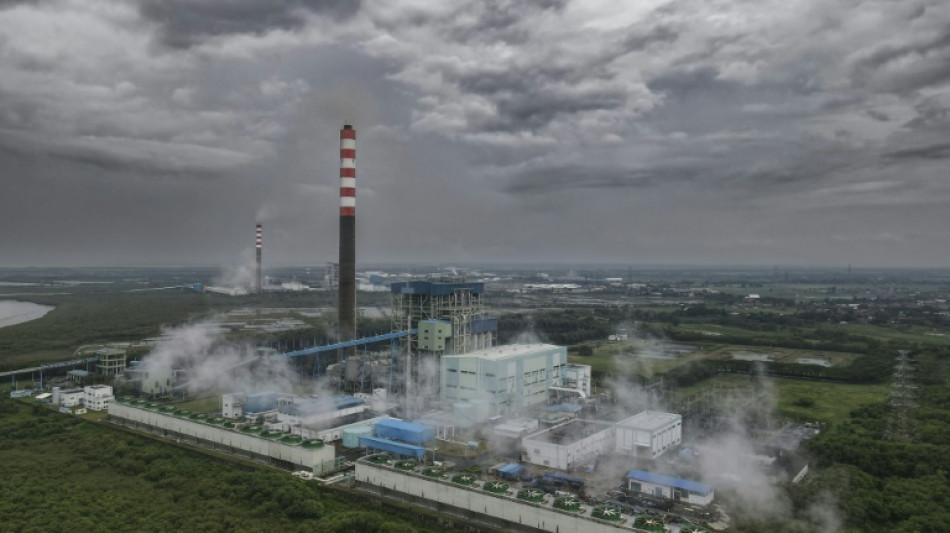
Indonesian villager Supriyanto is visibly frustrated as he discusses the sprawling coal power plant emitting white plumes of smoke over his small fishing community.
The Cirebon-1 plant was supposed to be in its final years, with its closure set for early 2035, as part of Indonesia's plans to wean itself from polluting coal with international support.
But a reversal last year cast fresh doubts on Jakarta's energy transition plans and dashed the hopes of locals who blame the plant for environmental and health problems.
Supriyanto, 32, is a green mussel trader and once bought from local fishermen who harvested the shellfish offshore.
They say the mussels have disappeared because of the plant's wastewater.
"There should be goods (green mussels) from our own village, now there aren't," Supriyanto, who like many Indonesians goes by one name, told AFP.
"Why does it (Cirebon-1) have to be here?"
Sarjum, 46, who lives in another village in the Cirebon area, said the plant has also affected his seafood trade and forced him to look for other work.
"The power plant discharged hot water. So the fish don't come," the father-of-three told AFP.
The consortium that owns Cirebon Power said it follows government regulations and wastewater is expelled "in a clear, pure condition, at the same temperature as the seawater".
The 660-megawatt (MW) Cirebon-1 coal plant began operating in 2012 with a 30-year contract. A second 1,000 MW facility started operation in 2023.
Cirebon-1 was picked for early retirement as a flagship project of a $20-billion international deal to help Indonesia phase out coal.
The 2022 Just Energy Transition Partnership (JETP) was supposed to channel funding from rich nations to help emerging economies green their grids.
But critics say there has been little progress.
Funding has grown to $21.8 billion, but only around $3.4 billion of that has been made available, Indonesia's government said earlier this month.
Last year, Washington withdrew altogether, with Germany stepping up to co-lead with Japan.
But the framework is in "deadlock", Center of Economic and Law Studies executive director Bhima Yudhistira Adhinegara said.
That is partly because several partners have their own energy transition schemes, like Japan's Asia Zero Emission Community.
"It means that each country is not placing their priority on the JETP itself," he told AFP, suggesting the deal should be "reformulated" with greater emphasis on local communities.
- 'Mixed signal' -
In 2024, Indonesian President Prabowo Subianto committed to phasing out fossil fuel power plants over the next 15 years.
But in December, the government said it would keep Cirebon-1 open, citing its long potential lifespan and "supercritical" technology, which burns coal more efficiently than older plants.
It said it would seek older and less efficient plants to close instead.
The government likely feared rising electricity prices because funding for replacement capacity remains uncertain, said Fabby Tumiwa, executive director of the Institute for Essential Services Reform (IESR) think-tank.
"The funds to build infrastructure to replace the coal plant are not all available now," he told AFP.
The move sent a "mixed signal" on the government's commitment, said Dinita Setyawati, Asia energy analyst at energy think-tank Ember.
It also highlights the need for funding to build "cleaner, alternative power plants to satisfy the energy needs", she said.
That might be better achieved with a "market-led energy transition", including deregulation of electricity distribution and perhaps subsidies, Dinita added.
Indonesia was the second country to sign a JETP after South Africa with the framework later applied in both Vietnam and Senegal.
There have been persistent criticisms, however, that the funding is difficult to access or offered as market-rate loans that risk creating debt traps.
Coal generates nearly 70 percent of Indonesia's electricity with state power firm PLN projecting 16.6 gigawatts in new coal and gas power capacity by 2034, according to a Centre for Research on Energy and Clean Air (CREA) study.
Captive coal plants supplying industrial sites will add 31 GW more, CREA said.
- Health problems -
Around Cirebon-1, many residents describe increased respiratory problems since operations began, and a CREA study linked air pollutant emissions from the plant to over 400 deaths annually.
The plant's owner insists it adheres to required emission thresholds, but the government's closure U-turn has left some locals disheartened.
"We no longer believe what the government says," said local activist Mohammad Aan Anwaruddin, who has lobbied for its closure.
Plans to close Cirebon-1 have stirred up mixed emotions, especially for those employed at the facility.
"I'm not a hypocrite. I'm the breadwinner, earning my living there for my wife and children," Sopian Suputra, who works as a security guard at the plant, said.
Sarjum said he will continue to campaign for the plant's closure, fearing for his children and grandchildren's health.
"I think its killing Cirebon people slowly."
A.Motta--PC