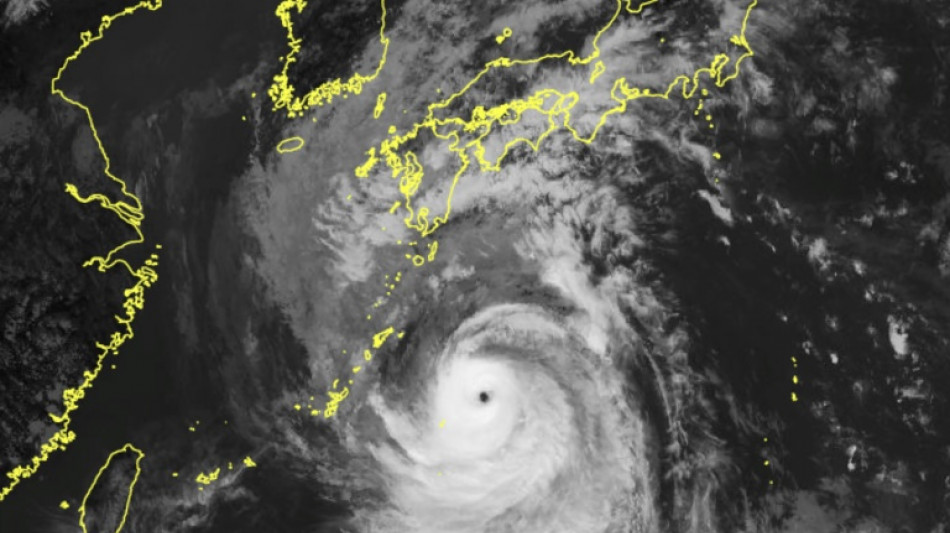
Millions told to seek shelter as Japan warns on Typhoon Nanmadol / Photo: Handout - Japan Meteorological Agency/AFP

 Trump's beef policies irk Texas ranchers, testing their loyalty

 Nvidia, OpenAI CEOs to attend Xi dinner at White House

 Anthropic picks Accenture for in-house AI safety evaluation

 Balogun returns as Monaco beat Lens to continue strong Ligue 1 start

 'Pause' on overt repression in Venezuela, but reforms still needed: HRW

 Global stocks mixed as yen falls despite Bank of Japan rate hike

 Cuba hit with seventh major blackout of the year

 Murray out with concussion so Wentz will start for Vikings

 UN chief 'deeply regrets' US visa refusal to Abbas for annual meeting

 England quick Carse to face no charges over alleged nightclub assault

 Mancini brings nine newcomers into the first squad of his Italy comeback

 Czechs level Davis Cup tie against USA as South Korea eye Finals

 New France boss Zidane confirms Mbappe as captain after naming first squad

 California governor signs order to explore AI 'kill switch'

 Head leads run spree as Australia win Zimbabwe ODI series

 In-form Raphinha wants to finish career at Barcelona

 Warren Buffett steps down as Berkshire Hathaway chairman

 Carrick confident Man Utd can 'work through' tough time

 Mbappe ends Nike partnership to join Swiss brand On

 Liverpool boss Iraola puts Bournemouth love affair on hold

 'A disaster' if Man City do not win says Maresca after flawless start

 Kerry James Marshall: American 'blackness' painter celebrated in Europe

 Spain coach De la Fuente offers 'full support' to people of Ceuta

 Russia seizes assets of Nestle, French firms over West's Ukraine support

 England can build on World Cup 'spirit', says Tuchel

Two million people in Japan were told Saturday to seek shelter before the arrival of Typhoon Nanmadol, national broadcaster NHK said, as the weather agency issued a rare "special warning" about the powerful storm.
NHK, which compiles alerts issued by local authorities, said level four evacuation instructions -- the second highest -- were in place for people in Kagoshima, Kumamoto and Miyazaki in the southern Kyushu region.
The move came as the Japan Meteorological Agency issued its highest alert for the Kagoshima region, a warning that comes when it forecasts conditions only seen once in several decades.
It is the first typhoon-linked special warning issued outside of the Okinawa region since the current system began in 2013.
On Saturday evening, Typhoon Nanmadol was classed at the agency's top category of "violent", and was packing gusts of up to 270 kilometres (167 miles) as it hovered about 200 kilometres north-northeast of Minami Daito island, part of a string of remote isles that form the Okinawa region.
The storm is expected to approach or make landfall on Sunday in Kagoshima prefecture, then move north the following day before heading towards Japan's main island.
"There are risks of unprecedented storms, high waves, storm surges, and record rainfall," Ryuta Kurora, the head of the Japan Meteorological Agency's forecast unit, told reporters.
"Maximum caution is required," he said, urging residents to evacuate early.
"It's a very dangerous typhoon."
"The wind will be so fierce that some houses might collapse," Kurora told reporters, also warning of flooding and landslides.
The evacuation warnings call on people to move to shelter or alternative accommodation that can withstand extreme weather.
But they are not mandatory, and during past extreme weather events authorities have struggled to convince residents to take shelter quickly enough.
Kurora said even inside strong buildings, residents should take precautions.
"Please move into sturdy buildings before violent winds start to blow and stay away from windows even inside sturdy buildings," he told a late night press conference.
Japan is currently in typhoon season and faces around 20 such storms a year, routinely seeing heavy rains that cause landslides or flash floods.
In 2019, Typhoon Hagibis smashed into Japan as it hosted the Rugby World Cup, claiming the lives of more than 100 people.
A year earlier, Typhoon Jebi shut down Kansai Airport in Osaka, killing 14 people.
And in 2018, floods and landslides killed more than 200 people in western Japan during the country's annual rainy season.
Ahead of Typhoon Nanmadol's arrival, flight cancellations began to affect regional airports including those in Kagoshima, Miyazaki and Kumamoto, according to the websites of Japan Airlines and All Nippon Airways.
Scientists say climate change is increasing the severity of storms and causing extreme weather such as heat waves, droughts and flash floods to become more frequent and intense.
V.Fontes--PC