New movie turns spotlight on France's forgotten colonial troops / Photo: JOHN WESSELS - AFP

 Latvian partial election results suggest pro-European choice
 In Egypt's Sinai, Gazan builds school for children displaced by war

 Trump tariffs a mixed bag for US auto industry

 Yemen government forces say struck Houthi targets

 Music links past, present for Pedro Pascal's cellist in 'Behemoth!'

 ALEX BODI ȘI AMBASADORUL REPUBLICII SUDANUL DE SUD, GUM DOMINIC MATIOK, DISCUTĂ LA BERLIN DESPRE POSIBILITATEA ÎNFIINȚĂRII UNUI CONSULAT ONORIFIC LA BUCUREȘTI

 Dodgers step up World Series three-peat bid with 5-3 win over Braves

 Spain break down Czechs as England outclass Croatia in Nations League

 Yamal on target as Spain hold off Czech Republic

 Latvian exit polls suggest pro-European choice
 Lula, Bolsonaro wrap up campaigns ahead of knife-edge election
 Tuchel hails 'complete' England after Croatia demolition

 Fury to invite Trump to lead ring walk before Joshua showdown

 Fashion industry in 'precarious moment', says Vivienne Westwood supremo
 Seventh heaven for England in Nations League rout of Croatia
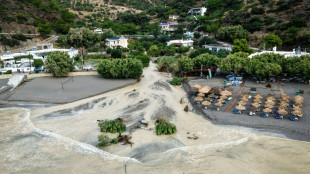 Storms, flooding cause chaos on Greek holiday island of Crete

 #IAmJaneDoe: online support campaign in US university rape case

 Brazil shine on Selecao's first visit to India
 Zverev sets up Djokovic quarter-final at China Open, Rybakina out
 Happier at home, Bordeaux hammer Lyon in Top 14
 Lula, Bolsonaro in final push for votes ahead of knife-edge election

 Boisterous fashion week barnstorms 'sleepy' Nigerian capital

 UAE investigators say flydubai co-pilot was planning 'terrorist act'
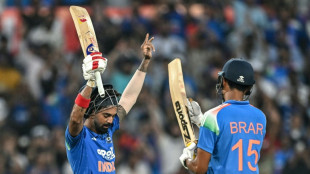 Rahul smacks century in India v Windies ODI

 Daryz seeks to join exclusive club of dual Arc winners
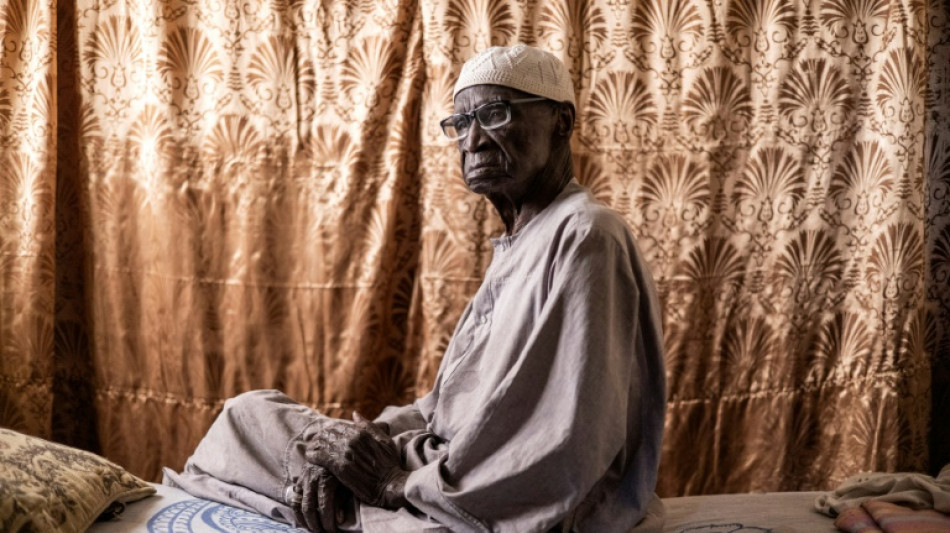
"They made us join up to wage war," said Ndiogou Dieye, 103, casting his memory back more than eight decades to when he and other young Senegalese donned uniforms to fight for distant France.
"We didn't know where we were going."
The wizened old soldier is one of the last survivors of France's colonial-era African infantry -- a force that fought in two world wars and colonial conflicts in North Africa and Indo-China.
After years of neglect, the troops are the subject of a blockbuster movie, "Tirailleurs," opening in France and Senegal this week, that stars Omar Sy -– best known internationally for the Netflix crime series "Lupin".
Sy plays a Senegalese father who voluntarily enlists in the French army in World War I to keep an eye on his son, who has been forced into uniform. Both are pitched into the horrors of the Western Front.
The "tirailleurs" -- loosely translatable as "skirmishers" -– were born in Senegal in 1857, to forge a corps of lightly armed, mobile troops who would harass the enemy ahead of an advancing main force.
After World War I broke out, France recruited across its West African colonies to transform the tirailleurs into a force designed to hammer the Germans on the Western Front.
They took part in several key battles, notably holding the line at a crucial moment in Verdun in 1916, arguably the most important battle in the four-year-long conflict.
- Toll -
Some 30,000 of the 134,000 tirailleurs who fought in WWI were killed, according to the specialist French magazine Historia.
Survivors were often crippled or scarred by trauma, yet their tale was often relegated to footnotes, and their names never featured on local war memorials in France -- the daily reminder to French people of the cost of the conflict.
High-sounding plans to provide hospitals and pensions were downgraded or sapped by bureaucracy, and tirailleurs sometimes suffered second-class treatment compared with their French counterparts.
In World War II, tens of thousands of tirailleurs fought in sub-Saharan and North Africa and took part in the 1944 landings in southern France.
Dieye said he was recruited in May 1940 in his home town of Thies, about 70 kilometres (45 miles) from Dakar, and joined the Seventh Regiment of tirailleurs.
After basic training near Dakar, his unit was shipped out to Madagascar but had to turn around because of a submarine threat.
It then headed to the French Congo and then to Gabon, where it liberated the capital Libreville from the collaborationist Vichy government "after a few shots," he said.
The regiment was sent to the Middle East to prepare for operations in Europe, but by then, Berlin had fallen.
Dieye returned to Senegal in 1945 as a sergeant, and in the post-colonial period joined the police, retiring in 1972 at the age of 52.
Today, he lives in a house in Thies surrounded by photos and memorabilia from his years of service.
- Anger -
Slow-moving but sharp-eyed, he is bitter towards France, accusing it of "dishonesty".
In December 1944, French troops at a barracks near Dakar opened fire on mutinous tirailleurs demanding back pay for years spent in prisoner-of-war camps.
The official toll of 35 dead is disputed, and the common grave where the soldiers were buried has never been found. The episode remains murky and bitterly remembered in Senegal despite an attempt by former French president Francois Hollande to shed light for reconciliation.
"You send someone to war, he claims his money and you punish him" by killing him, said Dieye, a tone of disgust in his voice.
He reserves his greatest anger for France's failure to pay his military pension, equivalent to 750 euros (dollars) annually, for the past two years.
"France hasn't kept its promise," he said. "I depend on the Good Lord and my children to survive. I get nothing as a former tirailleur. Zilch from France."
A source at the Veterans' Affairs Office at Senegal's armed forces ministry said that after military pensioners reach the age of 100, France usually requires documented proof that they are still alive.
Historian Mamadou Kone said he believed only 10 or so tirailleurs from World War II were still alive in Senegal. The last tirailleur from World War I, Abdoulaye Ndiaye, died in 1998 at the age of 104.
At home, tirailleurs were long "ostracized, considered armed enforcers of French imperialism. Their image was stained," said Kone.
Things changed in 2004, when then president Aboulaye Wade named December 1 as an annual day to commemorate the tirailleurs, enshrining their achievements "in two world wars which freed the world from Nazism and fascism," he said.
E.Paulino--PC