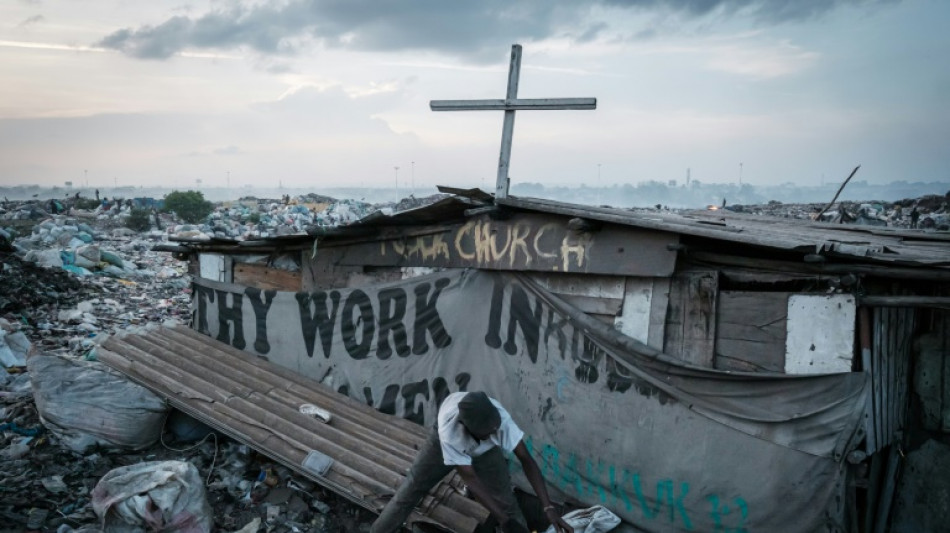
Donated clothing worsening Kenya's plastic pollution: report / Photo: YASUYOSHI CHIBA - AFP

 Asian Games set to close after records, rancour and rain

 Cry for help as French-Swiss lake dries up

 Sabalenka swept out of China Open in third round

 US urges 'restraint' as Ethiopia's Tigray crisis rocks region

 Teens on target again as USA down Mexico 3-0

 World records prove Asian Games were a hit, says top official

 US prison chief who oversaw botched execution resigns

 'Chaotic' Asian Games threaten Japan hopes of hosting Olympics again

 Finnish town braces for change from Google data centres

 What is fuelling French school protests?

 Without lawyers, migrant children face deportation from the US
 Three-peat seeking Dodgers open playoffs with a win, Rays hold off Yankees

 Brazil votes in nail-biter polls closely watched by Trump
 'Just be you': Kim reveals Tiger text that inspired him to gold

 Myanmar migrants returned to war-torn nation from Malaysia

 ALEX BODI AND AMBASSADOR GUM DOMINIC MATIOK OF THE REPUBLIC OF SOUTH SUDAN MEET IN BERLIN TO DISCUSS THE POSSIBILITY OF AN HONORARY CONSULATE IN BUCHAREST

 Lula, Bolsonaro wrap up campaigns ahead of Brazil's knife-edge vote

 Toulouse edge Castres in Top 14 derby

 Murakami homer propels White Sox to MLB playoff win over Guardians

 Israel targets top Hamas leader in deadly Gaza strike on anniversary

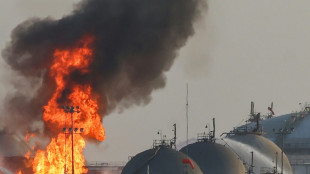 Houthis say struck oil facility near Riyadh, as Saudis hit Sanaa

 AI needs safety layers like nuclear plants: ex-OpenAI engineer

 MVP Judge will miss Yankees' MLB playoff series against Rays

 New lizard species discovered in Peru

 Fernandes hails Portugal's 'greatest symbol' Ronaldo, calls for unity

One third of all second-hand clothing shipped to Kenya in 2021 was "plastic waste in disguise", creating a slew of environmental and health problems for local communities, a new report said Thursday.
Every year, tonnes of donated clothing is sent to developing countries, but an estimated 30 percent of it ends up in landfills -- or flooding local markets where it can crowd out local production.
A new report shows that the problem is having grave consequences in Kenya, where some 900 million pieces of used clothing are sent every year, according to the Netherlands-based Changing Markets Foundation.
Much of the clothing shipped to the country is made from petroleum-based materials such as polyester, or are in such bad shape they cannot be donated.
They may end up burning in landfills near Nairobi, exposing informal waste pickers to toxic fumes. Tonnes of textiles are also swept into waterways, eventually breaking down into microfibres ingested by aquatic animals.
"More than one in three pieces of used clothing shipped to Kenya is a form of plastic waste in disguise and a substantial element of toxic plastic pollution in the country," the report said.
The research was based on customs data as well as fieldwork by non-profit organisation Wildlight and the activist group Clean Up Kenya, which conducted dozens of interviews.
Some of the clothing items were stained with vomit or badly damaged, the report found, while others had no use in Kenya's warmer climate.
"I have seen people open bales with skiing gear and winter clothes, which are of no use to most Kenyans," Betterman Simidi Musasia, Clean Up Kenya founder, told AFP.
- 'Enormous waste problem' -
Between 20 and 50 percent of all donated clothing was not of a sufficient quality to be sold on the local secondhand market, the report found.
Unwearable items might be turned into industrial wipes or cheap fuel for peanut roasters, swept into the Nairobi river, scattered around the market or sent to immense plastic graveyards outside the capital, such as the Dandora landfill.
Several waste pickers working at Dandora said they contracted breathing and asthma issues by inhaling smoke from burning plastic at the site, according to the report.
Musasia said items should be better sorted at the point of donation before being shipped to Kenya, instead of being blindly passed on, to try and prevent the problem at the source.
Experts say the problem of clothing waste has been exacerbated by the fast fashion boom in wealthier nations, where items -- many made from synthetic fibres -- might be worn only a few times before being discarded.
The report called for the use of non-toxic and sustainable materials in textile manufacturing, and the establishment of more robust extended producer responsibility schemes around the world.
"The Global North is using the trade of used clothing as a pressure-release valve to deal with fast fashion's enormous waste problem," it said.
L.Mesquita--PC
