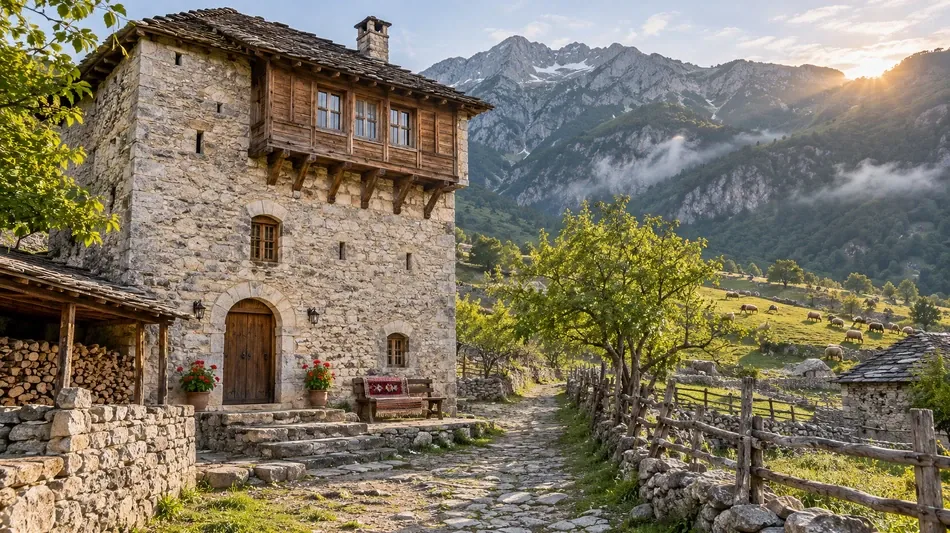
Restored Albanian tower houses anchor new rural tourism trail

 Restored Albanian tower houses anchor new rural tourism trail

 Sonia Gandhi reflects on family tragedy and reluctant political career

 Pope Leo begins three-country South American tour in Uruguay

 Khawaja says entire Australia camp knew of 2018 ball-tampering plan

 Portuguese Finance Minister to Review Socialist Budget Amendments

 Early Polar Vortex Disruption Creates Uncertain Winter Outlook for Pennsylvania

 Stadler Begins Testing First Hydrogen Narrow-Gauge Trains for Southern Italy

 Kospi Falls Below 5,000 as U.S. AI Regulation Fears Trigger Circuit Breaker
A new long-distance route through north-eastern Albania is using restored stone tower houses as guest accommodation while directing tourism toward remote villages.
The Tower Trail crosses the Mirdita, Mat, Bulqiza and Dibra regions, covering more than 100 miles over a suggested nine-day guided itinerary. The route passes through high plains, forests, river valleys and traditional settlements, with stays in farms, guesthouses and fortified houses known as kullas.
Built from local limestone and mountain timber, kullas served as family strongholds during conflict and as shelter for travellers. Many were constructed in the 18th and 19th centuries, confiscated during Albania’s communist period from 1944 to 1991, and returned to families in poor condition.
The Albanian Agritourism Association developed the trail to support restoration and local income in areas largely bypassed by mass tourism. Plans also include cycling and four-wheel-drive versions of the route, while longer walking stages can be divided or shortened by vehicle transfers.
P.Cavaco--PC