'First of its kind' power surge behind Iberia blackout: experts / Photo: MIGUEL RIOPA - AFP/File

 All Blacks knew Nonu would perform solo Haka - coach Rennie

 Britain's Glave upstages Jacobs to win European 100m gold

 Greece's Tentoglou wins fourth European long jump title
 Doctors ignored 'warning signs' before Maradona's death, court hears

 Pereira, the 'zombie city' devastated by Colombia's earthquake

 UN says 2 staff arrested by Afghan intelligence agency
 Colombia scrambles to find survivors as quake kills 240

 Ramsay-Peaty out of medals as Italy's Martinenghi wins European gold
 AI firm Manus to resume 'independent' operations after China blocks Meta deal

 Caught between great powers: the cautionary tale of Manus

 Heatwave hits evicted families sleeping rough in Rome

 US company stokes Greenland tensions by unloading drilling gear

 Cambridge academic in plagiarism row publishes memoir
 LeBron's Sixers hope to spoil Knicks party on NBA opening night
 UK 'on course' to record warmest summer for second year in a row
 Spotify to launch badge identifying AI music

 New plastic treaty document criticised for weaker ambition
 Hungary parliament approves Orban-critic judge as president
 Ebola outbreak in DR Congo kills more than 2,000
 ChargeAfter Powers BYLD Finance Expansion into Consumer Financing for Equipment Retailers

 MEXC Upgrades RealStocks With Three New Features to Enhance U.S. Stock Trading Experience

 Israel demolishes home of slain Palestinian involved in deadly West Bank clash
 Liverpool fans seek clarity on Bezos bid to buy stake

 Solar eclipse sparks scramble for protective glasses across Europe

 Oil prices jump as US-Iran deal hopes falter

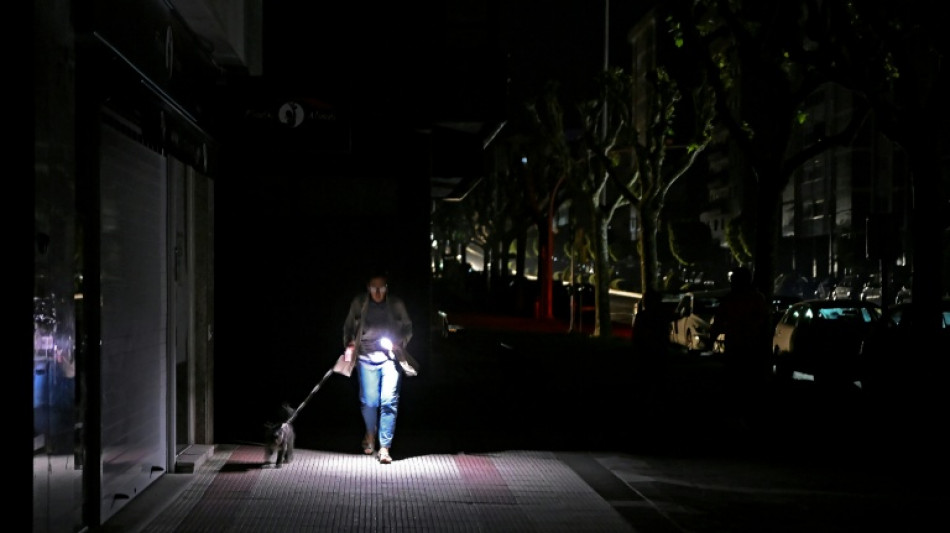
A power surge that caused a paralysing blackout across all of Spain and Portugal in April was an unprecedented event in Europe and possibly the world, but the root cause remains unknown, an expert panel said Friday.
"This was the most severe blackout incident in Europe in the last 20 years," Damian Cortinas, president of the association of electricity grid operators ENTSO-E, said during a presentation of the panel's preliminary report into the incident.
He said "cascading overvoltages" were behind the blackout, which he called a "first of its kind" on the continent.
Cortinas added that "we think (it is unprecedented) in the world as well", but cautioned that the experts did not have information from every country.
The April 28 outage cut internet and telephone connections, halted trains, shut businesses and plunged cities into darkness across Spain and Portugal. It also briefly affected southwestern France.
A Spanish government report had previously blamed the massive outage on overvoltage in June.
Overvoltage occurs when there is too much electrical voltage in a network, overloading equipment. It can be caused by surges in networks due to oversupply or lightning strikes, or when protective equipment is insufficient or fails.
- 'New territory' -
Friday's "factual" report, produced by a panel of 45 European experts mandated to carry out technical investigations, describes the sequence of events that led to the uncontrolled, widespread outage.
But it does not yet provide the primary causes of the initial incidents.
"This is new territory. This is also why we need a bit of time to be sure that we analyse what's going on and what would happen," Cortinas said.
The expert group will publish its final report in the first quarter of 2026, ENTSO-E said in a statement
"It will include a detailed root cause analysis and recommendations on how to prevent similar events happening across the European power system in the future," it added.
The factual report was based on a massive quantity of data, which took a lot of time to collect as experts from power generators and their users as well as third parties.
Some of the third parties "did not give the consent to the Spanish TSO (transmission system operator) to forward the data. So it took us a long time to collect to collect all the needed data," said Klaus Kaschnitz, the expert panel's co-lead.
"We sent out about 150 letters and, at the end, we received the last data in August," he said.
Some data is still missing.
- Blame game -
The blackout struck the Iberian Peninsula at 12:33 pm local time.
According to the report, two episodes of oscillations -- power, voltage, and frequency swings -- were observed during the half hours that preceded the incident.
Operators in control rooms took measures to mitigate the issue, such as reducing the export of power from Spain to France, the report said.
"While these measures mitigated the oscillations, their nature led to an increase of voltage in the Iberian power system," it said.
This was followed by losses of output at wind and solar plants, then a chain disconnection of several power generation centres, causing voltages to spike.
Investigators have yet to determine why systems to mitigate overvoltage failed.
Advocates for nuclear energy had blamed the supposed instability of renewable energy sources.
The head of Spanish grid operator REE, Beatriz Corredor, had instead pointed to certain "conventional energy" producers -- gas, nuclear or hydro -- with voltage control thresholds set too low.
In June, Spain's Ecological Transition Minister Sara Aagesen blamed REE, saying that the system "lacked sufficient voltage control capacity" that day.
A.Santos--PC