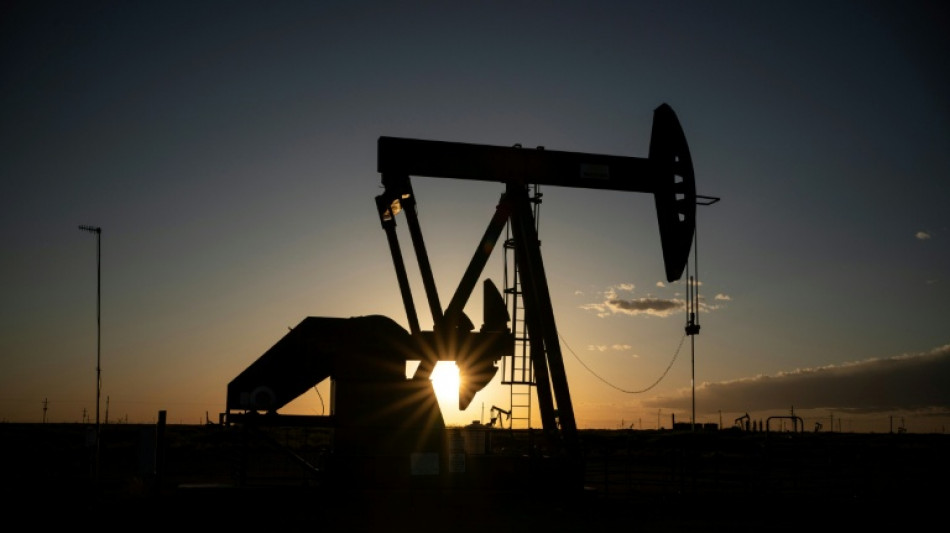
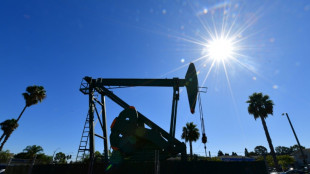
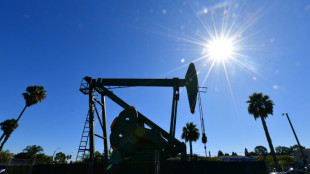
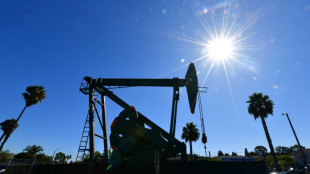
OPEC+ meets with future oil production hanging in the balance / Photo: Paul Ratje - AFP/File

 All Blacks knew Nonu would perform solo Haka - coach Rennie

 Britain's Glave upstages Jacobs to win European 100m gold

 Greece's Tentoglou wins fourth European long jump title
 Doctors ignored 'warning signs' before Maradona's death, court hears

 Pereira, the 'zombie city' devastated by Colombia's earthquake

 UN says 2 staff arrested by Afghan intelligence agency
 Colombia scrambles to find survivors as quake kills 240

 Ramsay-Peaty out of medals as Italy's Martinenghi wins European gold

 AI firm Manus to resume 'independent' operations after China blocks Meta deal

 Caught between great powers: the cautionary tale of Manus

 Heatwave hits evicted families sleeping rough in Rome

 US company stokes Greenland tensions by unloading drilling gear

 Cambridge academic in plagiarism row publishes memoir
 LeBron's Sixers hope to spoil Knicks party on NBA opening night
 UK 'on course' to record warmest summer for second year in a row
 Spotify to launch badge identifying AI music

 New plastic treaty document criticised for weaker ambition
 Hungary parliament approves Orban-critic judge as president

 Ebola outbreak in DR Congo kills more than 2,000

 ChargeAfter Powers BYLD Finance Expansion into Consumer Financing for Equipment Retailers
 MEXC Upgrades RealStocks With Three New Features to Enhance U.S. Stock Trading Experience

 Israel demolishes home of slain Palestinian involved in deadly West Bank clash
 Liverpool fans seek clarity on Bezos bid to buy stake

 Solar eclipse sparks scramble for protective glasses across Europe

 Oil prices jump as US-Iran deal hopes falter

Saudi Arabia, Russia and six other key members of the OPEC+ alliance are likely to agree to raise crude output when they meet virtually on Sunday, with analysts divided over the size of the expected hike.
The meeting by the group of eight oil-producing countries known as the "Voluntary Eight" (V8) comes as oil prices head for weekly losses and rumours of a possible output increase of up to 500,000 barrels per day (bpd) swirl.
Angered by what it dismissed as "wholly inaccurate and misleading" media reports, the 12-nation Organization of the Petroleum Exporting Countries (OPEC) urged news outlets in a statement on Tuesday to "exercise accuracy... in order to avoid fuelling" market speculation.
Experts had initially expected a production hike of 137,000 bpd from November, which would mirror the October increase.
But Commerzbank analyst Barbara Lambrecht cautioned that uncertainty remained, as "the group has frequently surprised markets with swift production hikes in the recent past".
Since April, the V8 group -- comprising Saudi Arabia, Russia, Iraq, the United Arab Emirates, Kuwait, Kazakhstan, Algeria and Oman -- has boosted production by 2.5 million bpd (mbpd) in total.
The group has sped up output increases at a pace very few had predicted at the beginning of the year, following a long period of producers seeking to combat price erosion by implementing production cuts to make oil scarcer.
- Prices in decline -
But in recent months, OPEC+ has shifted its strategy in a bid to regain market share in the face of competition from other countries, and "with output from the United States, Brazil, Canada, Guyana and Argentina at or near all-time highs", the International Energy Agency (IEA) said in its latest monthly oil report.
But the IEA stressed that global demand outlook for crude "remains largely unchanged", with growth of around 700,000 bpd expected for both 2025 and 2026.
The OPEC cartel was more optimistic in its latest projections for oil demand worldwide, forecasting increases of 1.3 mbpd in 2025 and 1.4 mbpd in 2026.
According to Tamas Varga of PVM, signs of a "long-awaited glut" are now "loudly knocking on the doors of our market".
Against this backdrop, the possibility of a larger increase in the grouping's quotas has sent the price of Brent crude -- the global benchmark for crude oil -- plummeting below $65 a barrel, a loss of around eight percent in a week.
- Russia in uncomfortable position -
Russia, the second-largest producer in OPEC+ behind Saudi Arabia, could oppose a sizeable increase in quotas from next month, amid fears it could cause crude oil prices to fall further.
Following last month's decision, Rystad Energy analyst Jorge Leon explained that "Russia depends on high prices to fund its war machine" and unlike Riyadh, the Kremlin has limited potential to increase production due to Western sanctions.
Russia, which currently produces around 9.25 mbpd, has a "maximum production capacity of 9.45 mbpd" compared to around 10 mbpd before the war, Homayoun Falakshahi at Kpler told AFP.
Moreover, Ukrainian strikes on Russian refineries have intensified since August, translating into "rising crude exports from Russia, as the oil cannot be used domestically", and making Moscow even more dependent on selling its crude abroad, said Arne Lohmann Rasmussen of Global Risk Management.
P.Serra--PC