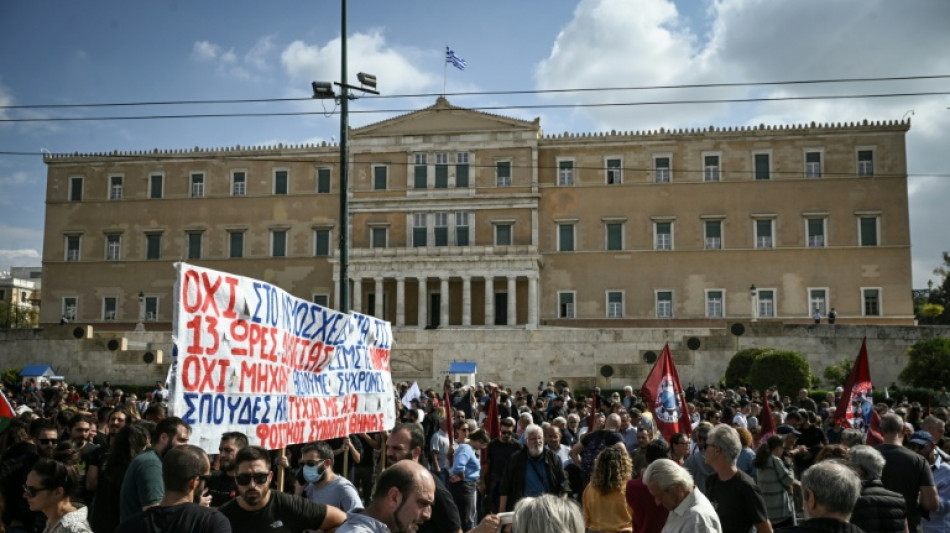
Greece weighs disputed 13-hour workday reform / Photo: Aris MESSINIS - AFP

 Barred from elections, Russia's anti-war party vows to fight on

 Jaissle states Newcastle ambition but urges patience

 NBA star Cooper Flagg trading card a slam dunk for lucky buyer

 ForumPay Expands Payment Infrastructure with New Card and Bank Transfer Acceptance Solution
 Oil prices higher, stocks flat ahead of inflation report

 Orban-critic ex-judge becomes Hungary president after predecessor ouster

 US rights groups sue Trump over ICC sanctions

 Sphere 3D Corp. (Nasdaq: ANY) Attracts 6.5% Stake from Turnaround Bitcoin-Mining Investor

 Oil prices lower, stocks higher as Hormuz doubts drag on

 Colombia scrambles to find survivors as quake kills 181

 Colombia scrambles to find survivors as quake kills 169

 MEXC Report: 74.2% of Traditional Finance Users Have Shifted Their Trading Activity to Crypto Exchanges

 MEXC Lists DAPPOS (DOS) With $60,000 Worth of DOS and 10,000 USDT in Airdrop+ Rewards

 Jellyfish force shutdown of three reactors at French nuclear plant

 Hodgkinson, Werro sail through Euro 800m qualifying

 Somali referee denied World Cup 'proud' to oversee UEFA Super Cup

 French newspapers target Google over AI summaries

 Ebola death toll in DR Congo outbreak rises to more than 2,000

 PrimeXBT Launches MT5 Cent Account for Beginners and Risk-Conscious Traders

 British sprinter Hunt chasing three more golds after winning 100m

 Ethiopia's Tigray rebel authorities condemn army drone strikes

 Too hot to live? French buyers rethink housing choices after heatwaves

 Ukraine says Russia fired N. Korean missiles in deadly attack

 Oil prices jump further as hopes for Hormuz deal fade

 Trump says would be 'terrible mistake' to oust embattled Infantino

Greece's parliament on Wednesday debated a controversial reform proposed by the conservative government, which would allow 13-hour workdays under exceptional circumstances, drawing fire from unions and opposition parties.
Unions have staged two general strikes against the reform this month, the latest on Tuesday, with thousands of workers protesting a bill "worthy of the Middle Ages," according to the left-wing Syriza party.
The government insists that the 13-hour workday is optional, only affects the private sector, and can only be applied up to 37 days a year.
"We are now giving the possibility (to an employee) to perform this extra work for the same employer, without commuting, with increased pay of 40 percent," Labour Minister Niki Kerameus argued in Parliament.
In a country where the economy has recovered since the debt crisis but remains fragile, this possibility already exists, but only if an employee has two or more employers.
The reform is seen as targeted towards Greece's services sector, especially during the busy summer tourism season, enabling employers to avoid hiring additional staff.
But opposition parties and unions argue that workers will risk layoffs if they refuse longer hours.
"Our health, both mental and physical, and the balance between personal and professional life are goods that cannot be replaced with money," Stefanos Chatziliadis, a senior member of civil service union ADEDY, told AFP during a Tuesday protest in Thessaloniki.
"Making it legal to work from morning till night is not normal and cannot be tolerated by our society. It is truly barbaric. It is inhuman," he said.
- Voluntary –
The legal working day in Greece is eight hours, with the possibility of performing paid overtime.
The new law is expected to be passed by parliament at a Thursday vote, where the ruling conservatives have 156 MPs in the 300-seat chamber.
Syriza leader Sokratis Famellos said the government "is establishing a true Middle Ages of labour."
However, Greece's labour minister criticised the "misleading use of the term '13-hour workday'" as it "suggests that everyone would work 13 hours a day."
It is a provision that will only be valid "up to 37 days a year, or about three days per month," and on a voluntary basis, she stressed.
Private and public sector employees have twice taken to the streets to denounce the "worsening of an already deeply problematic situation," according to the General Confederation of Greek Workers (GSEE).
It claims that many employees will be unable to refuse to work 13 hours, given the "unbalanced power dynamics between employer and employee, reinforced by the precariousness prevailing in the labour market."
- Violated –
Unions believe the right to a mandatory daily rest of 11 hours will be at risk, largely due to the time spent commuting to work.
"Working 13 hours a day means there is absolutely no free time left to lead a somewhat decent life: spending time with friends, family," said Dimitris Polyzoidis, 37, a technician at the Thessaloniki protest.
Sofia Georgiadou, 29, a store employee, denounced "a new attempt to legalise modern slavery."
"You can't really refuse; they always find ways to impose what they want," said Maria, a 46-year-old construction company employee.
According to Eurostat, Greeks already work 39.8 hours a week on average compared to the EU average of 35.8 hours.
The average working time hides significant disparities, and wages remain particularly low.
Servers and cooks in the tourist sector work extended days during peak season -- sometimes without any weekly rest
"Overwork is not a choice, it's a necessity, overtime is often a means of survival," according to financial daily Naftemporiki.
The current government has already legalised a six-day working week, especially during high demand in certain sectors, including tourism.
P.Mira--PC