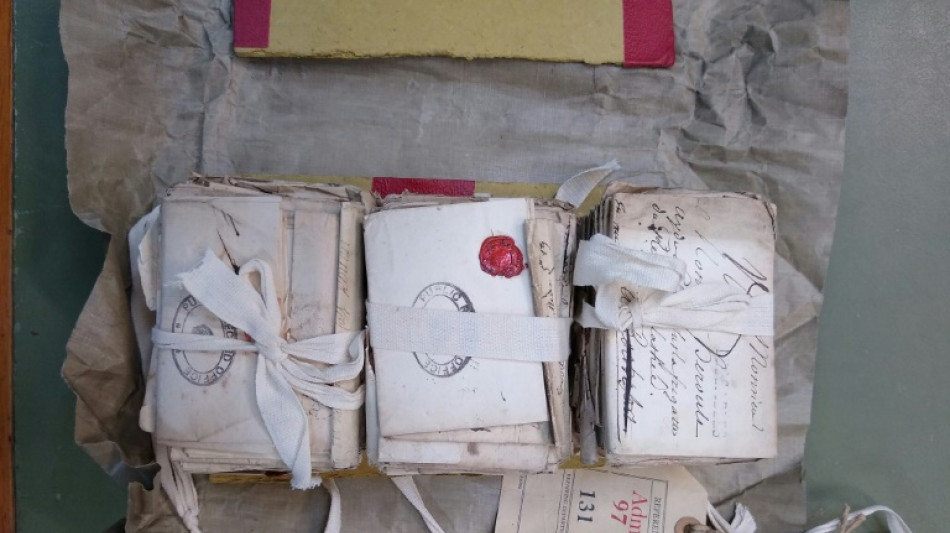
Confiscated French love letters finally opened after 265 years / Photo: Renaud Morieux - THE NATIONAL ARCHIVES/AFP

 Trump's beef policies irk Texas ranchers, testing their loyalty

 Nvidia, OpenAI CEOs to attend Xi dinner at White House

 Anthropic picks Accenture for in-house AI safety evaluation

 Balogun returns as Monaco beat Lens to continue strong Ligue 1 start

 'Pause' on overt repression in Venezuela, but reforms still needed: HRW

 Global stocks mixed as yen falls despite Bank of Japan rate hike

 Cuba hit with seventh major blackout of the year

 Murray out with concussion so Wentz will start for Vikings

 UN chief 'deeply regrets' US visa refusal to Abbas for annual meeting

 England quick Carse to face no charges over alleged nightclub assault

 Mancini brings nine newcomers into the first squad of his Italy comeback

 Czechs level Davis Cup tie against USA as South Korea eye Finals

 New France boss Zidane confirms Mbappe as captain after naming first squad

 California governor signs order to explore AI 'kill switch'

 Head leads run spree as Australia win Zimbabwe ODI series

 In-form Raphinha wants to finish career at Barcelona

 Warren Buffett steps down as Berkshire Hathaway chairman

 Carrick confident Man Utd can 'work through' tough time

 Mbappe ends Nike partnership to join Swiss brand On

 Liverpool boss Iraola puts Bournemouth love affair on hold

 'A disaster' if Man City do not win says Maresca after flawless start

 Kerry James Marshall: American 'blackness' painter celebrated in Europe

 Spain coach De la Fuente offers 'full support' to people of Ceuta
 Russia seizes assets of Nestle, French firms over West's Ukraine support
 England can build on World Cup 'spirit', says Tuchel

Undelivered letters written to French sailors during an 18th century war between Britain and France have finally been opened and studied -- after more than 250 years gathering dust.
The unread letters have provided a rare insight into the lives of sailors and their families in the 1700s, from the wife of a senior naval officer to an elderly mother chastising her son for not writing.
The Royal Navy seized the messages during the Seven Years' War, a global conflict that ended in 1763 that saw Britain and France lead rival alliances.
"I could spend the night writing to you... I am your forever faithful wife," wrote Marie Dubosc to her husband Louis Chamberlain, the first lieutenant of a French warship in 1758.
"Good night, my dear friend. It is midnight. I think it is time for me to rest."
Unknown to Marie, her husband's ship, the Galatee, had been captured by the British, researchers at the University of Cambridge found.
Louis never received the letter and his wife died the following year, almost certainly before he was released by the British.
In another missive dated January 27, 1758, the mother of young sailor Nicolas Quesnel from Normandy takes him to task about his lack of communication.
"I think more about you than you about me... In any case I wish you a happy new year filled with blessings of the Lord," 61-year-old Marguerite wrote in a letter probably dictated to someone else.
"I think I am for the tomb, I have been ill for three weeks. Give my compliments to Varin (a shipmate), it is only his wife who gives me your news," she added.
The Galatee was captured by the British en route from Bordeaux to Quebec in 1758.
- 'Universal human experiences' -
British Admiralty officials at the time deemed the letters of no military significance and the vast majority languished in the archives, unopened, until they attracted the attention of Cambridge history professor Renaud Morieux.
"I only ordered the box out of curiosity," said Morieux, whose findings were published on Tuesday in the journal "Annales. Histoire, Sciences Sociales".
Presented with three piles of very small letters held together by ribbon, Morieux said he "realised I was the first person to read these very personal messages since they were written".
"Their intended recipients didn't get that chance. It was very emotional," he said.
Morieux identified every member of the Galatee's 181-strong crew, with letters addressed to a quarter of them, and also carried out genealogical research into the men and their correspondents.
In 1758 alone a third of France's sailors were captured by the British.
Over the whole period of the Seven Years' War nearly 65,000 were imprisoned by the British.
Some died from disease and malnutrition although others were released.
Letters would have been the only means their families had of trying to contact them, said Morieux.
"These letters are about universal human experiences, they're not unique to France or the 18th century," he added.
"They reveal how we all cope with major life challenges.
"When we are separated from loved ones by events beyond our control like the pandemic or wars, we have to work out how to stay in touch, how to reassure, care for people and keep the passion alive," said the historian.
"Today we have Zoom and WhatsApp. In the 18th century, people only had letters but what they wrote about feels very familiar."
F.Moura--PC