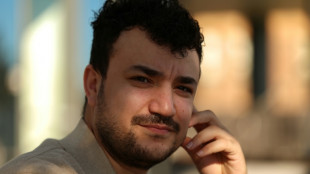
In war-torn Sudan, a school offers a second chance at education / Photo: Ebrahim Hamid - AFP/File

 Hong Kong court set to sentence activist Joshua Wong in security case

 Australia raises benchmark rate to highest level in 18 years

 'The Remarried Empress' Cast Discusses Bringing Fantasy Royal Drama to Life

 Asian stocks retreat as AI worries outweigh steep oil-price drop
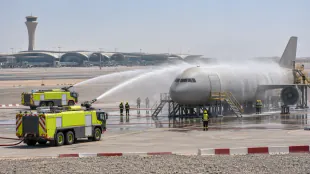 Hamad International Airport stages emergency drills during WATAN 2026

 Global failure to punish attacks leaves journalists at continuing risk

 Researchers Warn 'Bookkeeping Trick' Masks Beef Industry's Methane Emissions

 Climate Change Intensified Atlantic Hurricanes, Study Finds

 Qatar solar expansion opens scope for technical performance gains

 IXOPAY Announces IXO One, a Modular Payments Platform Built for an Era of Fluid Commerce
In a worn-down classroom in eastern Sudan, men and women watch attentively from a wood bench as a teacher scribbles Arabic letters on a faded blackboard.
Nodding approvingly in the corner is the school's 63-year-old founder Amna Mohamed Ahmed, known to most as "Amna Oor", which partly means lion in the Beja language of eastern Sudan.
She has spent the last three decades helping hundreds return to their education in Port Sudan, now the country's de facto capital.
The educator, who wears an orange headscarf wrapped neatly around her head, said she started the project in 1995 because of widespread illiteracy in her community.
"That's what pushed me to act. People wanted to learn -- if they didn't, they wouldn't have kept coming," she told AFP.
Ahmed's classes offer a second chance to those who missed out on formal education, particularly women who were denied schooling due to cultural or financial barriers.
- A fresh start -
For 39-year-old Nisreen Babiker, going back to school has been a long-held dream.
She left school in 2001 after marrying and taking on the responsibility of raising her younger siblings following her father's death.
"My siblings grew up and studied, and my children too," she said.
"I felt the urge to return to school. Even after all these years, it feels like I'm starting fresh," she told AFP.
Ahmed's school has also become a haven for those displaced by Sudan's ongoing conflict, which erupted in April 2023 between army chief Abdel Fattah al-Burhan and his former deputy Mohamed Hamdan Daglo, who leads the paramilitary Rapid Support Forces (RSF).
The war has killed tens of thousands, uprooted over 12 million, and driven swathes of the country into hunger and famine.
Maria Adam is among those who fled their homes after war broke out. She arrived in Port Sudan seeking safety and a better future.
"When I arrived in Port Sudan, I heard about this place and joined," said the 28-year-old, noting that she dropped out of school when she was 11.
- Changing lives -
"I want to finish my education so I can help my children," Adam told AFP.
Sudan's education system has been shattered by the conflict, with the United Nations estimating that over 90 percent of the country's 19 million school-age children now have no access to formal learning.
Across the nation, most classrooms have been converted into shelters for displaced families.
Even before the war, a 2022 Save the Children analysis ranked Sudan among the countries most at risk of educational collapse.
But the determination to learn remains strong at the Port Sudan school, where many students have gone on to enter high school and some have even graduated from university.
In one corner of the classroom, a mother joins her young son in a lesson, hoping to reshape both their futures.
"To watch someone go from not knowing how to read or write to graduating from university, getting a job, supporting their family -- that is what keeps me going," Ahmed said.
"They go from being seen as a burden to becoming productive, educated members of society," she added.
A.F.Rosado--PC