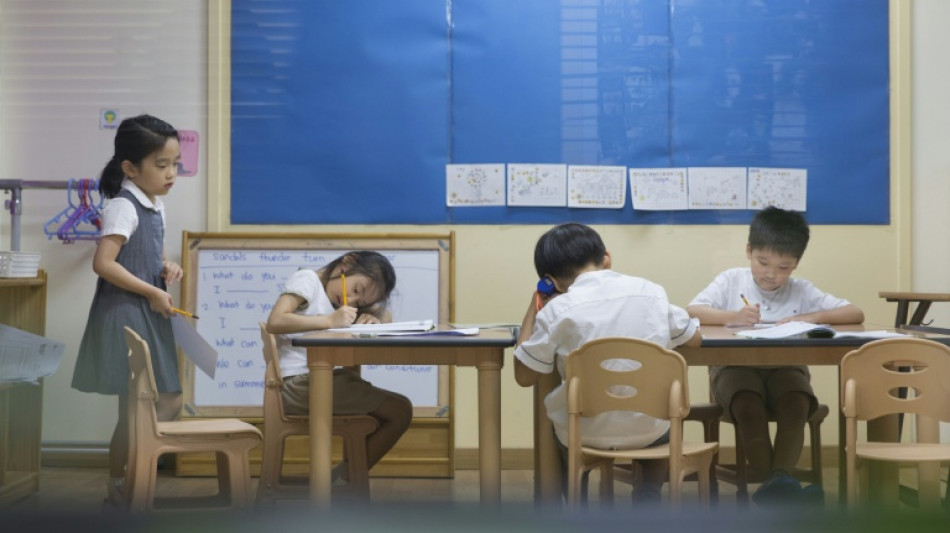
South Korea to ban mobile phones in school classrooms / Photo: YELIM LEE - AFP/File

 Kennedy Center: future unclear for iconic Washington arts hub

 Trump claims 'infinite' Greenland security deal with Denmark

 Helicopters battle wildfire threatening Ecuador's capital

 Brentford batter Chelsea to undo Alonso's promising start

 Kane hits Bundesliga century as Bayern rout Union

 Trump says CNN, MS NOW, Politico banned from White House

 Hushing and hedging: US companies retreat on climate

 Springboks to face Fiji before 2027 Rugby World Cup

 Nigeria miners struggled to breathe in cell before 37 died: survivors

 McIlroy on the charge at PGA Championship as Reed withdraws

 McIlroy on the charge at PGA Championship

 Crisis-wracked Volkswagen warns of 10-bn-euro hit to profits

 Costa Rica's Grynspan tops third informal poll for UN chief: diplomat

 Stock markets retreat after central bank rate hikes

 Russia labels director of Cannes Grand Prix winner a 'foreign agent'

 Macron warns of Russian 'hybrid' threat after meeting presidential hopefuls

 UN holds third informal poll for new chief

 Kulusevski return can spark Spurs: De Zerbi

 Shakira to cap off world tour with Madrid 12-gig run

 Isolated Syrian-Druze city blames Damascus for shortages

 Isolated Syrian-Druze city shortages

 Dutch drop Depay for Germany match in Xavi's first pick

 Ronaldo named in Portugal squad for Nations League

 Stock markets diverge after central bank rate hikes

 Anti-Assad music star makes triumphant return to Syria

South Korea has passed a bill banning the use of mobile phones in school classrooms nationwide, officials said Thursday, joining other countries in efforts to curb social media use among minors.
One of the world's most wired nations, South Korea has recently sought to tighten rules on electronic devices in schools, citing concerns over smartphone addiction among students.
The bill, which will take effect in March next year, bans smart devices including mobile phones in classrooms and was passed Wednesday, a National Assembly spokeswoman told AFP.
The move makes South Korea the latest country to restrict social media use among schoolchildren, following similar steps in countries including Australia and the Netherlands.
Seoul's Education Ministry said in a statement that the law bans the use of smartphones in classrooms except when needed as assistive tools for students with disabilities or special education needs, or for educational purposes.
The measure also establishes a legal basis to "restrict the possession and use of such devices to protect students' right to learn and support teachers' activities", it added.
Lawmakers including opposition People Power Party member Cho Jung-hun, who introduced the bill, said the issue had long been "contentious amid concerns over human rights violations".
But the country's National Human Rights Commission recently changed its stance, saying limits on phone use for educational purposes do not breach rights given their negative impact on students' learning and emotional well-being.
Against this backdrop, the law was needed to ease social conflict "by clearly defining rules on smart device use in schools", the lawmakers said in a document introducing the bill.
But it has drawn backlash from groups including the left-wing Jinbo Party, which said the law will "infringe on students' digital rights and right to education".
The measure "prevents adolescents from learning to make responsible decisions on their own and deprives them of opportunities to adapt to the digital environment", the party said in a statement.
P.Mira--PC