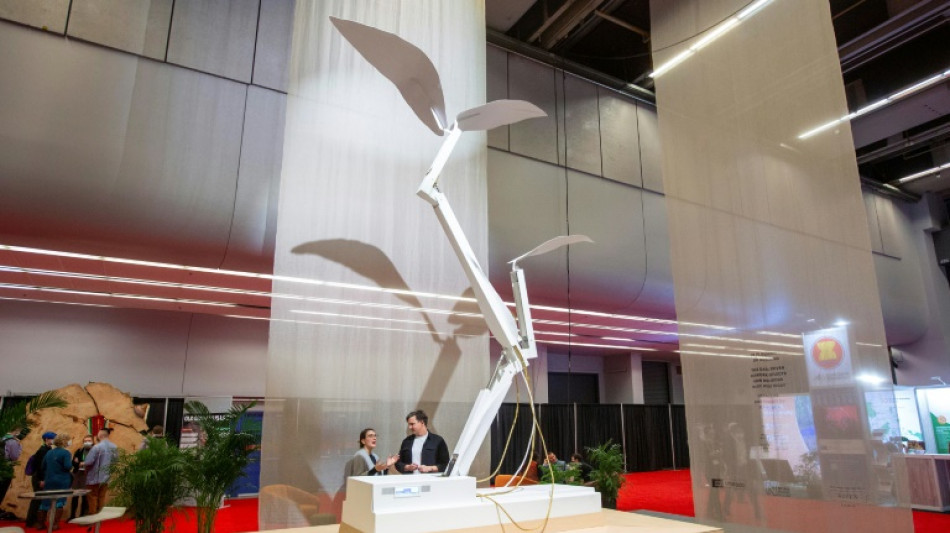
Robot plant grows, wilts on fate of UN nature talks / Photo: Lars Hagberg - AFP

 Drone owners rush to offload devices ahead of Beijing ban

 Trump's beef policies irk Texas ranchers, testing their loyalty

 Nvidia, OpenAI CEOs to attend Xi dinner at White House

 Anthropic picks Accenture for in-house AI safety evaluation

 Balogun returns as Monaco beat Lens to continue strong Ligue 1 start

 'Pause' on overt repression in Venezuela, but reforms still needed: HRW

 Global stocks mixed as yen falls despite Bank of Japan rate hike

 Cuba hit with seventh major blackout of the year

 Murray out with concussion so Wentz will start for Vikings

 UN chief 'deeply regrets' US visa refusal to Abbas for annual meeting

 England quick Carse to face no charges over alleged nightclub assault

 Mancini brings nine newcomers into the first squad of his Italy comeback

 Czechs level Davis Cup tie against USA as South Korea eye Finals

 New France boss Zidane confirms Mbappe as captain after naming first squad

 California governor signs order to explore AI 'kill switch'

 Head leads run spree as Australia win Zimbabwe ODI series

 In-form Raphinha wants to finish career at Barcelona

 Warren Buffett steps down as Berkshire Hathaway chairman

 Carrick confident Man Utd can 'work through' tough time

 Mbappe ends Nike partnership to join Swiss brand On

 Liverpool boss Iraola puts Bournemouth love affair on hold

 'A disaster' if Man City do not win says Maresca after flawless start

 Kerry James Marshall: American 'blackness' painter celebrated in Europe

 Spain coach De la Fuente offers 'full support' to people of Ceuta

 Russia seizes assets of Nestle, French firms over West's Ukraine support

It's not always easy to make sense of the complex environmental diplomacy taking place at a UN summit billed as humanity's last hope to save nature.
That's why a scientist and artist have teamed up to build a large, data-driven robotic plant that withers or flourishes depending on countries' policy commitments: a tangible demonstration of how human actions will impact the world's threatened species.
Called "ECONARIO," the 5.5-meter (18-foot) tall artwork took a year to build from recycled steel and is currently on display in Montreal Convention Centre, keeping policymakers at the COP15 meeting on their toes as they attempt to hammer out a deal to protect ecosystems.
Its creator, Dutch artist Thijs Biersteker, told AFP the idea behind it is simple: "If the research does not reach us, then how can the research teach us?"
"Art reflects the time we're in, and it should reflect these important issues."
The plant feeds on data from the Biodiversity Intactness Index (BII) -- an estimated percentage of the original number of species that remain, and their abundance in any given area, despite human impacts.
Data scientist Adriana De Palma of London's Natural History Museum, who serves as research lead for the BII, told AFP it is based on a robust, peer-reviewed and open access methodology.
As negotiations happen, the team behind BII input, for example, how many countries have committed to implement a cornerstone pledge of protecting 30 percent of lands and oceans by 2030.
"We can then predict what that is going to mean for biodiversity in 20, 50 or 100 years," she said.
- Rooting for success -
New funding pledges by wealthy countries to assist lower income nations in protecting their biodiversity have helped to nudge up slightly the predicted global average of BII to 70.7 percent by 2050 -- meaning the average ecosystem will have that percentage of its natural ecological community left.
The current figure is 68.5 percent, set to drop to 66.4 percent if "business as usual" continues but rise to 76.4 percent in case of "real action" which the UN summit was meant to deliver.
For now, ECONARIO is cycling between the pessimistic and optimistic scenarios in order to show what could be possible -- but if policymakers fail to achieve an ambitious target, that will be reflected in a very sorry looking robotic plant.
"We shouldn't shy away from the hard numbers, it's not time to sugarcoat anymore," said Biersteker.
De Palma added they were in talks with North American museums to loan the artwork out after the UN summit concludes, and it will eventually return to Europe.
"Using a piece of art like this to really connect with people so they see the damage that individual choices, company choices and government choices are having on the world, is incredibly valuable," she said.
P.Cavaco--PC



