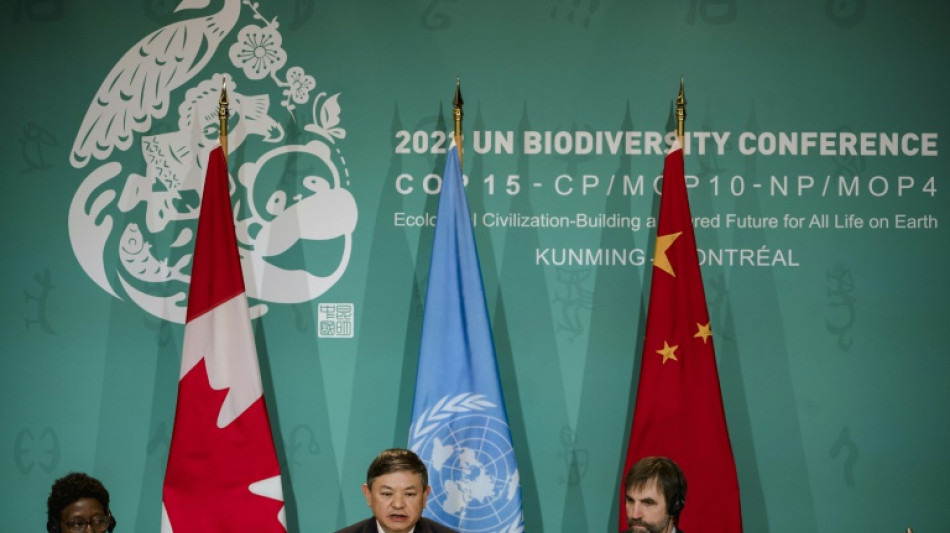
Hope stirs for deal to save nature at UN talks / Photo: ANDREJ IVANOV - AFP

 Drone owners rush to offload devices ahead of Beijing ban

 Trump's beef policies irk Texas ranchers, testing their loyalty

 Nvidia, OpenAI CEOs to attend Xi dinner at White House

 Anthropic picks Accenture for in-house AI safety evaluation

 Balogun returns as Monaco beat Lens to continue strong Ligue 1 start

 'Pause' on overt repression in Venezuela, but reforms still needed: HRW

 Global stocks mixed as yen falls despite Bank of Japan rate hike

 Cuba hit with seventh major blackout of the year

 Murray out with concussion so Wentz will start for Vikings

 UN chief 'deeply regrets' US visa refusal to Abbas for annual meeting

 England quick Carse to face no charges over alleged nightclub assault

 Mancini brings nine newcomers into the first squad of his Italy comeback

 Czechs level Davis Cup tie against USA as South Korea eye Finals

 New France boss Zidane confirms Mbappe as captain after naming first squad

 California governor signs order to explore AI 'kill switch'

 Head leads run spree as Australia win Zimbabwe ODI series

 In-form Raphinha wants to finish career at Barcelona

 Warren Buffett steps down as Berkshire Hathaway chairman

 Carrick confident Man Utd can 'work through' tough time

 Mbappe ends Nike partnership to join Swiss brand On

 Liverpool boss Iraola puts Bournemouth love affair on hold

 'A disaster' if Man City do not win says Maresca after flawless start

 Kerry James Marshall: American 'blackness' painter celebrated in Europe

 Spain coach De la Fuente offers 'full support' to people of Ceuta

 Russia seizes assets of Nestle, French firms over West's Ukraine support

Top officials at high-stakes UN biodiversity negotiations said Saturday they were confident of securing a major deal to save the natural world from destruction.
Observers had warned the COP15 talks aimed at sealing a "peace pact for nature" risked collapse due to disagreement over how much the rich world should pay to protect ecosystems in developing countries.
The talks that started on December 7 had appeared to be on the verge of breakdown when developing countries walked out days ago over the question of funding. But the mood among leaders turned upbeat on Saturday.
"I am greatly confident that we can ... keep our ambitions as well as achieve consensus," China's Environment Minister Huang Runqiu told reporters in Montreal, where the COP15 meeting is being held.
His Canadian counterpart Steven Guilbeault echoed his statement, saying: "We've made tremendous progress... I don't know about how many of us thought we could get there."
Huang said he would publish a draft agreement at 8:00 am EST (1300 GMT) on Sunday and hear lead delegates' feedback later in the day.
The negotiations officially run until December 19, but could go longer if needed.
French President Emmanuel Macron tweeted: "With just a few days to go before the end of the COP 15 Biodiversity Conference in Montreal, my message to our partners is: now is not the time for small decisions, let's go big!
"Let's work together to achieve the most ambitious agreement possible. The world is depending on it."
- Million species threatened -
Delegates are working to roll back the destruction and pollution that threaten an estimated one million plant and animal species with extinction, according to scientists that report to the UN.
The text is meant to be a roadmap for nations through 2030. The last 10-year plan, signed in Aichi, Japan in 2010, did not achieve any of its objectives -- a failure blamed widely on its lack of monitoring mechanisms.
Major goals in the draft under discussion include a cornerstone pledge to protect 30 percent of the world's land and oceans by 2030.
The more than 20 targets also include reducing environmentally destructive farming subsidies, requiring businesses to assess and report on their biodiversity impacts, and tackling the scourge of invasive species.
Representatives of Indigenous communities, who safeguard 80 percent of the world's remaining biodiversity, want their rights to practice stewardship of their lands to be enshrined in the final agreement.
"Indigenous Rights are not negotiable," said Orpha Novita Yoshua, an Indigenous Namblong woman from West Papua, in a statement released by Greenpeace.
"We are the ones doing the work. We protect biodiversity," said Valentin Engobo, leader of the Lokolama community in the Congo Basin. "You won't replace us. We won't let you."
- Money matters -
The issue of how much money the rich countries will send to the developing world, home to most of the world's biodiversity, has been the biggest sticking point.
"If the framework is not accompanied by adequate resources, then we will be destined to repeat the same failures that we saw after Aichi," warned Brian O'Donnell, director of the NGO Campaign for Nature.
"If it's weak we would certainly oppose it and encourage parties to oppose it and not sign up to a weak deal," he added. "We're still remaining hopeful that we can get there."
Several countries have announced new commitments. The European Union has committed seven billion euros ($7.4 billion) for the period until 2027, double its prior pledge.
But these commitments are still well short of what observers say is needed, and what developing countries are seeking.
Brazil has led that charge, proposing flows of $100 billion annually, compared to the roughly $10 billion at present.
Whether international aid is delivered via a new fund, an existing mechanism called the Global Environment Facility (GEF), or a halfway solution involving a new "trust fund" within the GEF is still up for debate.
A.Motta--PC



