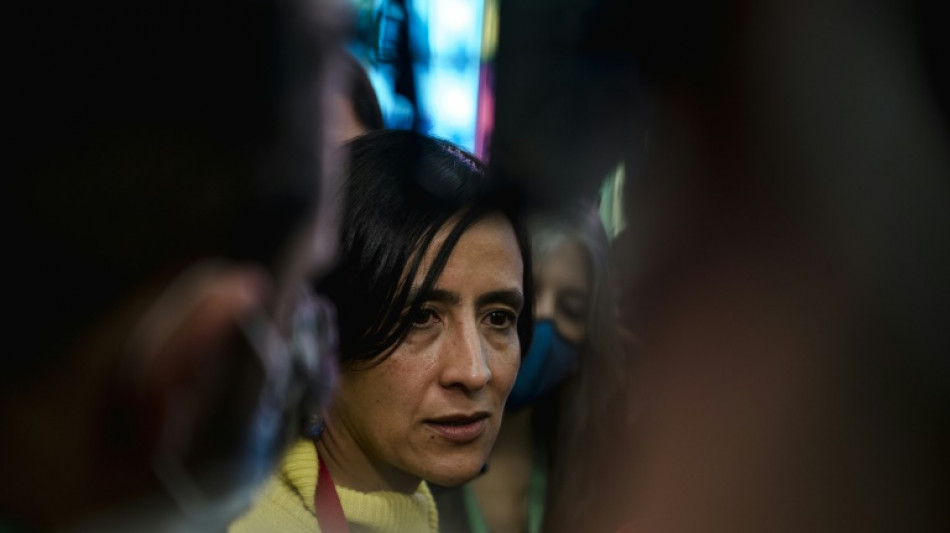
Draft UN biodiversity deal calls to protect 30% of planet by 2030 / Photo: ANDREJ IVANOV - AFP

 Drone owners rush to offload devices ahead of Beijing ban

 Trump's beef policies irk Texas ranchers, testing their loyalty

 Nvidia, OpenAI CEOs to attend Xi dinner at White House

 Anthropic picks Accenture for in-house AI safety evaluation

 Balogun returns as Monaco beat Lens to continue strong Ligue 1 start

 'Pause' on overt repression in Venezuela, but reforms still needed: HRW

 Global stocks mixed as yen falls despite Bank of Japan rate hike

 Cuba hit with seventh major blackout of the year

 Murray out with concussion so Wentz will start for Vikings

 UN chief 'deeply regrets' US visa refusal to Abbas for annual meeting

 England quick Carse to face no charges over alleged nightclub assault

 Mancini brings nine newcomers into the first squad of his Italy comeback

 Czechs level Davis Cup tie against USA as South Korea eye Finals

 New France boss Zidane confirms Mbappe as captain after naming first squad

 California governor signs order to explore AI 'kill switch'

 Head leads run spree as Australia win Zimbabwe ODI series

 In-form Raphinha wants to finish career at Barcelona

 Warren Buffett steps down as Berkshire Hathaway chairman

 Carrick confident Man Utd can 'work through' tough time

 Mbappe ends Nike partnership to join Swiss brand On

 Liverpool boss Iraola puts Bournemouth love affair on hold

 'A disaster' if Man City do not win says Maresca after flawless start

 Kerry James Marshall: American 'blackness' painter celebrated in Europe

 Spain coach De la Fuente offers 'full support' to people of Ceuta
 Russia seizes assets of Nestle, French firms over West's Ukraine support
Countries gathered at a UN meeting on biodiversity in Montreal were inching closer Sunday to a deal to protect 30 percent of the planet by 2030 and to stump up $30 billion in yearly aid for the developing world to save their ecosystems.
Fraught talks to seal a "peace pact for nature" came to a head as summit chair China presented a long-awaited compromise text that was cautiously welcomed by many, though some nations said more work was needed.
The plan maps out action for the next decade to roll back habitat destruction, pollution and the climate crisis that scientists say threaten a million plant and animal species with extinction.
It calls on wealthy countries to increase financial aid to the developing world to $20 billion annually by 2025, rising to $30 billion per year by 2030, while ensuring 30 percent of land and sea areas are effectively conserved and managed by the end of this decade.
The text includes language safeguarding the rights of Indigenous people as stewards of their lands, a key demand of campaigners, but was watered down in other areas -- for example, only encouraging businesses to report their biodiversity impacts rather than mandating them to do so.
The draft still needs to be agreed upon by the 196 signatories to the Convention on Biological Diversity before it is finalized.
Environmentalists say the "30 by 30" goal is the biodiversity equivalent of the Paris Agreement, which seeks to limit long-term global warming to 1.5 degrees Celsius.
The meeting, called COP15, is being held in Canada because of China's strict Covid rules.
- Risk of pushback -
"Six months ago, we didn't even know if we would have a COP this year, let alone a Paris moment for biodiversity, and that sincerely is where I think we're heading," said Canada's environment minister Steven Guilbeault in enthusiastic remarks.
But European commissioner for environment Virginijus Sinkevicius struck a more cautious note, signaling that the funding figures being discussed could be problematic.
"If we have other countries committing to fulfill those goals, such as China, I think that can be realistic," he said, also calling on Arab states to play their part.
Colombia's environment minister Susana Muhamad said she was "optimistic that the main goals have been landed," calling the draft an "important step forward."
Braulio Dias, however, speaking on behalf of the incoming Brazilian government of Luiz Inacio Lula da Silva, called for "better resource mobilization" -- technical speak for more aid to developing countries, a concern echoed by the Democratic Republic of Congo.
Conservation groups said the text was a mixed bag.
"The draft text makes the largest commitment to ocean and land conservation in history," said Brian O'Donnell, of the Campaign for Nature.
But Georgina Chandler, of Britain's Royal Society for the Protection of Birds, said she was worried about a lack of numeric "milestones" for restoring ecosystems on the way to 2050.
"We're basically not measuring progress until 28 years' time, which is madness," she said.
- Funding dispute -
Developing countries, spearheaded by Brazil, had been seeking the creation of a new fund to signal the Global North's commitment to the cause. But the draft text instead suggests a compromise: a "trust fund" within the existing mechanism, called the Global Environment Facility.
Colombia's Muhamad said her country would accept this as a stopgap measure.
The more than 20 targets also include cutting environmentally destructive farming subsidies, reducing pesticide use and tackling invasive species.
But the issue of how much money the rich countries will send to the developing world, home to most of the planet's biodiversity, has been the biggest sticking point.
Lower income nations point out developed countries grew rich by exploiting their natural resources and therefore demand to be paid well to protect their own.
Current financial flows for nature to the developing world are estimated at around $10 billion per year.
Beyond the moral implications, there is the question of self-interest: $44 trillion of economic value generation -- more than half the world's total GDP -- depends on nature and its services.
X.Matos--PC



