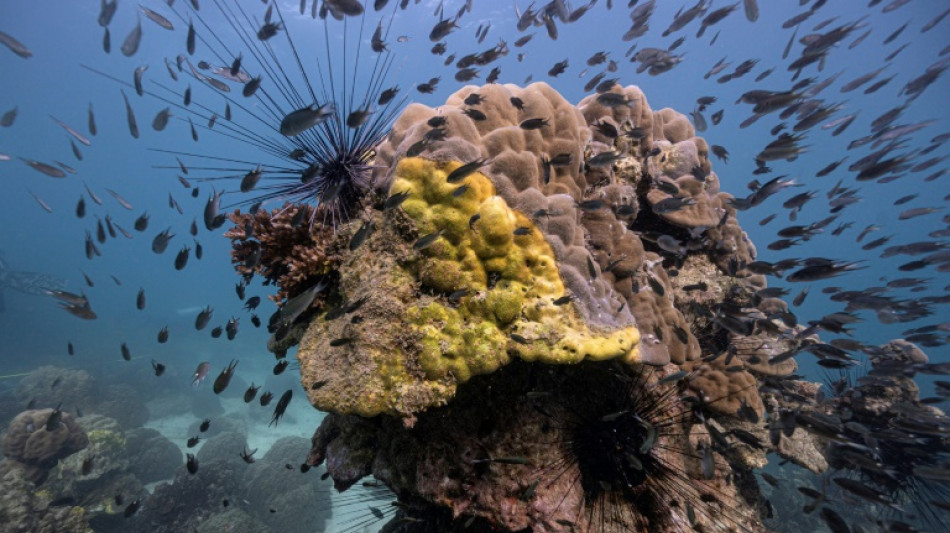
'It just dies': Yellow-band disease ravages Thailand's coral reefs / Photo: Lillian SUWANRUMPHA - AFP

 Drone owners rush to offload devices ahead of Beijing ban

 Trump's beef policies irk Texas ranchers, testing their loyalty

 Nvidia, OpenAI CEOs to attend Xi dinner at White House

 Anthropic picks Accenture for in-house AI safety evaluation

 Balogun returns as Monaco beat Lens to continue strong Ligue 1 start

 'Pause' on overt repression in Venezuela, but reforms still needed: HRW

 Global stocks mixed as yen falls despite Bank of Japan rate hike

 Cuba hit with seventh major blackout of the year

 Murray out with concussion so Wentz will start for Vikings

 UN chief 'deeply regrets' US visa refusal to Abbas for annual meeting

 England quick Carse to face no charges over alleged nightclub assault

 Mancini brings nine newcomers into the first squad of his Italy comeback

 Czechs level Davis Cup tie against USA as South Korea eye Finals

 New France boss Zidane confirms Mbappe as captain after naming first squad

 California governor signs order to explore AI 'kill switch'

 Head leads run spree as Australia win Zimbabwe ODI series

 In-form Raphinha wants to finish career at Barcelona

 Warren Buffett steps down as Berkshire Hathaway chairman

 Carrick confident Man Utd can 'work through' tough time

 Mbappe ends Nike partnership to join Swiss brand On

 Liverpool boss Iraola puts Bournemouth love affair on hold

 'A disaster' if Man City do not win says Maresca after flawless start

 Kerry James Marshall: American 'blackness' painter celebrated in Europe

 Spain coach De la Fuente offers 'full support' to people of Ceuta

 Russia seizes assets of Nestle, French firms over West's Ukraine support

Underneath the calm turquoise waters off eastern Thailand, a rapidly spreading disease is killing corals over vast stretches of the sea floor, and scientists fear it may be getting worse because of climate change.
Yellow-band disease -- named for the colour it turns corals before destroying them -- was first spotted decades ago and has caused widespread damage to reefs in the Caribbean. There is no known cure.
But it was detected for the first time off Thailand's eastern coast just last year, near the popular tourist city of Pattaya, and has already spread over roughly 600 acres (240 hectares) of the sea.
"I haven't seen anything like this before," said marine scientist Lalita Putchim, of Thailand's Department of Marine and Coastal Resources.
"Everywhere we went we saw it, and we expect to see more of it as we go."
Scientists believe overfishing, pollution and rising water temperatures because of climate change may be making the reefs more vulnerable to yellow-band disease.
The disease's impact cannot be reversed, unlike the effects of coral bleaching.
"When the coral is infected with this disease, it just dies," Lalita said.
The loss of corals could have a devastating impact on the ecosystem -- the reef is "like a forest", sustaining massive amounts of life, and its death could eventually impact humans too, she added.
Thai scientists are hoping their investigation into this outbreak will help find a way to stop or cure yellow-band disease.
On one research trip near Samaesan island in Chonburi district, Lalita and her team donned diving gear on a boat before heading underwater.
They photographed infected corals, taking measurements and photographs while harvesting samples to study later.
Thai marine authorities are using social media to track reports of infected reefs, and have also asked the public to report any sightings of affected corals.
Thai researchers have also been aided by local volunteers, as well as business owner Thanapon Chaivanichakul, who collected underwater photographic evidence.
"I was shocked when I first saw it," Thanapon told AFP, using a series of expletives to describe the disease.
The disease is also a threat to the livelihoods of many in the area.
Choopan Sudjai, the owner of a sightseeing boat, relies on the income from tourists who come to see the area's natural beauty -- especially the coral reefs.
"Now that the coral has been infected and will be destroyed, what will we do in five years?" said the 55-year-old.
"It feels as if our own home has been destroyed."
P.Serra--PC



