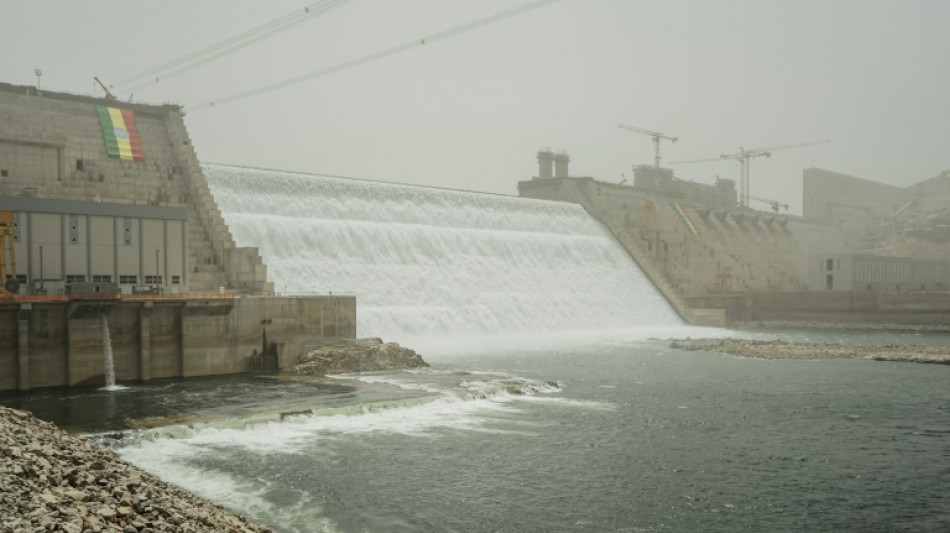
Trapped sediment in dams 'endangers' water supplies: UN / Photo: Amanuel SILESHI - AFP/File

 Drone owners rush to offload devices ahead of Beijing ban

 Trump's beef policies irk Texas ranchers, testing their loyalty

 Nvidia, OpenAI CEOs to attend Xi dinner at White House

 Anthropic picks Accenture for in-house AI safety evaluation

 Balogun returns as Monaco beat Lens to continue strong Ligue 1 start

 'Pause' on overt repression in Venezuela, but reforms still needed: HRW

 Global stocks mixed as yen falls despite Bank of Japan rate hike

 Cuba hit with seventh major blackout of the year

 Murray out with concussion so Wentz will start for Vikings

 UN chief 'deeply regrets' US visa refusal to Abbas for annual meeting

 England quick Carse to face no charges over alleged nightclub assault

 Mancini brings nine newcomers into the first squad of his Italy comeback

 Czechs level Davis Cup tie against USA as South Korea eye Finals

 New France boss Zidane confirms Mbappe as captain after naming first squad

 California governor signs order to explore AI 'kill switch'

 Head leads run spree as Australia win Zimbabwe ODI series

 In-form Raphinha wants to finish career at Barcelona

 Warren Buffett steps down as Berkshire Hathaway chairman

 Carrick confident Man Utd can 'work through' tough time

 Mbappe ends Nike partnership to join Swiss brand On

 Liverpool boss Iraola puts Bournemouth love affair on hold

 'A disaster' if Man City do not win says Maresca after flawless start

 Kerry James Marshall: American 'blackness' painter celebrated in Europe

 Spain coach De la Fuente offers 'full support' to people of Ceuta

 Russia seizes assets of Nestle, French firms over West's Ukraine support

Thousands of the world's large dams are so clogged with sediment that they risk losing more than a quarter of their storage capacity by 2050, UN researchers said Wednesday, warning of the threat to water security.
A new study from the UN University's Institute for Water, Environment and Health found that, by mid-century, dams and reservoirs will lose about 1.65 trillion cubic metres of water storage capacity to sediment.
The figure is close to the combined annual water use of India, China, Indonesia, France and Canada.
That is important, the researchers say, because these big dams are a key source of hydroelectricity, flood control, irrigation and drinking water throughout the world.
"Global water storage is going to diminish -- it is diminishing now -- and that needs to be seriously taken into account," the study's co-author and Institute director Vladimir Smakhtin told AFP.
Researchers looked at nearly 50,000 large dams in 150 countries, and found that they have already lost about 16 percent of water storage capacity.
They estimated that if build-up rates continue at the same pace, that will increase to about 26 percent by mid-century.
Rivers naturally wash sediment downstream to wetlands and coasts, but dams disrupt this flow and over time the build-up of these muddy deposits gradually reduces the space for water.
Smakhtin said this "endangers the sustainability of future water supplies for many" as well as posing risks to irrigation and power generation.
- Part of a larger issue -
Accumulation of sediment can also cause flooding upstream and impact wildlife habitats and coastal populations downstream.
Sedimentation is a part of a larger issue: by 2050, tens of thousands of large dams will be near or past their intended lifespan.
Most of the world's 60,000 big dams -- constructed between 1930 and 1970 -- were designed to last 50 to 100 years, after which they risk failure, affecting more than half the global population who will live downstream.
Large dams and reservoirs are defined as higher than 15 metres (49 feet), or at least five metres high while holding back no less than three million cubic metres of water.
Global warming compounds the risk in ways that have yet to be fully measured.
"Climate change extremes like floods and droughts will increase, and higher intensity showers are more erosive," Smakhtin said.
This not only increases the risk of reservoirs overflowing but also accelerates the build-up of sediment, which affects dam safety, reduces water storage capacity and lowers energy production in hydroelectric dams.
- Alternatives -
To address looming challenges of ageing dams and reservoir sedimentation, the study authors list several measures.
Bypass, or sediment diversion, can divert water flow downstream through a separate river channel.
Another strategy is the removal, or "decommissioning", of a dam to re-establish the natural flow of sediment in a river.
But addressing water storage issues is especially complex because there is no one-size-fits-all solution, Smakhtin said.
"The loss of water storage is inevitable for different reasons," Smakhtin said. "So the question we should be asking is what are the alternatives?"
A March 22-24 UN 2023 Water Conference in New York will provide the possibility for countries to voice concerns and make commitments for the future of water management, he said.
L.Henrique--PC



