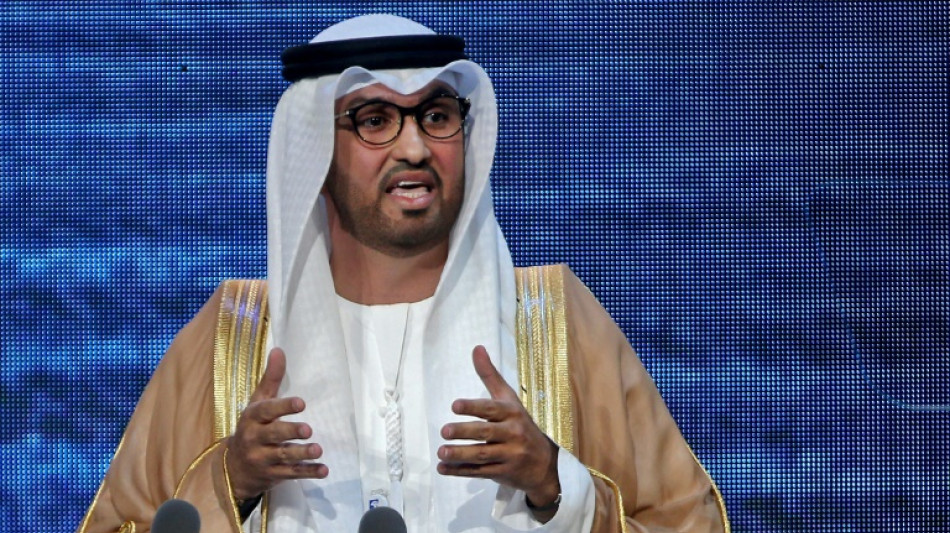
Oil boss as climate talks host: what's behind UAE's choice? / Photo: - - AFP/File

 Drone owners rush to offload devices ahead of Beijing ban

 Trump's beef policies irk Texas ranchers, testing their loyalty

 Nvidia, OpenAI CEOs to attend Xi dinner at White House

 Anthropic picks Accenture for in-house AI safety evaluation

 Balogun returns as Monaco beat Lens to continue strong Ligue 1 start

 'Pause' on overt repression in Venezuela, but reforms still needed: HRW

 Global stocks mixed as yen falls despite Bank of Japan rate hike

 Cuba hit with seventh major blackout of the year

 Murray out with concussion so Wentz will start for Vikings

 UN chief 'deeply regrets' US visa refusal to Abbas for annual meeting

 England quick Carse to face no charges over alleged nightclub assault

 Mancini brings nine newcomers into the first squad of his Italy comeback

 Czechs level Davis Cup tie against USA as South Korea eye Finals

 New France boss Zidane confirms Mbappe as captain after naming first squad

 California governor signs order to explore AI 'kill switch'

 Head leads run spree as Australia win Zimbabwe ODI series

 In-form Raphinha wants to finish career at Barcelona

 Warren Buffett steps down as Berkshire Hathaway chairman

 Carrick confident Man Utd can 'work through' tough time

 Mbappe ends Nike partnership to join Swiss brand On

 Liverpool boss Iraola puts Bournemouth love affair on hold

 'A disaster' if Man City do not win says Maresca after flawless start

 Kerry James Marshall: American 'blackness' painter celebrated in Europe

 Spain coach De la Fuente offers 'full support' to people of Ceuta
 Russia seizes assets of Nestle, French firms over West's Ukraine support

The United Arab Emirates has picked the head of its national oil company as president of this year's COP28 climate talks, prompting criticism from environmental activists.
Here we examine the UAE's reasons for choosing Sultan Al Jaber and what message it is sending ahead of the UN climate talks later this year.
- Who is Sultan Al Jaber? -
Al Jaber is the chief executive of the UAE's Abu Dhabi National Oil Company (ADNOC), which is one of the world's biggest oil firms.
The 49-year-old, who was educated in the United States and Britain, is also the UAE's Minister of Industry and Advanced Technology.
He was named the UAE's special climate envoy in 2020, a post he also previously held from 2010-2016.
He is also the founder of Masdar -- a multibillion-dollar, state-backed company that invests in renewable energy, backing projects in more than 40 countries since it was founded in 2006, according to UAE state media.
Al Jaber, who has taken part in more than 10 COP meetings, headed the UAE's delegation to the last UN climate summit in Egypt. It was by far the biggest delegation to attend the talks, and one of the largest in COP history.
In 2009, he was appointed to the UN's Advisory Group on Energy and Climate Change by Ban Ki-Moon, the then secretary general.
"Sultan Al Jaber has been spearheading the UAE's climate action well before and during his tenure at ADNOC," said climate expert Karim Elgendy, Associate Fellow at Britain's Chatham House think tank.
- Why the controversy? -
Holding COP28 in a major oil-producing country has provoked concern from activists urging a shift away from oil, which produces the greenhouse gases that heat the planet.
Those worries were only stoked by the choice of a fossil fuel executive as the face of the talks.
Tasneem Essop, executive director of Climate Action Network International said it was a "conflict of interest" to choose a figure "heading an industry that is responsible for the crisis itself".
Jaber's nomination also heightened concerns that lobbyists looking to delay the phasing-out of fossil fuels will be given more sway.
Already, the COP26 in Scotland had 500 fossil fuel lobbyists in attendance -- a figure that only increased with COP27 in Egypt, with the UAE sending the highest number.
"COP28 needs to conclude with an uncompromised commitment to a just phase out all fossil fuels: coal, oil and gas," said Tracy Carty from Greenpeace International.
"There is no place for the fossil fuel industry in the global climate negotiations."
- What's the message? -
The UAE -- one of the world's biggest crude producers -- "sees no contradiction" in the selection of Al-Jaber, Elgendy said.
The Gulf nation has repeatedly maintained that oil and gas will be needed for decades to power the world economy, while generating revenues that could be invested in renewable energy sources.
"The choice of Dr Sultan is absolutely representative of the UAE's approach to climate action, which pledges to decarbonise its economy... but advocates for its moral right to export every molecule of fossil fuel," Elgendy said.
"It argues that the world will still need some fossil fuel supplies by 2050 and that these should come from the lowest cost and lowest carbon producers," namely Gulf Arab countries, Elgendy added.
The UAE is also a strong advocate for including oil executives in the climate conversation, arguing that their experience in the energy industry is helpful in tackling climate change.
"For Gulf countries, where oil wealth contributes significantly to the economy, a great deal of climate action will need to come from this exact sector," said Aisha Al-Sarihi, a research fellow at the National University of Singapore's Middle East Institute.
"Excluding the oil industry from the negotiating table might not serve the region," the Omani expert told AFP.
L.Carrico--PC



