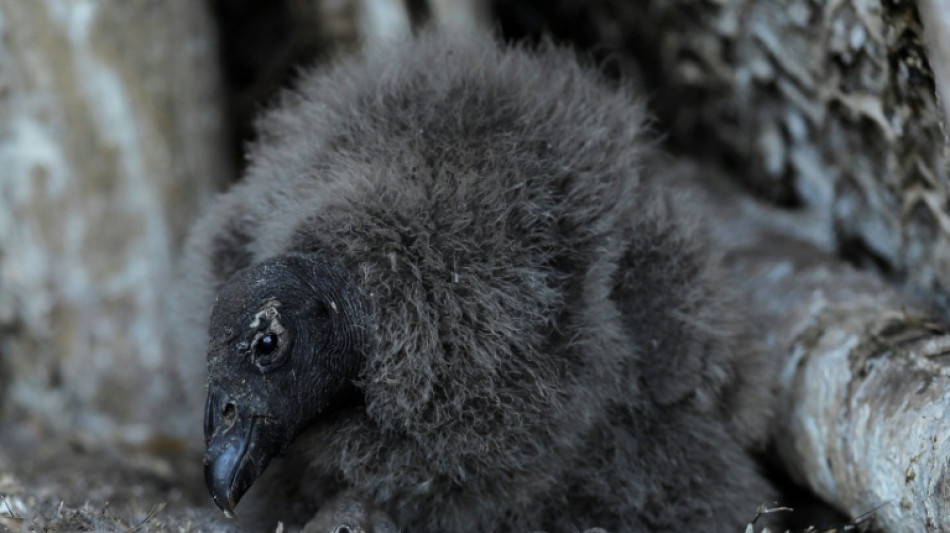
Chile preparing threatened condor chicks for release into wild / Photo: JAVIER TORRES - AFP

 Drone owners rush to offload devices ahead of Beijing ban

 Trump's beef policies irk Texas ranchers, testing their loyalty

 Nvidia, OpenAI CEOs to attend Xi dinner at White House

 Anthropic picks Accenture for in-house AI safety evaluation

 Balogun returns as Monaco beat Lens to continue strong Ligue 1 start

 'Pause' on overt repression in Venezuela, but reforms still needed: HRW

 Global stocks mixed as yen falls despite Bank of Japan rate hike

 Cuba hit with seventh major blackout of the year

 Murray out with concussion so Wentz will start for Vikings

 UN chief 'deeply regrets' US visa refusal to Abbas for annual meeting

 England quick Carse to face no charges over alleged nightclub assault

 Mancini brings nine newcomers into the first squad of his Italy comeback

 Czechs level Davis Cup tie against USA as South Korea eye Finals

 New France boss Zidane confirms Mbappe as captain after naming first squad

 California governor signs order to explore AI 'kill switch'

 Head leads run spree as Australia win Zimbabwe ODI series

 In-form Raphinha wants to finish career at Barcelona

 Warren Buffett steps down as Berkshire Hathaway chairman

 Carrick confident Man Utd can 'work through' tough time

 Mbappe ends Nike partnership to join Swiss brand On

 Liverpool boss Iraola puts Bournemouth love affair on hold

 'A disaster' if Man City do not win says Maresca after flawless start

 Kerry James Marshall: American 'blackness' painter celebrated in Europe

 Spain coach De la Fuente offers 'full support' to people of Ceuta

 Russia seizes assets of Nestle, French firms over West's Ukraine support

Alhue and Mailen were born in captivity but conservationists hope to free the chicks soon as part of a project to boost Chile's ailing population of Andean condors.
The Andean condor, a type of vulture, is the largest flying bird in the world but its population is considered "vulnerable" by the International Union for the Conservation of Nature's Red List of Endangered Species.
There are just an estimated 6,700 Andean condors living in the wild.
At Chile's Rehabilitation Center for Birds of Prey (CRAR), conservationists are trying to boost those numbers.
"The aim is to introduce condors to nature born from condors that cannot be freed, who are here for life," said Eduardo Pavez, the CRAR founder.
The CRAR center in Talagante, 40 kilometers from Santiago, looks after birds that cannot be released into the wild, either because they cannot fly or have become too accustomed to human contact.
The parents of both Alhue, a male, and female Mailen, have lived in the center for years and cannot be released.
- Venerated but threatened -
The condor has long been venerated by indigenous peoples in the Americas.
In Andean religious mythology, the condor was a symbol of power and ruled the upper world, acting as an intermediary with the world of spirits and the sun god, Inti.
It features on the coat of arms of several countries, such as Colombia, Ecuador, Bolivia and Chile.
It is virtually extinct in Venezuela in the north of the continent, while the largest concentrations are found in the south of Chile and Argentina.
The greatest threat to the condor is human occupation of the Andean mountain range, and a lack of food.
CRAR, founded in 1990, takes in all sorts of birds of prey including owls and falcons that are injured, have been in an accident or were kept in captivity.
Its aim is to rehabilitate them and release them back into the wild, but in many cases that is impossible.
Alhue's mother, for example, was injured by a power line and can no longer fly.
Mailen's mother, who was brought to the center at the age of about one, has become too accustomed to humans to be able to survive in the wild.
Over the years, CRAR has already freed 13 out of 25 condor chicks born in captivity, with another four due to be soon released.
- Teaching by pecks -
Within the next six to nine months, once they are fully grown, Alhue and Mailen will be separated from their parents.
The parents will then be able to begin reproducing again while their offspring will start socializing with and learning from other adult condors at the center.
They will be taken to a large cage where adults that cannot be released mix with juveniles preparing for the outside world.
There they can fly around and communicate with other members of their species.
"Here they establish a hierarchy where the adult males dominate. They have to learn that hierarchy, sometimes by force of pecks, so they find their place in condor society," said Pavez.
That is a vital apprenticeship for Mailen and Alhue ahead of their likely release in the southern hemisphere in spring of 2024 so that they are able to build relationships with other wild condors, get to know their territory and find food.
E.Paulino--PC



